The 50/30/20 Rule for Beginners
How to budget when your income changes monthly
By Dori Zinn
6 min. read
If you earn unsteady or irregular income, you’re in good company. For hourly workers, take-home pay changes in 7 out of every 10 months, even when those workers stay at the same job, according to a JPMorganChase Institute study. The typical month-to-month swing is 9%, and 1 in 4 months brings a change of 21% or more.
This type of change in income can make budgeting a bit challenging. But there are budgeting options for irregular paychecks. The 50/30/20 rule still works when your income shifts. WorkMoney has your guide to this budgeting rule and how it can work for you.
What Is the 50/30/20 Rule?
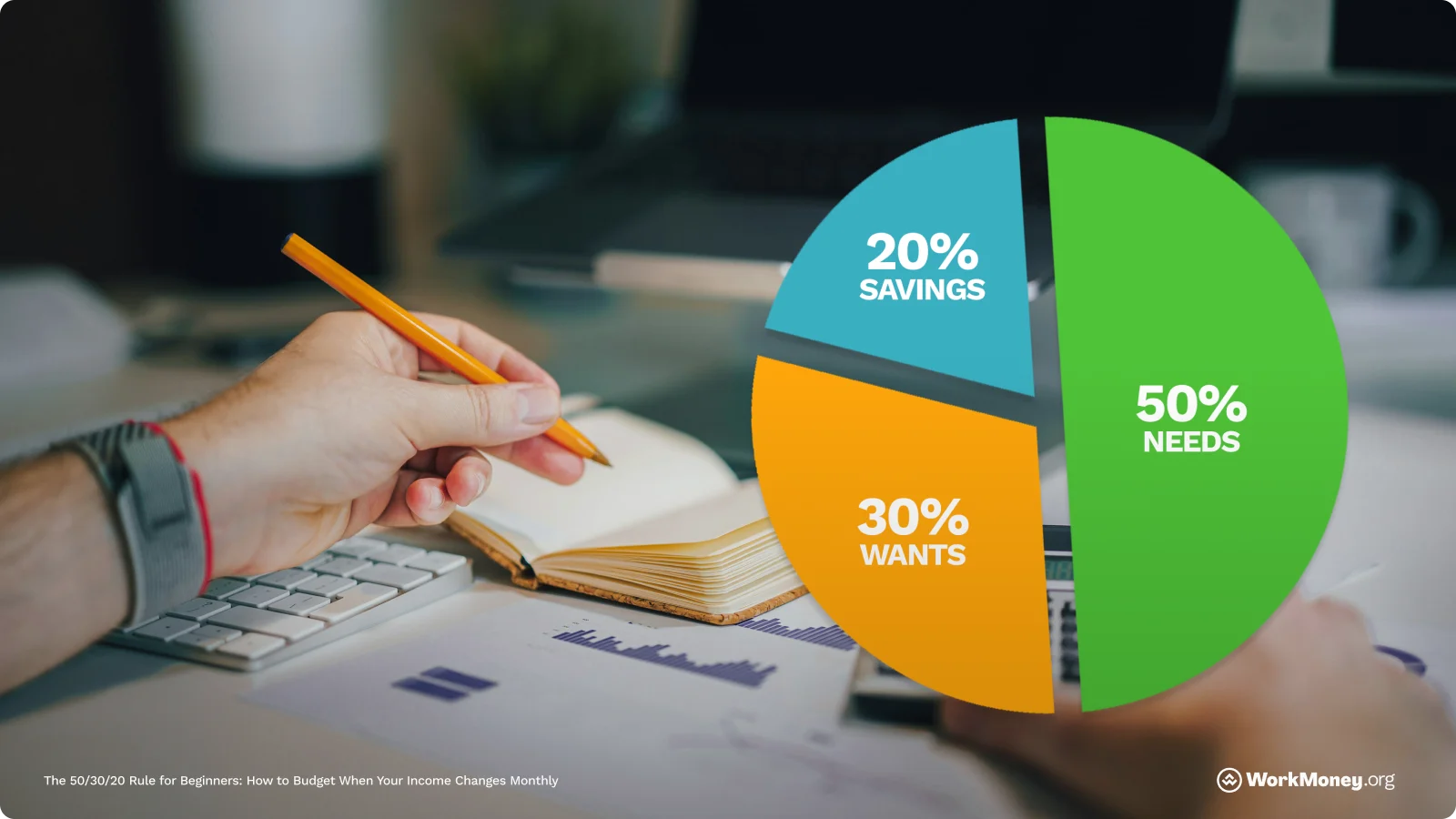
The 50/30/20 rule splits your income into three major buckets:
50% for needs
30% for wants
20% for savings and debt payoff
Use your take-home pay, which is what lands in your bank account after taxes come out, rather than your salary before taxes and deductions.
The rule comes from the 2005 book All Your Worth: The Ultimate Lifetime Money Plan, written by Elizabeth Warren and her daughter, Amelia Warren Tyagi.
Needs: 50%
Your needs are the bills you have to pay to live and work: rent or mortgage, utilities, groceries, transportation, insurance, phone and internet, and the minimum payments on any debt. Your basic groceries would be considered a need.
Wants: 30%
Your wants make life better but are not essential. These would be dining out, streaming services, hobbies, travel, and some life upgrades. Wants are allowed. A budget with zero room for joy is a budget you will quit.
Savings and debt: 20%
This bucket covers your emergency fund, retirement, and any extra debt payments beyond the minimums. If your income changes month to month, the savings can be even more important.
The 50/30/20 Rule by the Numbers
To get a breakdown of this budgeting method, run the numbers. Let’s say your monthly take-home pay is $3,000. Multiply your earnings by each bucket to get your three targets.
Needs (50%): $3,000 x 0.5 = $1,500
Wants (30%): $3,000 x 0.3 = $900
Savings or debt (20%): $3,000 x 0.2 = $600
The 50/30/20 Rule for Irregular Income
Not everyone earns a predictable income. For some, $3,000 might be a good month, but $1,900 is a rough one. With fluctuating income, try to build your budget around an average check, not your last one.
1. Find your baseline
Add up your take-home pay from the last 3-6 months, then divide by the number of months. This gives you a rolling monthly average. An average helps smooth out the highs and lows of irregular income, so one big or small check doesn’t throw off your whole plan.
Here’s what that might look like:
Month 1: $2,500
Month 2: $3,000
Month 3: $2,000
Month 4: $2,000
Month 5: $2,500
Month 6: $3,000
For six months, you earned $15,000. Divided by 6, making your average monthly take-home pay $2,500.
2. Apply 50/30/20 to the average
If your average is $2,500, your breakdown would be:
$1,250 for needs
$750 for wants
$500 for savings or debt
3. Budget low, save high
Plan your sp3. Budget low, save highending around a slightly-below-average month. When you have a strong month, move that additional income into savings. So when you end up in a weak month, you can pull money from savings to cover any gaps. A buffer can help turn your unpredictable income into a steady one.
4. Start with savings
It’s nice to have big goals, but start by putting away a small cash cushion. This could be 1-2 weeks of expenses. A little padding in your savings helps make those low months feel manageable. Over time, build it toward a full emergency fund, stashing away 3-6 months’ worth of expenses.
It’s OK to recalculate your average every few months. As your income rises or falls, your baseline should follow.
Making Adjustments to Your 50/30/20 Budget
If you live in a high-cost-of-living area or put more money towards your living expenses, 50% may not cover your needs. That’s completely OK. Your split might be more like 60/30/10 or 70/20/10 for a while.
The exact numbers don’t matter as much as making sure your money is going where it should. A month that lands outside the rule doesn’t mean you’re a failure. It’s information to use to adjust your budget for next month.
Remember, use the 50/30/20 method as a guide, not a hard-and-fast rule. Check in with your budget for a few minutes every week to see where your money is going. This helps make sure you stay on track, and if you notice anything going off track, you can make adjustments.
Don’t forget to mark your wins when you can. This could be when you hit your first savings goal, make an extra debt payment, or cover your first slow month without borrowing money. Celebrating the wins helps you remember that you’re doing it right, even if it doesn’t look perfect.
Lowering Your “Needs”
The fastest way to fit inside the 50/30/20 rule is to shrink the 50 percent. Trimming your core bills frees up room in other areas.
Government assistance programs are earned benefits that can lower the cost of your essentials. Lifeline can reduce the cost of phone and internet service. LIHEAP helps with home heating and cooling bills. Both cut directly into your needs.
WorkMoney partners can help too. Arbor checks your electric bill and secures a lower, fixed supply rate. AccessPerks offers discounts on everyday buys like food and clothing. Upside, a free app, pays cash back on gas, groceries, and dining. Each one helps stretch a fluctuating income a little further.
Final thoughts
You can make the 50/30/20 method work for a fluctuating income, as long as you create adjustments that fit your lifestyle. First, define your three buckets, then budget on a rolling average. Try to keep a cushion to cover the lean months. Stay flexible instead of trying to maintain perfect percentages, and try to skip the self-shame when a month doesn’t go to plan.
A budget should be a tool that gives you control and room to build a better life, even with a changing income. Build better financial habits to give yourself the life you want so you aren’t stuck with stress, guilt, or a lifetime of debt.
Was this information helpful?
About the Author

Dori Zinn
Dori Zinn is a longtime personal finance journalist with nearly 20 years of experience in digital media. Her work has been featured in the New York Times, Wall Street Journal, CBS News, Yahoo, CNN, USA Today, and more. She loves helping folks learn about money. If she isn’t writing, she’s reading, baking, or watching football.