The Joy of Money book by Carrie Joy Grimes

You don’t have to figure money out alone

Get clear, practical guidance and real-life insights from our CEO, Carrie Joy Grimes, in her new bestseller, The Joy of Money.

Learn more
WorkMoney

  • Careers
  • Contact Us
  • Frequently Asked Questions
  • In the News

  • Food
  • Utilities
  • Housing
  • Healthcare
  • Transportation

  • Budgeting
  • Credit
  • Debt Management
  • Save Money
  • Work & Income
  • Taxes

  • Insurance
  • Home Ownership
  • Investing
  • Retirement
  • Major Life Events

Resources

  • Articles
  • The Joy of Money

  • Member Benefits
  • Member Testimonials
  • Member Login
  • Sign Up

  • Privacy Policy
  • Terms
  • SMS Terms of Service
  • Product Terms
  • Site Map

  • English
  • Español
  • Facebook
  • X
  • Instagram
  • LinkedIn
© 2026– WorkMoney
Home /

7 Budget Categories You’re Probably Forgetting

7 Budget Categories You’re Probably Forgetting

Master your spending by planning for the hidden costs that usually break your monthly budget

By Brett Holzhauer

7/22/26

5 min. read

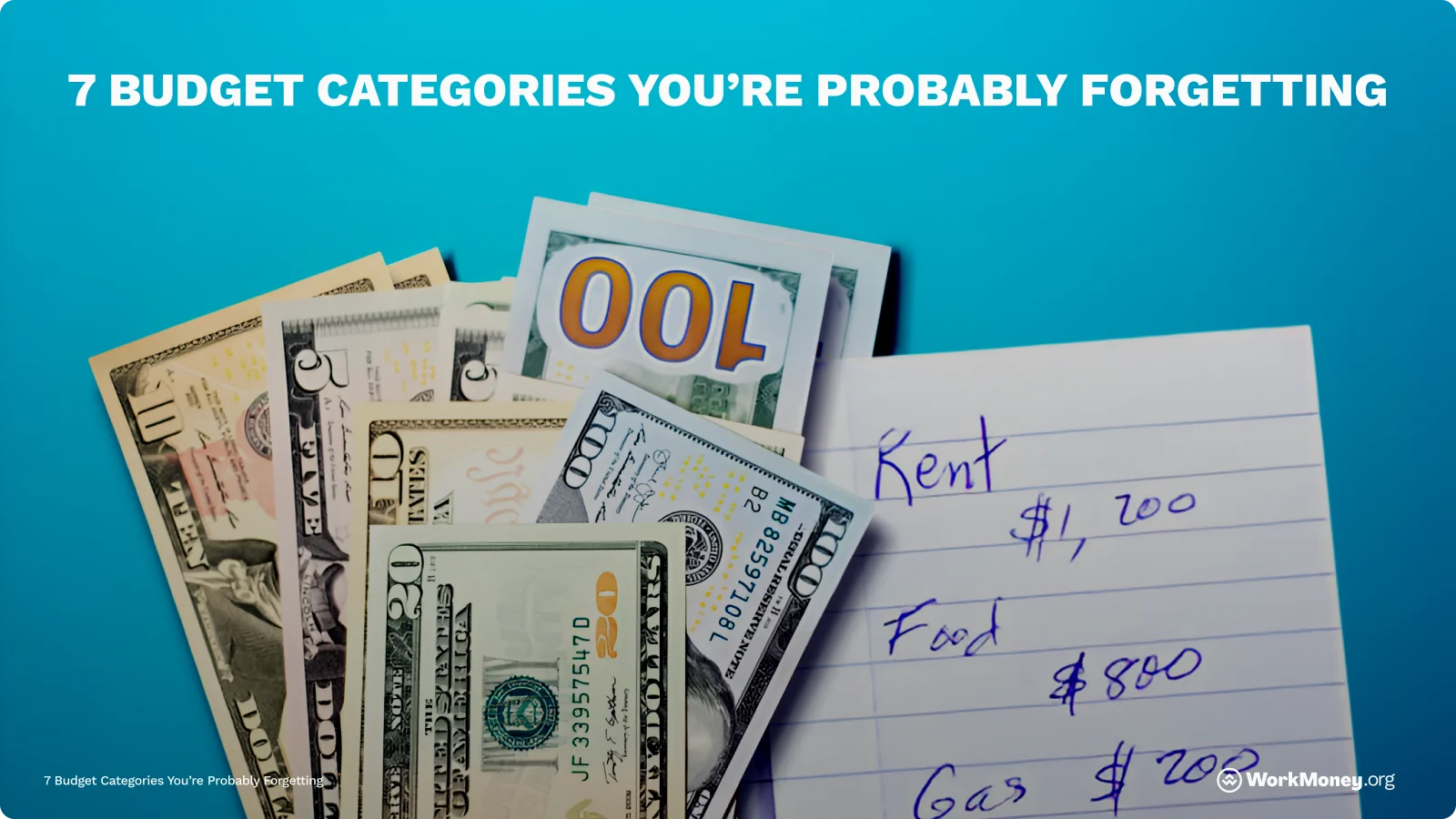
Money pile next to a list of expenses

Key takeaways

  • Many “surprise” expenses aren’t random, they’re simply unplanned categories that show up later and disrupt your budget

  • Smaller, irregular costs like maintenance, healthcare, and annual bills can quietly add up to thousands per year if ignored

  • Emotional spending around travel, holidays, and social events often amplifies costs and leads to budget creep

  • The solution isn’t stricter discipline, it’s better planning by assigning every expected expense a place in your budget

There are a few standard budget categories we’re accustomed to building into our monthly expenses. Rent, food, transportation, utilities, and debt service may come to mind. However, the smaller ancillary expenses can sometimes fall into an abyss if they don’t have a place to land on our list or spreadsheet. 

A budget isn’t something built to restrict you, but rather it’s a tool that helps you decide what to do with your money. But here’s the motivation to plan for the smaller, infrequent expenses expenses: the more you can plan and assign purchases to categories, the more likely you will be to reach your financial goals.

WorkMoney built a guide to help you potentially identify budget categories that you may be forgetting in your monthly budget.

The Most Common Budget Categories People Forget

Each of these categories are dependent on your lifestyle, and your own needs. Not all of these may apply to you, but it’s worth noting that each of these may come up in your life at some point.

How This Simplifies Your Future

Having more budget categories in your budget may seem restrictive, but rather it should be viewed as strategic and being prepared.

Many of these budget categories are not a matter of if, but when, they happen. With funds set aside, you can enjoy the moment even more, and fight off any potential anxiety or regret when those expenses pop up.

About the Author

Brett Holzhauer

Brett Holzhauer

Brett Holzhauer is a Certified Personal Finance Counselor (CPFC) who has reported for outlets like CNBC Select, Forbes Advisor, LendingTree, UpgradedPoints, MoneyGeek and more throughout his career. He is an alum of the Walter Cronkite School of Journalism at Arizona State. When he is not reporting, Brett is likely watching college football or traveling.


X
LinkedIn
Skip to main content
WorkMoney
  • Save MoneyOn food, bills, and everyday expenses
    Save MoneyOn food, bills, and everyday expensesExplore
    • Food
    • Utilities
    • Housing
    • Healthcare
    • Transportation
  • Take ControlCreate budgets, pay debt & build your safety net
    Take ControlCreate budgets, pay debt & build your safety netExplore
    • Budgeting
    • Credit
    • Debt
    • Savings
    • Work
    • Taxes
  • Plan AheadFor retirement, big purchases, and your goals
    Plan AheadFor retirement, big purchases, and your goalsExplore
    • Insurance
    • Homeownership
    • Investing
    • Retirement
    • Life Events
  • Member Benefits
  • About Us

Searching…

Sign up
DonateSign up

Searching…

  • Save MoneyOn food, bills, and everyday expenses
    Save MoneyOn food, bills, and everyday expensesExplore
    • Food
    • Utilities
    • Housing
    • Healthcare
    • Transportation
  • Take ControlCreate budgets, pay debt & build your safety net
    Take ControlCreate budgets, pay debt & build your safety netExplore
    • Budgeting
    • Credit
    • Debt
    • Savings
    • Work
    • Taxes
  • Plan AheadFor retirement, big purchases, and your goals
    Plan AheadFor retirement, big purchases, and your goalsExplore
    • Insurance
    • Homeownership
    • Investing
    • Retirement
    • Life Events
  • Member Benefits
  • About Us
DonateSign up
  • 1. Home Maintenance & Repairs

    If you’re a homeowner, home maintenance costs have now become a significant line item. Home repair costs are now estimated at over $8,800 per year, or $733 per month, according to Bankrate. 

    Repair and maintenance costs can come in both small and large increments as well. A new HVAC system could be thousands, while a simple air conditioner filter can be $10-$20. No matter the size of the cost, they can add up and dig into your monthly budget. 

    While there are predictable maintenance costs like flushing your water heater yearly, there can also be surprise breaks or costs that come up. The rule of thumb suggested by many is to have between 1-4% of your home value away for maintenance costs. This can be part of your emergency fund, or even a sinking house fund that’s solely for home costs.

    Your budget is your rulebook for your hard earned dollars, but having money earmarked for your home can be helpful.

  • 2. Car Expenses Beyond Gas

    There are expected and unexpected expenses when it comes to vehicles. Nonetheless, your ride is going to cost you money every year, outside of gas or charging it.

    AAA currently has the average maintenance cost at $792 per year. This can result from new tires, oil changes, replacing fluids, registration costs, insurance premium increases, and more.

    If you want to be extra cautious, set aside $1,000 yearly for your vehicle. This can also act as a great buffer for a down payment if something unexpected happens to your car.

  • 3. Medical & Health Costs

    Healthcare expenses can vary widely based on healthcare insurance access, family size, and more. On top of that, some people may be healthier than others, so that can also impact spending amounts.

    The average person spends about $1,600 annually on out-of-pocket healthcare expenses, according to Peterson-KFF. These expenses include copays, deductibles, prescriptions, and services insurance doesn’t fully cover. While that number can seem manageable, it varies widely—many people pay several thousand dollars in a single year depending on their health needs.

  • 4. Annual & Semi-Annual Bills

    Some of the most common budget breakers aren’t surprises, they’re just spaced out enough to feel like they are. Car insurance premiums, annual memberships to warehouse clubs like Costco, and recurring subscriptions don’t hit your account every month, which makes them easy to forget when you’re building a budget. 

    The tricky part is that these expenses are completely predictable. But when you’re not actively tracking them, they feel random and they can throw your budget off. The fix is simple: map out every annual and semi-annual charge, total them up, and divide by 12. That way, you’re budgeting for them every month—even when they’re not hitting your account.

  • 5. Travel & Holidays

    Travel and holidays are some of the most predictable “unpredictable” expenses in your budget. However, they show up in bursts: a $600 flight, $300 in gifts, a long weekend that quietly turns into four figures. During the holidays, that spending can quickly result in mounting credit card debt.

    What makes this category especially tricky is that emotion amplifies the spending. That emotional layer makes it easier to justify overspending in the moment, even if it throws your budget off afterward. The fix isn’t to cut these expenses entirely, but rather have funds set aside so you have the financial capacity to be with the people you care about.

  • 6. Technology Replacement

    Cell service providers have become quite clever in marketing new phones to consumers, but it typically comes in the form of financing them over two to three years. And by the time you’re done paying it off, the phone is worth a fraction of what it was – and you’re on to the next phone. 

    Now, there’s nothing wrong with upgrading your technology. However, it should be done by saving for it as a line item in your budget – so you can purchase the item in full rather than financing it.

    This goes for cell phones, televisions, tablets, or any other piece of technology. Even setting aside $25 per month can offset the cost of upgrading significantly.

  • 7. Life Events & Social Spending

    Weddings, birthdays, and milestone celebrations can quickly derail a budget without proper planning. Attending a single wedding can cost hundreds when you factor in travel, gifts, attire, and accommodations. Add in bachelor or bachelorette trips, and it’s easy to see how just a few invitations a year can quietly turn into thousands in spending. 

    These aren’t optional expenses as you’re showing up for friends, family, and major life moments. That emotional pressure can lead to budget creep: spending more on gifts, saying yes to every event. Over time, it’s not just a one off celebration, but rather a steady stream of social obligations that your budget likely isn’t accounting for.

Related Articles

Every dollar counts. See how to stretch yours.

A person in a white lab coat pointing at a pad of paper. Behind the person is a shelf with various boxes. In front of her is a person smiling while writing on the paper she's pointing at.

Suggested read

5 Simple Ways to Save Money on Prescriptions

Prescription drugs are too expensive, but we’ve found a few small steps that lead to big savings

A shelf full of prescription bottles

What’s the Difference Between Brand and Generic Drugs?

Generic drugs are as safe and effective as brand-name drugs, but they can cost up to 80% less. Learn about the benefits of generic drugs and how to save money on prescriptions.

Someone writing in a notebook about healthcare hacks

Healthcare Hacks Every Family Member Should Know to Save in 2026

Your guide to preventative care and finding real healthcare savings for your family.

Doctor standing with arms folded holding a stethoscope.

How to Use Preventative Care to Save on Your Medical Costs

Small health steps now can lead to big medical savings later

Other Ways to Save Money

Unlock savings opportunities in every corner of life.

Top money-saver

Health insurance that’s got your back

Save an average of $447/month on health coverage with Stride.

See solution

Medicaid health insurance

Get low cost or free health insurance

See solution