5 Ways You Could Lower Your Car Insurance Bill by $1,000 This Year
Smart strategies to slash your premiums and keep more cash in your pocket every month
By Dori Zinn
3 min. read

The law requires you to have car insurance in most states, but with rising rates, it’s getting harder to afford. According to Experian, the national average annual cost for full-coverage car insurance was $2,295 in February 2026. In March of 2023, it was $2,140 a year.
This number varies widely by where you live, the type of coverage you have, and your insurance carrier. Vermont residents pay an average of $1,427 a year, while drivers in Maryland pay $4,227 annually.
Regardless of where you live, lowering your car insurance can help you save on your car costs. WorkMoney has your guide to saving on car insurance this year.
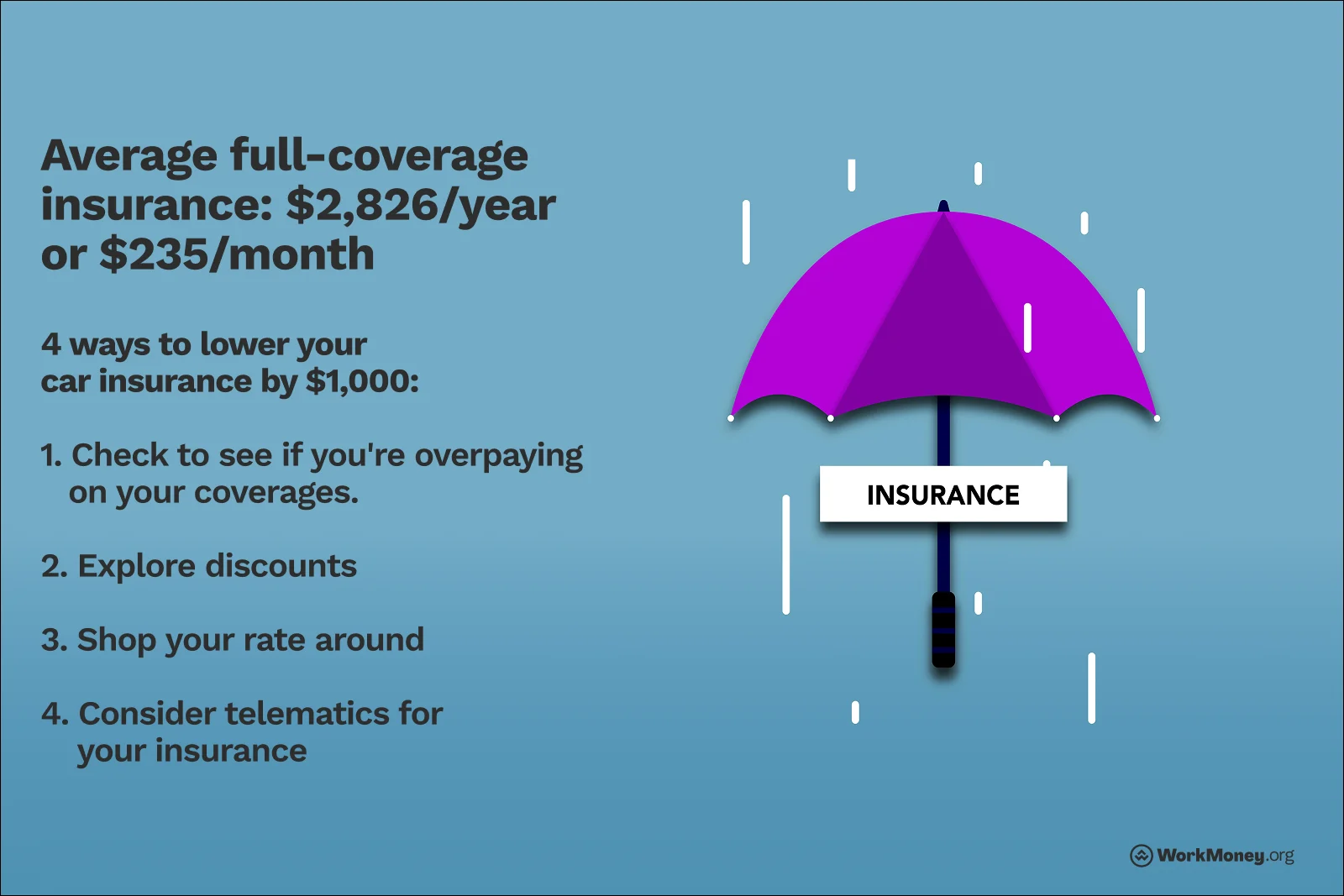
5 Ways to Lower Your Car Insurance Bill This Year
While there may not be a single way to save $1,000 on your car insurance this year, taking a few steps to lower your bill can add up.
Check if You’re Overpaying
The first thing you should do is check your coverage. Review your current plan to see if you’re overpaying for coverage you don’t necessarily need.
Take an audit of your policy to:
Review deductibles. Your deductible is what you pay out of pocket before insurance kicks in. The lower your deductible, the higher your monthly premium. The higher your deductible, the lower your premium. It’s a higher out-of-pocket cost in case something happens, but it saves you month to month. Can you raise your deductible to lower your monthly premiums? Increasing your deductible could save you anywhere from 15% to 40%.
Check coverage levels. You may not need comprehensive or collision coverage if you drive an older car. Do the math: if your vehicle is worth less than 10x the premium, your insurance coverage may not be worth the cost.
Unnecessary add-ons. Your car insurance might be charging you for things like rental car reimbursement or roadside assistance. If you get these offers elsewhere, like from a credit card or another membership, you may not need these for your car insurance.
Explore Discounts and Deals
Rewards and deals are some of the biggest selling points for car insurance carriers. You might be overlooking so many discounts, like:
Multi-car: Having multiple cars on one policy
Good driver: Longstanding history of a safe driving record
New car: Getting a new car that’s less than three years old
Passive restraint: Owning a car with certain factory-installed safety features, like airbags
Bundling: Having multiple insurance policies — like home and auto — with one provider
Anti-theft: Your car has certain security systems installed to prevent theft
Low mileage: Drive your car less than a certain amount set by your provider
Military: Be an active-duty or veteran
Your car insurance company may offer other types of discounts. If you’re a good student, passed a defensive driving course, have paid your premium in full, or have opted into paperless billing, you could score a discount.
There might be other deals you qualify for that are specific to your carrier, state, and job. Ask your car insurance company if there are professional or union affiliations and see if you’re eligible.
See if you’re eligible for low-cost auto coverage, like California’s Low Cost Automobile (CLCA) Insurance program, which offers car insurance to folks who meet income and other eligibility requirements.
Compare Rates With Other Insurers
One of the best ways to tell if you’re getting a good deal on your car insurance is to compare your policy to competitors. You can use tools like Insurify to get real-time car insurance quotes from multiple providers. Drivers who have used Insurify save an average of $1,025 a year on car insurance.
It’s important to compare the same policy and coverage to other insurance companies so you know what competitors offer. While you don’t have to switch to another company right away, you can use this as leverage when you call your provider to negotiate a lower price.
Call Your Provider
One of the best ways to get a discount is to ask for one. Call your insurance company and discuss other options. See what discounts you qualify for, ask if you’re eligible for other programs, and mention offers you’ve received from competitors and see if they’ll match it.
Most of the time, insurance companies don’t want to lose your business and will work with you on lowering your costs if you ask about it. The worst thing they can say is no, but you won’t know until you ask.
Consider Telematics
Telematics is when car insurance companies monitor your driving habits. Companies collect your driving data to evaluate how you drive, including how fast (or slow) you go, how you brake, when you drive, and cell phone use while driving.
Car insurance companies offer a telematics discount so they can collect your data, and you can see a deal on your payments. While most insurers offer telematics, most drivers don’t know about the program or don’t use it. According to Consumer Reports, only 14% of policyholders have used telematics with their current car insurance company.
The purpose of telematics is for car insurance companies to evaluate your risk. If you typically speed or text while driving, telematics could flag you as more risky, which could increase your bill. But if you feel like you’re being watched, you might develop better driving habits.
How much you’ll save with a telematics discount varies widely by your car insurance company and your risk profile. Consumer Reports says Allstate offers a 40% discount, while Nationwide, Liberty Mutual, and Farmers, among others, offer 5-10%. It could take months before this discount kicks in, since your car insurance company needs to collect enough data to calculate your risk.
Final thoughts
Even though you need car insurance to drive your vehicle, you can take a bunch of small steps to lessen the financial burden. A little bit goes a long way. Try to review your policy whenever it’s set to renew, usually every six months or a year, so you can stay on top of getting the best deal.
Take the next step
Slash your car insurance premiums
Save up to $1,100 a year on your vehicle with Insurify
Easily lower your car loan payments
See if you can save over $1,900 a year by refinancing your auto loan through Caribou.
Save hundreds on home insurance in under 5 minutes
Comparing premiums on Insurify can now save you up to $1,100 annually.
Was this information helpful?
About the Author

Dori Zinn
Dori Zinn is a longtime personal finance journalist with nearly 20 years of experience in digital media. Her work has been featured in the New York Times, Wall Street Journal, CBS News, Yahoo, CNN, USA Today, and more. She loves helping folks learn about money. If she isn’t writing, she’s reading, baking, or watching football.