How to Use Preventative Care to Save on Your Medical Costs
Small health steps now can lead to big medical savings later
4 min. read

It’s no secret that preventive maintenance on your home or vehicle pays off, as you’ll save more in the long term by avoiding costly surprises. The same principle applies to your body.
Preventive healthcare can make a significant difference in your overall health, and save you money along the way. On a grand scale, the Institute of Medicine (IOM) estimates that $55 billion is wasted each year on missed prevention opportunities.
But you don’t have to be part of that statistic. WorkMoney put together this guide to help you take advantage of preventive healthcare and avoid costly future appointments.
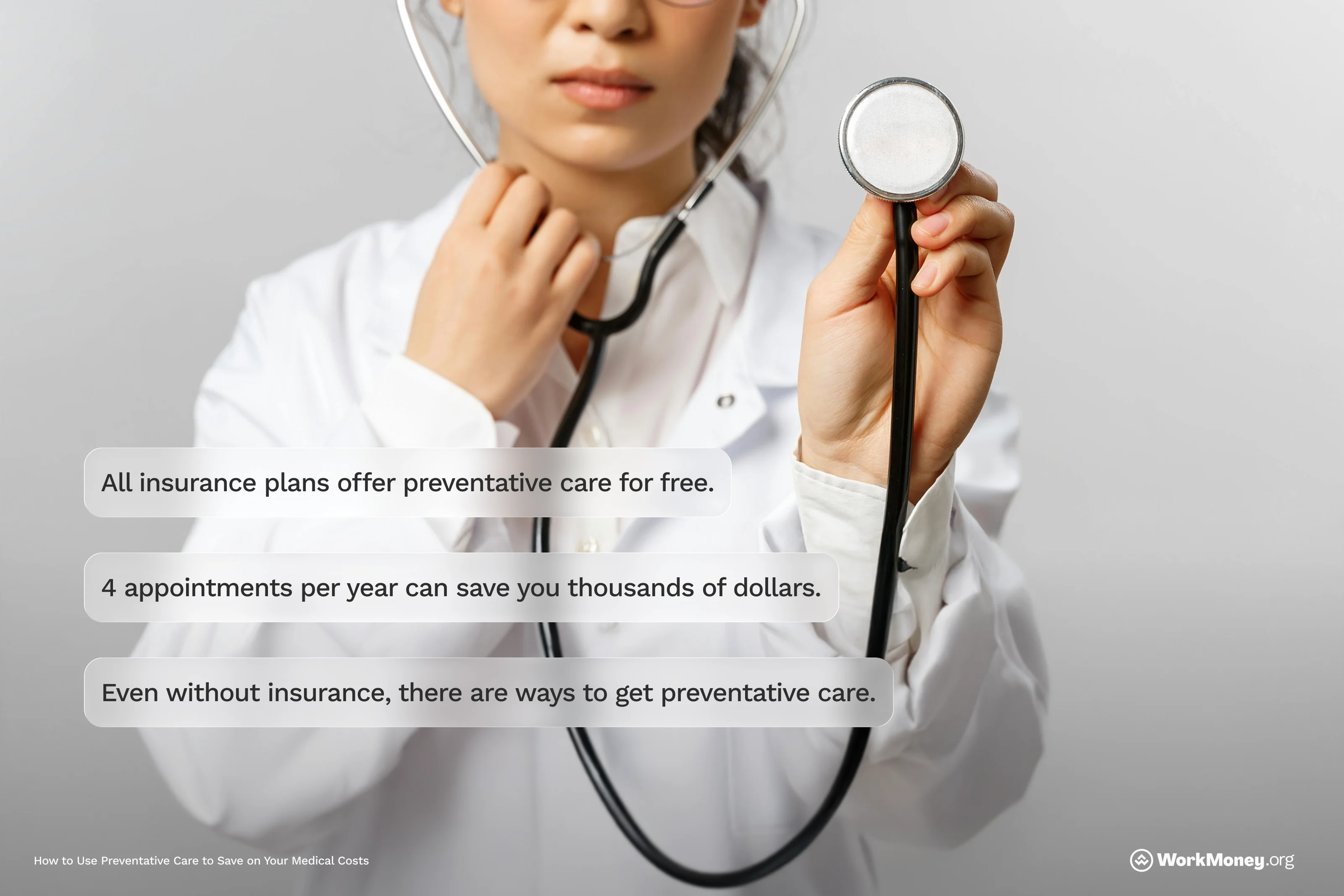
Why Preventative Care Pays Off
Preventive care is routine healthcare focused on keeping you healthy by detecting potential problems early on, before they become serious or expensive to treat. What is considered preventive care depends on your medical plan, but typically includes a free yearly physical exam. It can be easy to put off, but going to this routine appointment can be extremely helpful.
For example, a routine physical might catch high cholesterol or prediabetes early—conditions that can be managed with minor lifestyle changes instead of costly hospital stays later. Receiving regular dental cleanings can prevent gum disease, which can cost thousands if left untreated. And a simple vision exam can uncover early signs of glaucoma or diabetes, both of which can cause permanent damage if ignored.
Even something as simple as a flu shot (low-cost or even free under most insurance policies), could potentially save you from a significant hospital bill. Beyond the money, prevention also saves time, stress, and, most importantly, lives.
What’s Free With Insurance (Even Before You Hit Your Deductible)
If you have insurance, you automatically have access to preventative services, thanks to the Affordable Care Act. And, that means they’re free, even before you hit your deductible. Pro tip: Make sure the provider you see is in-network with your benefit plan in order to keep these services free.
Here is a list of services that may qualify as preventative care, depending on your medical plan. Be sure to check your specific benefit details to confirm coverage before getting care done.
Adult Preventive Services | Women’s Preventive Services | Children’s Preventive Services | Additional Services |
|---|---|---|---|
Annual physical Blood pressure, diabetes, and cholesterol screening Obesity screening and counseling Tobacco use screening and cessation counseling Immunizations (flu, tetanus, hepatitis A & B, shingles, HPV, etc.) Depression screening HIV and other sexually transmitted infection (STI) screenings Counseling for alcohol misuse and diet/exercise | Well-woman visits Contraception and birth control Screening for cervical cancer and sexually transmitted infections Breastfeeding support and counseling Prenatal care services | Well-child visits Immunizations recommended by CDC (MMR, DTaP, polio, etc.) Developmental and behavioral screenings Vision and hearing screenings Obesity and anemia screenings | Certain cancer screenings (breast, colorectal, cervical) Osteoporosis screening for women Preventive care for older adults, such as fall risk and cognitive impairment screening |
Why Your Insurance Company Wants You to Get a Checkup
Your insurance company wants you to use your preventative benefits for one simple reason: when you are healthier, they spend less money.
They’d rather you get regular preventive care. Delaying it could lead to a serious condition that’s much more costly for both you and them. In fact, a report from Deloitte says that investing in disease prevention, early detection, and other proactive measures could save the US health care system up to $2.2 trillion a year by 2040, or more than $7,000 per person.
And the same logic applies to your health and finances as well. By using the benefits you’re entitled to, you can improve your health and save yourself a ton of money and future issues.
Free and Low-Cost Preventative Care
If you don’t have insurance, that doesn’t mean you have no access to low or no-cost care. Around 26 million Americans don’t have health insurance. There are still several ways you can find free and low-cost preventative care in your area. Here are a few resources to consider:
Health centers: There are roughly 1,400 health centers built to serve those who don’t have traditional health insurance.
Local health clinics: The NAFC offers free and low-cost healthcare options around the country.
Vaccines: Many local health departments offer free vaccines for children and qualifying adults.
To continue the savings, check out GoodRx to save on your prescriptions. And if you’re struggling with medical bills or medical debt, DollarFor can help you seek financial assistance.
While getting an appointment and prioritizing your health can sometimes be unenjoyable or an inconvenience, these small actions can save both your life and your wallet, in the long run.
Final thoughts
Avoiding regular maintenance on your health can have significant financial consequences. If you’re diagnosed with a more serious condition later on from avoiding your regular healthcare visits, you can have a cannonball of issues arise, from unexpected medical costs to missing days at work. However, many of these issues can be mitigated by getting annual checkups.
Investing in your health is just like financial investing, it can compound positively by doing small things consistently. If you’re reading this realizing that you haven’t had an annual physical in awhile, you aren’t alone. Only 20% of U.S. adults get an annual physical. But it’s not too late - schedule a physical with your primary care doctor by the end of the year (or by the end of your medical plan’s benefit year) to take advantage of your annual free physical.
Take the next step
Health insurance that’s got your back
Save an average of $447/month on health coverage with Stride.
Medicare made simple
Get free help finding the best Medicare plan for you and your budget, with CoverRight
Access local medical care near you
Connect to clinics for checkups, screenings, and everyday health needs.
Was this information helpful?
About the Author

Brett Holzhauer
Brett Holzhauer is a Certified Personal Finance Counselor (CPFC) who has reported for outlets like CNBC Select, Forbes Advisor, LendingTree, UpgradedPoints, MoneyGeek and more throughout his career. He is an alum of the Walter Cronkite School of Journalism at Arizona State. When he is not reporting, Brett is likely watching college football or traveling.