Money Styles: Are You a Spender, Saver, or Avoider?
Discover your financial personality and how to make it work for your future
3 min. read

Many people attribute mastering money simply to how much they make yearly. Yes, it’s never a bad thing to make more money, but money doesn’t live on a spreadsheet – but rather in our behavior.
Similar to personality styles, there are also three core ways people approach their finances: spender, saver, or avoider. You likely know where you fall between the three without much thought. Each of them has their own sets of pros and cons, and ways they can spiral out of control. To have a healthy financial life, there are ways to find a balance between all three.
WorkMoney breaks down what each of these Money Styles are in detail and how you can become better at money by identifying your own money style.
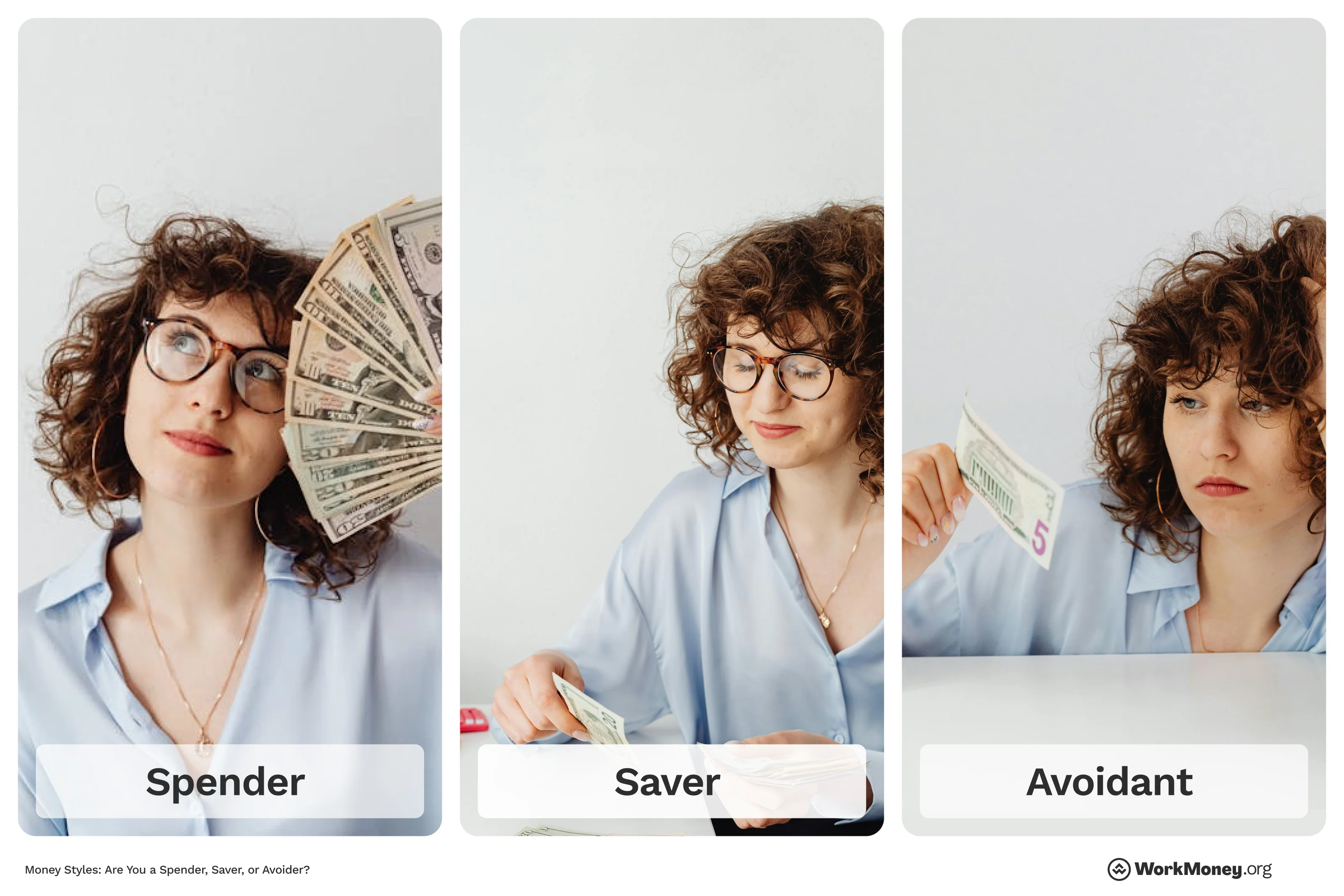
The Three Money Styles
The Spender
First, there is the spender. They are generally optimistic about their ability to make money in the future to offset their expenses. They typically make purchases from an emotional state, whether it be happy, sad, or anything in between. Lifestyle is a priority for them, whether it be splurging on experiences or investing in their health.
The strength for spenders is that they aren’t paralyzed by fear. However, this can quickly turn into either lifestyle creep or the dreaded debt spiral.
If this is you, and you’re looking to pull back on your spending, here are a few simple wins to consider:
First, track spending for 3 days. Doing this can help you understand where you’re spending the most, and give you insight on where you can improve.
Next, instill the 24-hour pause rule for purchases over $50. If you tend to make expensive, impulse purchases, give yourself 24 hours from the time you want to make a purchase. In that 24 hours, your mind may reset and understand you may not need it.
After that, automate one small weekly transfer to savings. Even if it’s $20 per week, any small amount can help adjust your expectations to live with a bit less.
Lastly, aim to cancel or downgrade one subscription. Subscriptions have become a financial mess for consumers. A recent survey suggests consumers are spending $90/month on subscriptions. The monthly cost may seem insignificant, but the yearly cost ($1,080) is nothing to overlook.
The Saver
Next, there are savers. The core traits of most savers are being budget-oriented, focused on security and safety, and having a low tolerance for debt. They focus on stability and discipline for the long run, and are likely investing for retirement.
However, savers should be aware if they’re under-investing and over-hoarding cash. Additionally, enjoying the money they make is also equally important.
First, you can consider moving excess savings into higher-yield or investment accounts. This means that if you have money stashed away in savings, be sure that it’s inside an account earning interest, like a high-yield savings account.
Next, you can create a “guilt-free spending” line item: For savers, the idea of spending money intentionally can evoke negative emotions. Hoarding your hard earned money in perpetuity is not a way to live your best life.
The Avoidants
Lastly, where many people sit is the avoidant. Avoidants don’t want to face financial statements or make decisions based on multiple factors. It could be from money trauma, anxiety, or the simple fact of being discouraged from their own personal financial situation.
It’s important to know that avoidance isn’t a sign of irresponsibility, but rather a stress response. Money is a highly stressful subject for many people, with as many as three in four consumers reporting stress.
If this is the category you sit in, know that you aren’t alone. Roughly half of people could fall into the avoidant category. But the longer you sit in the avoidance, the problem can literally and figuratively become worse as fees, interest, and missed financial opportunities compound.
But tackling finances can be overwhelming and evoke many emotions. For this reason, it’s best to start slowly. To start tackling things, try to log into one financial account today. That could be a checking account, savings account, credit card, or other financial product. Simply acknowledging where you’re at is a significant step.
If you want to take one more step, schedule a 10-minute weekly check in for your own finances. This can be as simple as checking your accounts to evaluate where you stand, or taking slow steps like opening up an investment account to jump forward financially. Small actions like this can add up over time.
Final thoughts
You don’t have to categorize yourself solely as one of these three. Most people are a blend. You might see yourself in one pattern during certain seasons of life and shift into another when your circumstances change. That is normal. Money is not static, and neither are we.
The important takeaway is not the label. It is awareness. When you recognize your emotional relationship with money, you stop reacting on autopilot. You begin to see why you avoid checking your accounts, why you overspend after a stressful week, or why you cling tightly to every dollar even when you can afford to loosen up.
From there, change becomes possible. Not overnight, and not perfectly, but intentionally. You can build systems that support you instead of shame you. You can replace guilt with clarity. You can move from fear to strategy.
Improving your financial situation is not just about math. It is about understanding yourself. Once you do that, the numbers become a tool, not a source of stress.
Was this information helpful?
About the Author

Brett Holzhauer
Brett Holzhauer is a Certified Personal Finance Counselor (CPFC) who has reported for outlets like CNBC Select, Forbes Advisor, LendingTree, UpgradedPoints, MoneyGeek and more throughout his career. He is an alum of the Walter Cronkite School of Journalism at Arizona State. When he is not reporting, Brett is likely watching college football or traveling.