Understanding Auto Loans and Car Payments
Clear answers on how auto loan payments work and smart tools to manage the cost
By Dori Zinn
5 min. read

When buying or leasing a car, it’s normal to look at the full price tag and do mental gymnastics to figure out if you can afford the monthly payments. According to Experian, monthly payments for a new car average $749 for a loan and $612 for a lease.
Those monthly payments can get pricey, especially as the median monthly income for U.S. workers was about $4,824 in the second quarter of 2025, according to the Bureau of Labor Statistics (BLS). And those are averages, as every job pays differently based on what you do, your expertise, and where you live.
How much you spend on a car could be more or less than the average amount, and it’s not always easy to understand what makes up your car payments. WorkMoney breaks down your monthly loan so you know exactly where your money is going, plus some ways to save on your payments.
How Do Car Payments Work?
You have two major options when buying a new car: a lump-sum cash payment or taking out a car loan. Leasing a car typically requires a loan without an option to pay for it in cash, but you’ll have to talk to your dealership about what they allow.
There are several options to get a car loan, whether through the dealership, bank, or another financial institution, like an online lender or credit union. Once approved for your loan, your lender buys the car for you, requiring you to make regular monthly payments to your lender until the loan is paid in full.
Your loan terms are how many months you’ll make those set monthly payments based on how much you borrowed and your interest rate. For example, a 60-month term means you’ll make monthly payments for five years. However, you can pay more than the minimum payment to shorten the length of the loan.
Every lender — including the dealership — sets their own interest rates. You can shop around and see which lenders have the best rates based on the car you want, your down payment or trade-in (if you have one), your loan terms and your credit score.
A Breakdown of a Typical Car Payment
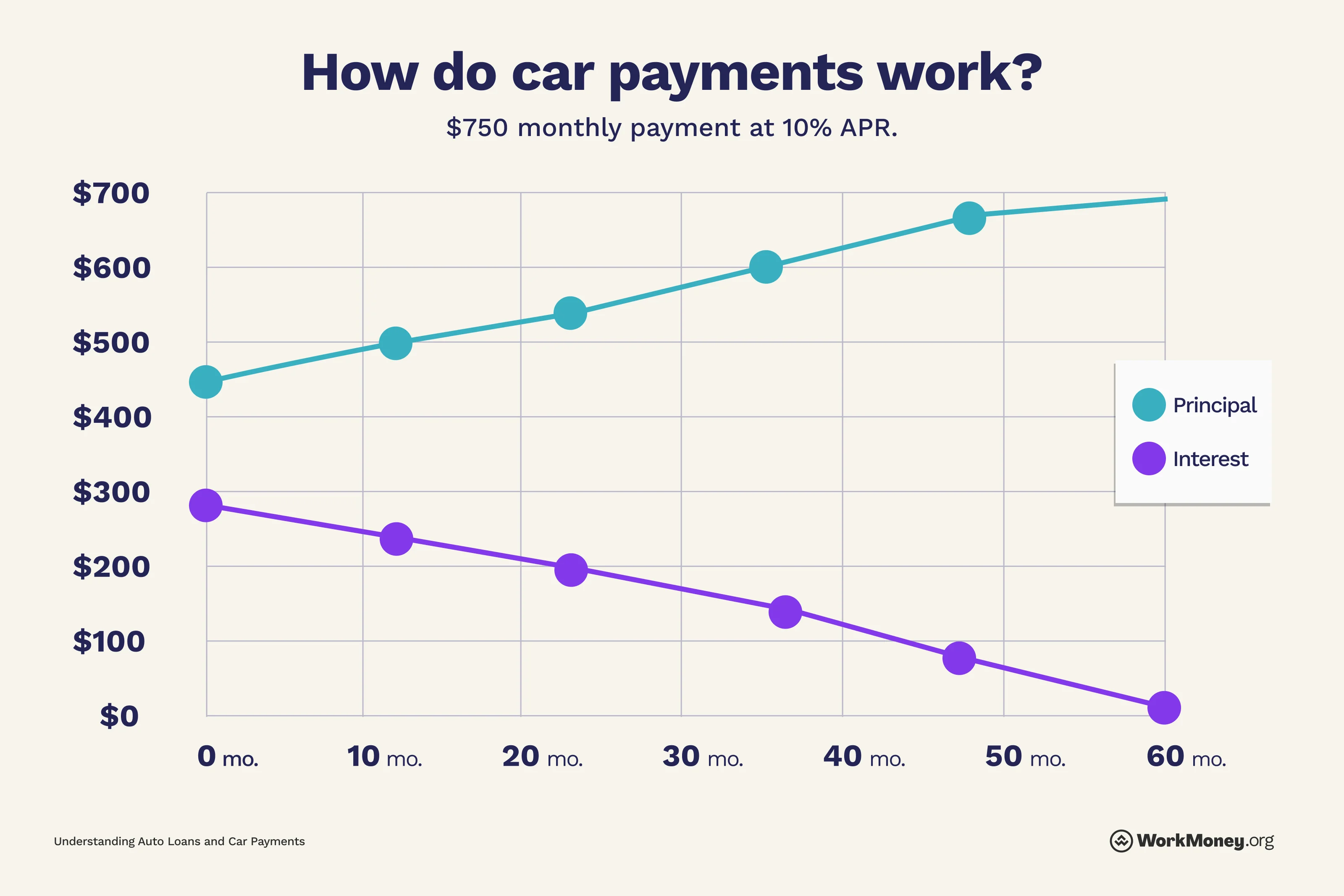
Your car payment is the total of your principal payment, your interest payment, and any applicable taxes and fees. While you pay the same fixed amount every month, where those dollars go changes. Here’s what that looks like.
Imagine you found a car for $48,000. You have a trade-in vehicle that the dealership says is worth $12,700, which you can use to offset the cost of your loan. You’ll borrow $35,300 with a 60-month term and a 10% APR. You’re looking at a $750 car payment.
Payment Month | Total Payment | Principal Payment | Interest Payment |
|---|---|---|---|
1 | $750 | $456 | $294 |
12 | $750 | $500 | $250 |
24 | $750 | $552 | $198 |
36 | $750 | $610 | $140 |
48 | $750 | $673 | $77 |
60 | $750 | $744 | $6 |
How Auto Loan Interest Rates Work
Even though you’re making the same $750 monthly payment, it gets broken down differently. Lenders take your car payment and use the funds in a set order: first, any outstanding payments and fees (like late fees), then your interest rate, and then your principal payment.
Car loans are front-loaded, just like home loans. A larger portion of your monthly payment goes towards the interest rate to repay your lender for giving you the loan.
Auto loans have simple interest, not compound interest, like what you see with credit cards. Simple interest is a flat percentage of the annual interest rate added to what you owe on your principal balance.
If You Need Help With Auto Payments
If you struggle to make your monthly loan payment, contact your lender to see if they can offer you financial assistance. Your lender could reduce your monthly payments, modify your loan, change your payment schedule or put your loan into forbearance. This option pauses your loan payments without penalty.
Not all lenders offer assistance, so you may need to look elsewhere for help. Using apps like Relief could save you in other areas so that you can put more money towards your car payment. Relief works with creditors and lenders to negotiate your payments, lower your debts, and work on an affordable payment plan.
You can also refinance your auto loan. Caribou helps car owners refinance their current auto loans into more affordable terms. This could get you a lower monthly payment, interest rate, or both. You can use different refinancing calculators to see your potential options on your own, but if you can’t get a lower interest rate than what you have now, try looking for other relief options.
Changing Your Auto Payment Strategy
Not everyone has the financial means to make regular car payments, let alone extra ones. But if you can put more money towards your car, it could save you thousands of dollars in the long run.
Making larger monthly payments or extra principal-only payments lowers the total interest you pay at the end of your loan terms. The faster you pay down your principal balance, the less interest you’ll pay over time.
Let’s use our earlier example: a $35,300 loan and a $750 monthly payment. After 60 months and a 10% interest rate, you’ve paid $45,000, which includes $9,701 in interest.
If you change your payment strategy to making two $375 payments every other week, you’ll pay $8,578 in total interest — $1,123 less than your monthly setup. There are 52 weeks in a year, so you’re making 26 payments yearly rather than the 12 you’d be making on a monthly plan. Because you’re paying every other week rather than monthly, you’re essentially making one extra payment per year, even though you’re paying the same amount every month.
You can also try making additional monthly payments on top of your regular payment, even if it’s $50 or $100. If you pay an extra $50, you’ll save $811 in interest when your loan ends. If you pay $100 more, you’ll save almost $1,500. For $200 more monthly, you’ll cut your total interest payment by $2,581 and pay off your loan more than a year early.
Final thoughts
Borrowing money and understanding the fine print isn’t always easy. Lenders don’t always spell out contracts in plain language. If you aren’t sure you’re making the right choice on your auto loan, pause to talk out the details with your lender. Don’t be afraid to ask every question necessary to get your answers. Regardless of what your lender says, you must understand what you’re on the hook for before signing your loan agreement.
If you’re making payments, you can change your strategy to save in the long run. You can also find help through apps like Relief and Caribou. Find the help you need so you don’t have to feel overwhelmed by your car payment ever again.
Take the next step
Easily lower your car loan payments
See if you can save over $1,900 a year by refinancing your auto loan through Caribou.
Slash your car insurance premiums
Save up to $1,100 a year on your vehicle with Insurify
Was this information helpful?
About the Author

Dori Zinn
Dori Zinn is a longtime personal finance journalist with nearly 20 years of experience in digital media. Her work has been featured in the New York Times, Wall Street Journal, CBS News, Yahoo, CNN, USA Today, and more. She loves helping folks learn about money. If she isn’t writing, she’s reading, baking, or watching football.