The Costs and Benefits of Buying an EV
Is an electric car right for your wallet? We break down the real numbers and potential savings
By Dori Zinn
3 min. read
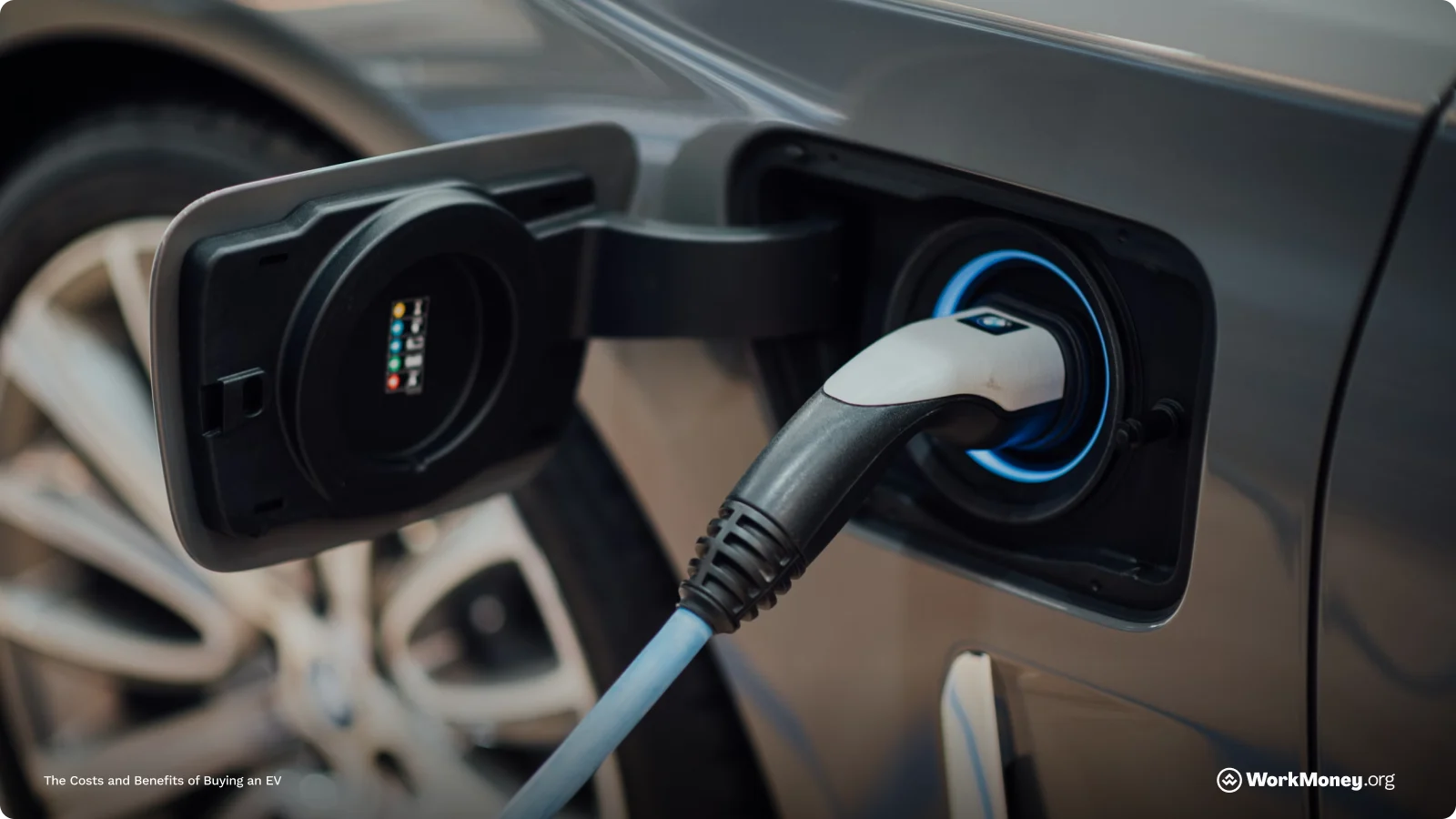
Switching to an electric vehicle is better for the environment and, in the long run, for your wallet. A study from the University of Michigan found that a fully electric vehicle produces up to 73% less greenhouse gas emissions than a gas-powered car, regardless of where you live in the U.S. And according to the New York Times, driving 100 miles in a gas-powered car costs roughly $13; in an EV, it’ll cost you about $5.
Buying a car is a major purchase, EV or not. WorkMoney has compiled the costs and benefits of buying an EV so you can determine if it’s the right move for you.
Sticker Price and Upfront EV Costs
According to Kelley Blue Book, the average cost of an EV was $57,245 in August. Among all car purchases, the average price was $49,077. But that’s not always the case and depends a lot on the type of car you get. A 2025 Nissan Leaf starts at $29,280 — half the average EV cost.
According to Experian, it’s more expensive to lease a gas-powered Honda CR-V than a Tesla Model 3: $512/month for a CR-V lease compared to $395/month for a Model 3. For buying, Model 3s average $616 a month compared to $631 for a CR-V. Honda is the number one car maker among leased models.
Additionally, the federal EV tax credits have ended. This means you won’t get that $7,500 on a new EV or $4,000 for buying a used one.
How much you pay for gas-powered and electric vehicles depends on your financing options, if you’re trading a car in, and your down payment. The more you can pay up front, the lower your monthly payments will be if you get an auto loan.
If you’re worried about the initial cost of buying an EV, consider the type of car that best fits your household, leasing options, or buying used. Do your research to avoid buying a car that’s more than you can afford.
Home Setup for EVs
If you live in an apartment or condominium complex, you may not be able to add a home charging setup where you live. However, your homeowners' association or development may add charging stations for EV drivers.
For single-family homes, you can charge your car with a Level 1 charger, which is the same plug you use to charge your phone or computer. However, this low-power option could take days to charge your car. For the average driver, this could be plenty enough if you commute from home to work and back.
Many EV owners install a Level 2 charger, running on 220 volts. These chargers get you a fully charged battery in a few hours (depending on your vehicle). On average, expect to pay anywhere from $400 to $700 for a Level 2 charger. It’s a good idea to hire an experienced electrician, but it’ll cost you more on top of the installation.
Car Insurance Changes
Buying an EV not only costs more at the dealership, but it also costs more to insure. According to Insurify, the cost of EV insurance is 49% higher than that of gas-powered cars, averaging $4,058 compared to $2,732. Some EVs are more expensive to insure than others, with Tesla models being the most costly. EVs are still relatively new, so making and sourcing parts takes longer than gas-powered cars, as those car parts are easier to come by. With less availability and training for car mechanics, EVs are more expensive to repair when accidents happen, so auto insurance companies see them as a higher liability.
In some states, car insurance differences are much less than the average. In New Jersey, the cost to insure an EV is 15% higher than a gas-powered car. In California, it’s 31%.
Even though general insurance costs are higher, you can use car insurance calculators to see which EV models have lower insurance costs and fit into your car-buying budget.
Maintenance and Upkeep
Electric vehicles have significantly fewer parts to maintain and manage than gas cars. A 2020 Consumer Reports study found that EVs have 50% lower repair costs, with EV drivers saving about $4,600 over the total life of owning a car compared to a gas-powered one.
With an EV, you’re no longer responsible for oil changes, spark plugs, coolant flushes, and similar upkeep. When you need repairs, your bill might be higher than for a gas car. That’s because EV parts are more expensive to produce and ship. So it’ll cost you more, and you may have to wait longer for completed repairs.
For instance, a battery replacement can be expensive since EVs run solely on batteries. EV battery replacements are as low as $4,489, up to $17,658, according to ConsumerAffairs. EV battery warranties are usually eight years or 100,000 miles, whichever comes first. But you may not ever replace your battery, since the average lifespan of one is at least 11 years, and many modern EVs won’t reach the end of their life until they’re 20 years old, according to MotorTrend.
Gas and Charging Costs
The cost of charging varies widely by where you live, the charger you're using, and when and how often you charge. Charging your car means a higher electricity bill, but not as much as you think. Recharging a fully depleted 200-mile range EV will cost you about $6. Doing that a couple of times a week is less than $50 a month. But most folks don’t run their car to an empty battery, so that amount will likely be less.
AAA says that driving an EV 15,000 miles annually runs about $546. For a gas car, driving will cost you $1,255 in fuel.
If you install solar panels on your home, you could lower those additional costs in your electricity bill.
Final thoughts
Buying a car is a pricey purchase, and getting an electric vehicle has a pricier upside than gas-powered cars. After the initial sticker purchase, you may pay more in insurance and repairs, although you’ll face fewer maintenance needs than gas-powered cars.
Purchasing an EV is a big move, and with some homework, you could save in the long run. See what tax incentives and credits you qualify for at the state and local levels, compare EVs, and review your budget so you know exactly what you’re on the hook for with your electric vehicle purchase.
Was this information helpful?
About the Author

Dori Zinn
Dori Zinn is a longtime personal finance journalist with nearly 20 years of experience in digital media. Her work has been featured in the New York Times, Wall Street Journal, CBS News, Yahoo, CNN, USA Today, and more. She loves helping folks learn about money. If she isn’t writing, she’s reading, baking, or watching football.