Investment Asset Allocation 101: How to Slice Your Investment Pie
Learn how to spread your investments to lower risk and grow your wealth over time
By Dori Zinn
6 min. read
Investing isn’t just for folks with a lot of money. Anyone can invest, even if you don’t know what you’re doing and you have just a few dollars to get started.
For newbies, investing terms can throw would-be investors off, and you could be left more confused than before you started. Let’s start with the basics.
An asset is anything you own that has value, like your investments, your car, or your house. When it comes to investing, your assets are usually things like stocks, bonds, and cash.
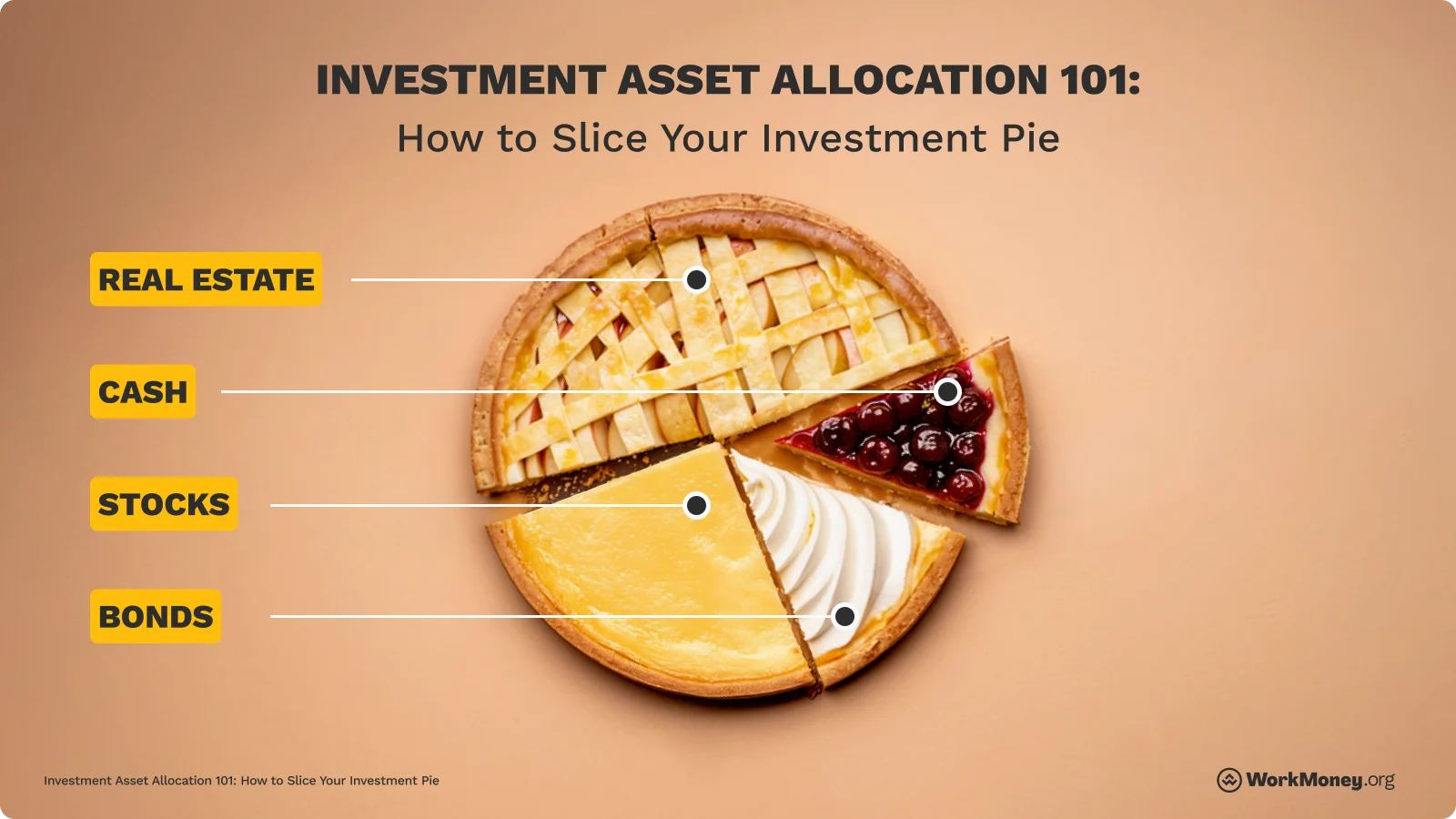
Asset allocation is how you split your money across those different assets. How you split it depends a lot on your risk tolerance, or how much ups and downs in value you can handle before it starts to bother you. If watching your account balance swing up and down stresses you out, you may have a lower risk tolerance. If you can ride out the dips because you’re investing for the long term, your risk tolerance might be higher.
If you’re beginning your investing journey or you’re thinking about it, WorkMoney has your guide to investment asset allocation. Learn what it means, how to do it, and why it matters so much to your portfolio.
What Is Asset Allocation?
Now that you know the basics, it’s time to figure out how to divide your money across different assets. There’s no “best” asset allocation, because every investor is different. What works for one investor may not be ideal for another, so the best asset allocation depends on your individual goals, risk tolerance, and circumstances.
The Main Asset Classes Explained
Spreading your money across many assets helps you avoid putting too much into a single asset or investment type. There are a few asset classes to choose from, the main ones being stocks, bonds, and cash.
Stocks
Buying a stock gives you ownership in a company. You can buy shares in well known companies like Microsoft, Apple, United Airlines, Coca-Cola, and more.
Stocks go up and down in value over time, so be sure that you understand the risk and rewards factor before investing.
Bonds
Bonds are loans that governments or companies take from investors. Rather than go to a bank, private companies and governments use money from investors and pay you back with interest over time, along with the amount you loaned by a set end date (called the maturity date).
Bonds are typically less risky than stocks. That’s because you usually know upfront how much interest you’ll earn and when you’ll get your money back, so bond prices don’t swing around nearly as much as stock prices do.
Cash
Cash includes things like:
Savings accounts
Money market accounts
Treasury bills
Money market funds
Cash and cash equivalents are some of the safest investments, but don’t have as high of a return potential compared to stocks.
Why These Matter
Understanding the risks tied to each asset type helps you decide where to put your money. Stocks, bonds, and cash are the asset classes you’re most likely to in a retirement or college savings plan. It’s important to pay attention to common asset types, as well as less common ones such as real estate, precious metals, and cryptocurrency.
How Much You Need to Start Investing
The common misconception is that you need thousands of dollars to begin investing. This isn’t true. You can get started for as little as a few dollars.
Rather than setting a number based on what others are investing, figure out the right number for you. That could mean using a portion of your tax refund to fund an investment account. You can cancel an unused subscription and invest those funds instead. If you get cash back from a credit card, put those earnings into your investment account.
Say you make an initial investment of $25 and contribute $25 a month. With an estimated 7% interest rate that’s compounded annually, you’ll have $4,194.11 after 10 years. After 20 years, you’ll have $12,395.39.
These are conservative estimates, and you can always contribute more if you come into some extra cash. Say you recently paid off a car loan. You can use the money you were paying each month to boost your investment contribution.
You don’t need $1,000 and a financial advisor to start investing. Instead, just start with the few extra dollars you have right now.
The Hidden Cost of Doing Nothing
While investing isn’t for everyone, doing nothing can be more detrimental than you think.
Let’s say you keep all of your money in a basic savings account that you auto-contribute to every month when you get paid. Most traditional savings accounts earn 0.01% APY — essentially nothing.
The average annual inflation rate is around 3%. This means if your money isn’t earning at least that much in a savings account, you’re essentially losing money because your purchasing power is plummeting.
While you could put your money into a high-yield savings account, keeping all of your money there means you’re not spreading it out enough to earn as much as you could be. While investing carries risk, not investing can also cost you a lot of lost earning potential in the long run.
Pay Down Debt or Invest: How to Choose
Carrying debt can hold you back from many potential investments. But not all debt is treated the same. What you carry can help you figure out how much money to put towards investments and how much to pay towards your debt.
According to Fidelity, balanced asset allocations typically return around 6% a balanced asset allocation is 6%. So if your debt has an interest rate at 6% or higher, focus on paying down that high-interest debt before investing. If your debt is less than 6%, you can put extra cash towards your investments.
Why Rebalancing Keeps You on Track
Managing your asset allocation doesn’t take a ton of work on your part, but that doesn’t mean your investments are completely set-it-and-forget-it. In some cases, your asset allocation may veer off course or your goals may change. That’s where rebalancing comes in.
Rebalancing is the process of adjusting your portfolio to align with your investment strategy and goals. Rebalancing helps you manage risk and stay diversified. If one of your investments is underperforming or a market sector is volatile, rebalancing can help reduce risk by adjusting your portfolio.
Some brokerages and robo-advisors rebalance your portfolio on your behalf.
NOTE: Investing involves risk, including the possible loss of principal. Past performance is not indicative of future results.
The Bottom Line
Asset allocation may seem like a lot of math and number-crunching, but really, it’s about making sure your portfolio is balanced so you don't focus too heavily on one area. Look at your portfolio as a tool that works for you, helping you achieve financial freedom.
What's Next?
How to Start Investing: A Beginner's Guide
You don’t need to be rich to build wealth. Here’s how
Investing for the First Time: How to Start with Just $50 a Month
Learn how to grow your wealth over time by starting small with simple and accessible tools
About the Author

Dori Zinn
Dori Zinn is a longtime personal finance journalist with nearly 20 years of experience in digital media. Her work has been featured in the New York Times, Wall Street Journal, CBS News, Yahoo, CNN, USA Today, and more. She loves helping folks learn about money. If she isn’t writing, she’s reading, baking, or watching football.