How to Start Investing: A Beginner's Guide
You don’t need to be rich to build wealth. Here’s how
5 min. read

The word investing comes with a range of emotions – notably feelings of being overwhelmed and lost.
The easiest way to demystify investing is to put your money to work with an asset, with the hopes of it rising in value. You can invest in things like real estate, public companies, private companies, cryptocurrency, collectibles like sports cards, and more.
A simple way to begin investing is through the stock market. This means that you’re purchasing shares of publicly traded companies in exchange for partial ownership of the business. But you don’t have to become a stock market expert and study companies for hours on ends, with the hope of buying the right stock at the right time. In fact, the vast majority of people who pick individual stocks make less than those who buy large benchmarks that track the overall stock market, called index funds.
But before you get into the technicalities of investing, there are several items to tackle first. WorkMoney has put together a step-by-step guide on what to consider before investing, investing 101, and common things to look out for.
First, Get Clear on Your Financial Foundation
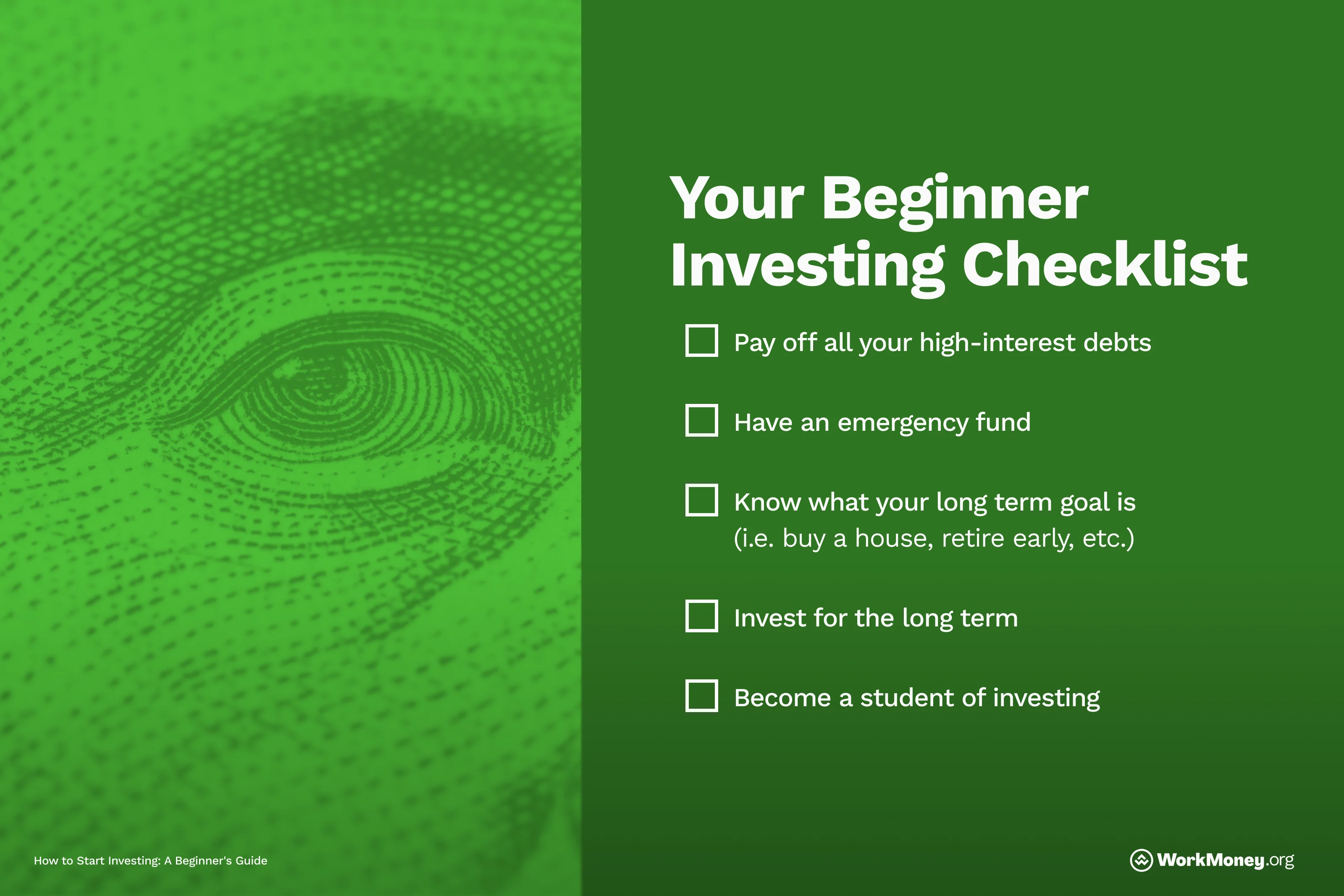
Investing can be an enjoyable and exciting experience as you begin to build your net worth. But investing for the future can only be successful once you’ve handled the daily and monthly steps needed to have a healthy financial picture. Be sure to check these boxes off first before putting any money towards investments:
Pay off all high interest debt, including credit card debt, personal loans or auto loans. Anything above 9% APR should be considered high interest and a top priority to pay off.
Have an established emergency fund. The popular rule for many is to have 3-6 months worth of living expenses set aside. This is in case you suddenly lose your job, have an unexpected car repair, or face other unexpected expenses.
Have wiggle room in your budget. Once you account for all of your monthly expenses and hit the two above marks, that additional money can be put to use for investing.
Second, There Is A Language To Investing
A large reason for investing being a scary topic to tackle is the jargon that comes along with it. Just like any hobby or task, there is going to be a learning curve.
Here’s a quick glossary for you:
Term | Definition |
|---|---|
Stock | A share of ownership in a company. When you buy a stock, you own a small piece of that business. |
Bond | A loan made to a company or government that pays interest over time and returns your money when it matures. |
Mutual Fund | A pooled investment that combines money from many investors to buy a mix of stocks, bonds, or other assets. |
Index Fund | A type of mutual fund or ETF designed to mirror the performance of a specific market index, like the S&P 500. |
Exchange-Traded Fund (ETF) | Similar to a mutual fund, but it trades on the stock market throughout the day like a stock. |
Diversification | The strategy of spreading your investments across different assets to reduce risk. |
Portfolio | The total collection of all your investments, such as stocks, bonds, and funds. |
Risk Tolerance | How much uncertainty or potential loss you’re comfortable accepting in pursuit of higher returns. |
Asset Allocation | The way your portfolio is divided among different types of investments (e.g., 60% stocks, 30% bonds, 10% cash). |
Dividend | A payment made by a company to shareholders, usually from its profits. |
Capital Gains | The profit you earn when you sell an investment for more than you paid for it. |
Compound Interest | The process of earning interest on both your original investment and the interest it’s already generated. |
Inflation | The gradual rise in prices over time that decreases the purchasing power of your money. |
Market Volatility | The degree of variation in investment prices—how much and how quickly they rise or fall. |
Expense Ratio | The annual fee (expressed as a percentage) that funds charge investors to cover operating costs. |
Don’t stress about memorizing or knowing these terms by heart. The best way you can learn this is by consuming news and media around investing. Start reading the Wall Street Journal casually, listen to investing podcasts like the Bogleheads On Investing, or listen to CNBC. It will sound like a different language, but like anything else, you will learn over time.
Understand Your Reason For Investing
We all invest with one core goal – to make our money work for us. We can only do so much work with our backs and our brains, but the money we earn can continue to do even more work through investing.
But there’s a deeper layer to address: what is the goal of growing your net worth? It could be anything from wanting to have a comfortable retirement, being able to retire early (also known as FIRE), wanting to pay for your kids/grandkids education, or buying a larger home. Any goal that requires money can be attached to your investing journey.
It’s important to define these early. If you’re aimlessly investing without a goal in mind, it can be easy to neglect it or feel defeated during market downturns. But if you have a long-term vision, say 20 years from now, it can be psychologically easier to continue putting your money to work for a goal long in the future.
More on Investing
in The Joy of Money Book
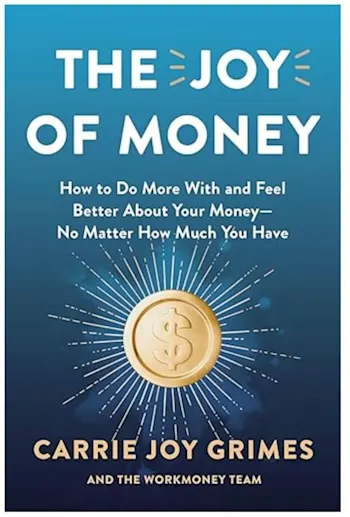
Carrie Joy, the CEO of WorkMoney, shares simple, practical ways to start investing with confidence in her new book, The Joy of Money. Learn more
Know Your Options
Just like there are different kinds of bank accounts (checking account, savings account), there is a wide variety of investment accounts where you can purchase stocks for the future. Each account has different requirements for who can use it, tax stipulations, and more.
Here’s a brief list of common investment accounts and the rules that apply to each.
Account Type | Who Can Use It | Tax Treatment | Key Notes |
|---|---|---|---|
401(k) | Employees with access through their employer | Contributions are pre-tax, lowering taxable income. Growth is tax-deferred, and withdrawals in retirement are taxed as income. | Annual contribution limit: $23,000 (2025), plus $7,500 catch-up if 50+. Many employers offer matching contributions. |
Traditional IRA | Anyone with earned income (subject to income limits for deductibility) | Contributions may be tax-deductible, depending on income and workplace plan access. Growth is tax-deferred; withdrawals are taxed as income in retirement. | Annual limit: $7,000 (2025), plus $1,000 catch-up if 50+. Early withdrawals (before 59½) generally incur a 10% penalty. |
Roth IRA | Individuals under income limits ($161,000 single, $240,000 married filing jointly in 2025) | Contributions are after-tax, but growth and withdrawals are tax-free in retirement (if held ≥5 years and age ≥59½). | You can withdraw contributions anytime without penalty. Ideal for those expecting higher taxes later. |
Health Savings Account (HSA) | People with a high-deductible health plan (HDHP) | Contributions are pre-tax, growth is tax-free, and withdrawals for qualified medical expenses are tax-free. | Annual limits (2025): $4,300 individual, $8,550 family, plus $1,000 catch-up if 55+. Can be used as a retirement account after age 65 (non-medical withdrawals then taxed as income). |
Brokerage Account (Taxable) | Anyone | No special tax breaks — you pay capital gains tax on profits and taxes on dividends/interest each year. | Offers maximum flexibility — no contribution limits or withdrawal penalties. Great for long-term investing beyond retirement accounts. |
SEP IRA | Self-employed individuals or small business owners | Contributions are tax-deductible, grow tax-deferred, and are taxed on withdrawal. | Contribution limit: 25% of compensation or $69,000 (2025), whichever is less. Employer-only contributions. |
Solo 401(k) | Self-employed individuals with no employees (besides spouse)** | Combines employee and employer contributions — both pre-tax (or Roth if chosen). | Limit: up to $69,000 (2025) including both portions. Higher limits than a Traditional or Roth IRA. |
The most common one is a 401(k), which is an employer-sponsored plan. Roughly 70% of private-sector employees have access to a 401(k) plan, which allows workers to set aside money for retirement. The money is pulled from your paycheck, and you defer the taxes until you withdraw the money at retirement. Within the 401(k), you can invest the money you put in into different investments, such as individual stocks, ETFs, index funds, bonds and more.
You don’t have to select only one account to invest in. You could have several accounts, depending on your financial situation and desired outcomes.
Writer’s note: For example, I’m a 32-year-old single male. I invest in a 401(k), Roth IRA, and Health Savings Account.
Build Good Habits Early
Investing is very similar to working out – small, consistent choices over the long term tend to pay off positively.
Investing for the short term usually doesn’t work because it’s almost impossible to predict what the stock market will do from day to day. Even professional investors get it wrong most of the time. In fact, even investors who have passed away outperform active stock pickers. This is because buying and holding for the long-term continues to be a winning strategy for most investors. When you buy and hold, you allow compound interest to work for you, also known as the 8th wonder of the world.
What Investing Can Potentially Grow To
It’s easy to underestimate the impact of small, consistent investments over time. Thanks to compound growth—the process of earning returns on both your contributions and the returns you’ve already earned—your money can multiply far beyond what you initially put in. Even if the market experiences ups and downs, maintaining a steady investing habit can make a major difference in your long-term wealth.
For example, investing just a few hundred dollars a month can lead to impressive growth over 20 years at a 7% annual return (compounded monthly):
$100 per month → ≈ $52,000
$200 per month → ≈ $104,000
$300 per month → ≈ $156,000
$500 per month → ≈ $260,000
To get a sense of what your investments can turn into, play around with a compound investment calculator. It can be an inspiring tool to see what you can build over the long term.
Start Small, Stay Curious
The best way to get started is to carve out a small amount each month from your monthly budget and begin investing today. Set it to automatically be withdrawn from your checking account and invest in an ETF or index fund of your choice. Once the numbers begin to grow, it can be a great motivation to put more into it.
And as you begin, become a student of investing along the way. Read the WSJ, listen to CNBC, and begin reading investing blogs and Reddit boards. You can learn an immense amount simply by listening to those who are knowledgeable and applying it to your investing journey.
Was this information helpful?
About the Author

Brett Holzhauer
Brett Holzhauer is a Certified Personal Finance Counselor (CPFC) who has reported for outlets like CNBC Select, Forbes Advisor, LendingTree, UpgradedPoints, MoneyGeek and more throughout his career. He is an alum of the Walter Cronkite School of Journalism at Arizona State. When he is not reporting, Brett is likely watching college football or traveling.