How to Resist Impulse Buying: 5 Proven Tips
Practical steps to stop impulse buying and take back control of your money
5 min. read

Impulse buying is defined as buying something that you didn’t normally plan on purchasing, but acted on a quick desire to have it. It can be done in person on a small or large purchase, and in person or online.
We’ve all likely fallen for this at one point or another. Our emotions pack more power over our wallets than we realize. Stress, excitement, and even boredom can push us to spend in ways we normally wouldn’t. A 2023 Bankrate survey said that U.S. adults have spent $71 billion on impulse buys based on social media alone.
The problem with impulse spending is that it can quickly derail accomplishing financial goals. Whether it’s slowing down to hit a savings goal or adding to mounting credit card debt, impulse spending can turn into “death by a thousand cuts.”
The WorkMoney team put together five proven tips to resist impulse buying.
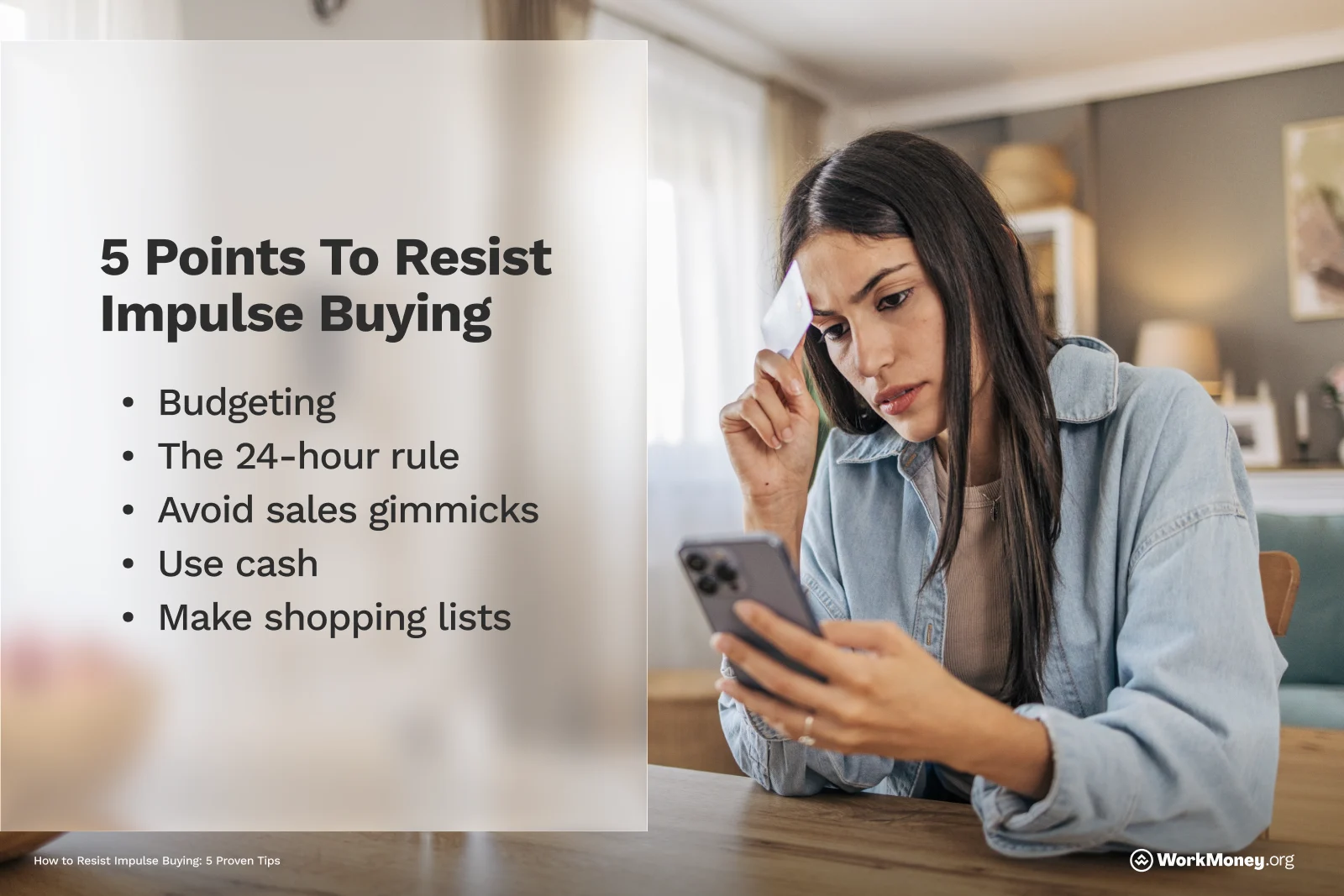
Create a Budget and Stick to It
Budgets are an incredibly important part of building wealth, but also of enjoying the money you have responsibly. Even extremely wealthy people cut back on unnecessary spending, including Warren Buffett’s cheap haircut and Bill Gates’ emphasis on modest watches.
However, a budget should meet three goals: paying for the necessities (i.e. food, shelter, transportation), pushing your wealth forward (i.e., saving, paying off debt), and allowing you to live and enjoy within your means.
Creating a budget can seem overwhelming, but we’ve created a sample budget template that you can use to begin building the financial life you want.
To get started, fill in the top line with your monthly income and work your day down the list. From there, you can see how much money you potentially have left over for free spending.
If you want a budgeting solution that is less manual, consider using a budgeting app like YNAB or Monarch Money. You can connect these apps directly to your debit or credit card, and track your spending in real-time.
Category
Amount ($)
Income
Housing (Rent/Mortgage)
Utilities (Electric, Water, Gas, Internet)
Transportation (Car, Gas, Insurance, Transit)
Groceries
Dining Out
Health & Insurance
Debt Payments (Loans, Credit Cards)
Savings & Investments
Entertainment & Subscriptions
Leftover Money
Implement the 24-Hour Rule
We’ve all seen something we wanted, and potentially even purchased it – only to later regret it. The same Bank Rate survey mentioned above said 57% of impulse buyers regretted at least one of their purchases.
The simplest way to avoid wasting money and regretting a purchase is to consider the purchase for 24 hours. We can all experience a rush of emotions before and after purchasing something we want, only to feel those emotions quickly fade away.
If you really want something, give it one full day before you decide to purchase it. I’ve done this myself, and after 24 hours, I begin to lose the desire.
Don’t Buy The Gimmicks
We all work hard for the money we have in our wallets. It’s unfair to ourselves to give it away recklessly, and multi-billion-dollar companies know exactly what it takes to capture more dollars.
For example, the all-too-popular “on sale” sign at your favorite store, email promotions, social media ads, and more. All of these things aim to get more money from your wallet and into theirs.
There’s nothing wrong with shopping smartly, but the less you see these flashy phrases and offers, the less likely you are to shop. Here are a few ways to do that:
Unsubscribe from brand texting and email marketing. In fact, 40% of Americans are doing exactly that. This will declutter your digital life and help curb any temptation to spend.
Research pricing. Seeing the word “sale” is tempting to participate in, thinking that you’re getting a deal on a product. If you see an item in-store with an advertised price, you may double-check it online to see if you can get it for less. Additionally, if you see an item on Amazon for sale, check the pricing history on CamelCamelCamel. Or if you’re open to purchasing second-hand, look on sites like Facebook Marketplace if someone is selling it for less.
Use Cash or a Prepaid Card
Scientists and psychologists have largely concluded one core thought when it comes to money: using cash will save you money. Several studies, including this one from MIT suggest that credit cards are less “painful” than paying with cash. This 2021 study suggests “credit cards drive greater purchasing by sensitizing reward networks in the brain, involving the same dopaminergic reward center (the striatum) that is exploited by addictive drugs like cocaine and amphetamines.”
Conversely, when you use cash to pay, the pain receptors in your brain have higher responses.
On a less scientific level, tracking cash going in and out is simpler than tracking card payments. Using the envelope method, you can budget out your entire month by stuffing cash into envelopes for specific expenses. The idea is that once you run out of cash in an envelope, you can no longer spend in that category. You can also do this with prepaid debit cards.
Make a Shopping List and Plan Purchases
When you venture to the grocery store, mall, or anywhere else to make purchases, it’s vital to have a list to reference. Without it, you could find yourself wandering and making purchases you normally wouldn’t.
Pro tip: You can save more at the grocery store with Upside with cash back rewards on purchases you may already make.
Additionally, if you have a larger purchase, it’s helpful to set a plan to pay for it. For example, if you want to upgrade your coffee machine at home, set aside money from each paycheck into an envelope or a high-yield savings account. By doing this, you can make the purchases you want without taking on high-interest credit card debt or neglecting your other financial goals.
Final thoughts
We are all likely guilty of making a purchase based on our emotions, big or small. There’s no use in guilting yourself for past mistakes, but there’s plenty of room to improve going forward.
A budget will help you stay on track to hit your financial goals, the 24-hour rule will give you space to be more intentional about the things you want, become a pro at detecting sales gimmicks, use cash if you find yourself overspending, and be deliberate about what you need versus what you want when you’re shopping.
Was this information helpful?
About the Author

Brett Holzhauer
Brett Holzhauer is a Certified Personal Finance Counselor (CPFC) who has reported for outlets like CNBC Select, Forbes Advisor, LendingTree, UpgradedPoints, MoneyGeek and more throughout his career. He is an alum of the Walter Cronkite School of Journalism at Arizona State. When he is not reporting, Brett is likely watching college football or traveling.