The 3 Most Common Errors on Credit Reports (And How to Fix Them)
Spot mistakes on your credit report and fix them fast to boost your score without paying a dime
By Dori Zinn
4 min. read
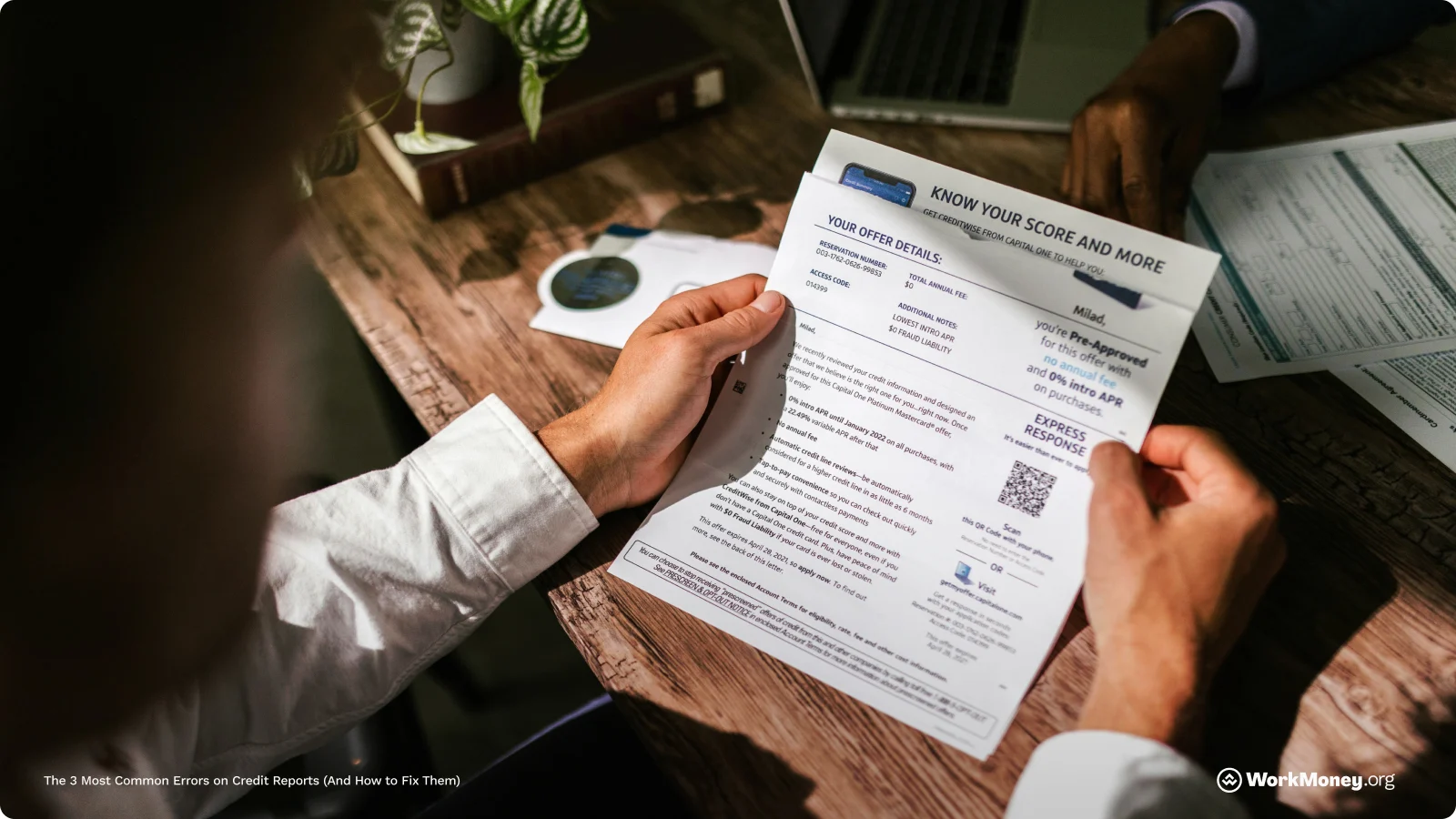
Your credit report is the most important factor when it comes to borrowing money. But even if you keep your report in tip-top shape, you could still run into credit reporting errors.
These errors can hurt your score and impact your chances of qualifying for everything from buying a house to getting a job. Many times, these errors can show up through no fault of your own, and they don’t mean you’re irresponsible with your finances.
If you’re trying to figure out how to spot common errors on your credit report, WorkMoney has your guide on how to fix them.
3 of the Most Common Credit Reporting Errors
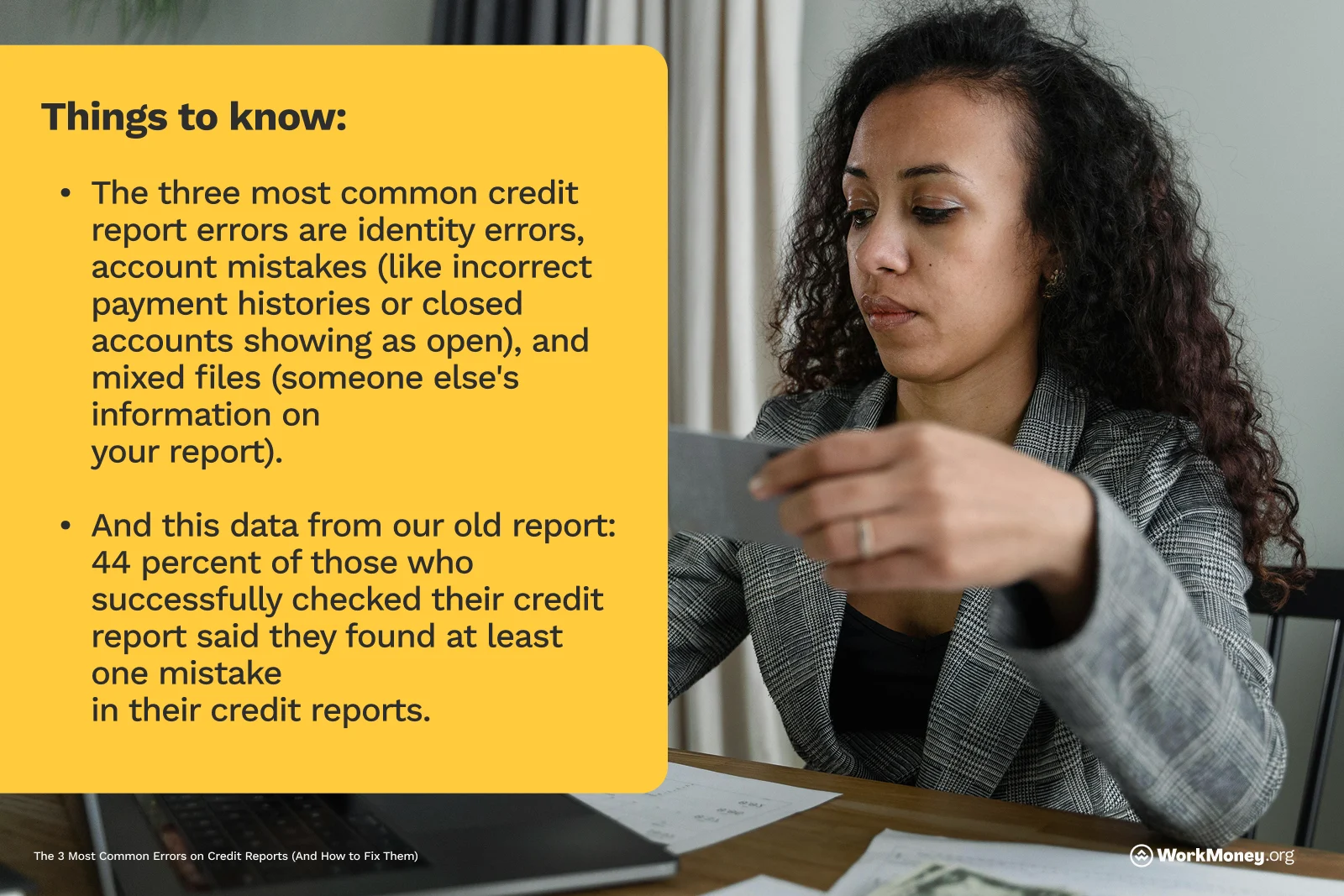
While there are a few common credit reporting errors, three stand out: identity errors, account mistakes, and mixed files.
1. Identity errors
You may think you have a name, but there’s a chance someone is walking around with the same name as you. You could have their personal information on your account, such as past addresses and old accounts.
This could be a serious issue if the person who shares your name has accounts with outstanding or overdue payments, which could cause your credit score to drop. The Consumer Financial Protection Bureau (CFPB) says this type of error is one of the most common.
Identity errors can also appear as accounts opened in your name due to identity theft. While these may still technically belong to your likeness, they are part of identity errors on your credit report.
How to Fix It
Request credit reports. Download all of your credit reports from the three major credit bureaus. AnnualCreditReport.org is federally approved and lets you download each of your reports for free once a year.
Find all the errors. Take a few minutes to carefully comb through each report. Highlight any errors related to your identity or that look like they don’t belong to you.
Start a dispute. You’ll need to submit a dispute to each credit bureau with the error. If you have errors on TransUnion and Equifax but not Experian, submit disputes to the two with the reported errors.
Add supporting documents. You’ll need to include any supporting documents to prove who you are, so the credit bureau knows beyond a doubt that the account you are disputing doesn’t belong to you. Attach a copy of your report with the highlighted information that you want to dispute and why (for instance, that these identities do not belong to you), along with the request that you want the information removed or corrected.
Take extra steps. If you believe the identity error on your credit report comes from a case of identity theft, report your case to the Federal Trade Commission and the CFPB.
2. Account Mistakes
There are a couple of different types of accounting mistakes that could end up on your credit report, including:
Closed accounts that are still showing up as “open” on your report.
You’re reported as an account holder when you’re an authorized user, or vice versa.
Accounts that are in good standing but are being reported as late or delinquent.
Wrong dates are tied to the account, like an incorrect opening account date or the wrong date of your last payment.
The same debt is listed more than once.
How to Fix It
Get copies of credit reports. Download and review your credit reports, noting any account errors in each credit bureau's report.
Gather important documents. Find any bank statements and financial documents that show the correct payment history, the right account holder information, or accurate dates.
Reach out to the original lender. Request account information and file a dispute with the original account issuer.
Contact credit bureaus. File a dispute with any credit bureau that lists the account mistake. Explain in detail the mistake and attach copies for proof.
Keep detailed records. Make a file on your computer that includes copies of your proof, your dispute, and any correspondence regarding the mistake, whether it’s with the original lender, a new lender, or the credit bureau. Keep this file at the ready until the dispute is closed.
3. Mixed Files
A mixed file on your credit report is when a credit bureau puts someone else’s information on your credit report. While this could be someone with a similar name to yours, it could also be someone with a completely different name. Sometimes it involves someone with a Social Security number close to yours, or addresses getting mixed up with another person.
For delinquent accounts, past-due payments, or bankruptcies, you could see your score tank. Additionally, you might start getting calls and letters from debt collection agencies for something that never belonged to you.
How to Fix It
Download your credit reports. There’s a chance this mixed file is on one of your credit reports and was a random mistake. It may also show up on multiple reports. Carefully go through each one to check for errors.
Document the differences. Figure out which reports have mixed files and gather proof that these accounts don’t belong to you.
Start a dispute. File a dispute with each credit bureau that shows the mistake, making sure to select “mixed file” in your filing.
Request a manual review. Simple errors may take longer to fix, but a manual review gets a human to review your case.
Provide proof. It’s not easy to prove an account doesn’t belong to you. But stay diligent throughout your dispute, providing documentation and proof of who you are and any corresponding information that proves this account is not yours. Be ready to share proof of your address history, birth certificates, Social Security cards, and a copy of a government-issued ID.
How Long Does It Take to Get Errors Removed From Credit Reports?
It can take anywhere from 30 to 45 days to get errors removed from your credit report, depending on the type of error you had.
Each credit reporting agency is required to investigate disputes within 30 days of filing. If you have to submit extra documentation, the agency can extend the investigation by 15 days.
What Happens if You Disagree With the Dispute Results?
Once you get a written notice of your results, they may not be in your favor. If your dispute didn’t result in your favor, you can take a few different steps, including:
Statement of dispute. Reach out to the credit bureau and request a statement of dispute explaining why you think the corresponding information is inaccurate. Anyone who pulls your credit report in the future will see the statement.
Resubmit a dispute. You can resubmit a dispute after your original investigation has closed. If you have new or updated information, this could help prove your case. But keep in mind that credit reporting agencies have the freedom to dismiss disputes, especially if you continue to dispute the same concern.
Final thoughts
Your credit report isn’t akin to set-it-and-forget-it. Make time to regularly (at least annually) check your credit reports to make sure everything is accurate.
Even if you don’t find any mistakes in your report, you may need help managing your outstanding debt. Greenpath helps manage your mounting credit card debt by lowering APRs, simplifying payments, and creating a payoff timeline.
Take the next step
Turn rent payments into credit boosters
Get over a 50% exclusive discount on Esusu rent reporting
Was this information helpful?
About the Author

Dori Zinn
Dori Zinn is a longtime personal finance journalist with nearly 20 years of experience in digital media. Her work has been featured in the New York Times, Wall Street Journal, CBS News, Yahoo, CNN, USA Today, and more. She loves helping folks learn about money. If she isn’t writing, she’s reading, baking, or watching football.