The "Why" Behind the House: Saving for a Home When It Feels Impossible
Stop chasing a dream that is not yours and start saving for a life that fits you
By Dori Zinn
3 min. read
Rising home prices and uneasy mortgage rates can make it seem like buying a home is far out of reach. According to the Federal Reserve Bank, the average home sale price in the last quarter of 2025 was $534,000 — up nearly $30,000 from the previous quarter.
While the national mortgage rates have fallen almost a full percentage point over the last year, that doesn’t mean the current rates are affordable for everyone. Stagnant wages and rising living costs make it feel more impossible than ever for would-be homebuyers to afford a home.
The good news is that there are still ways to save for a home and find hidden ways to save. WorkMoney has your guide to what housing costs look like, along with practical steps for creating a budget-friendly savings plan if you are thinking about making the move from renting to owning.
Understand What It Actually Costs to Buy a Home
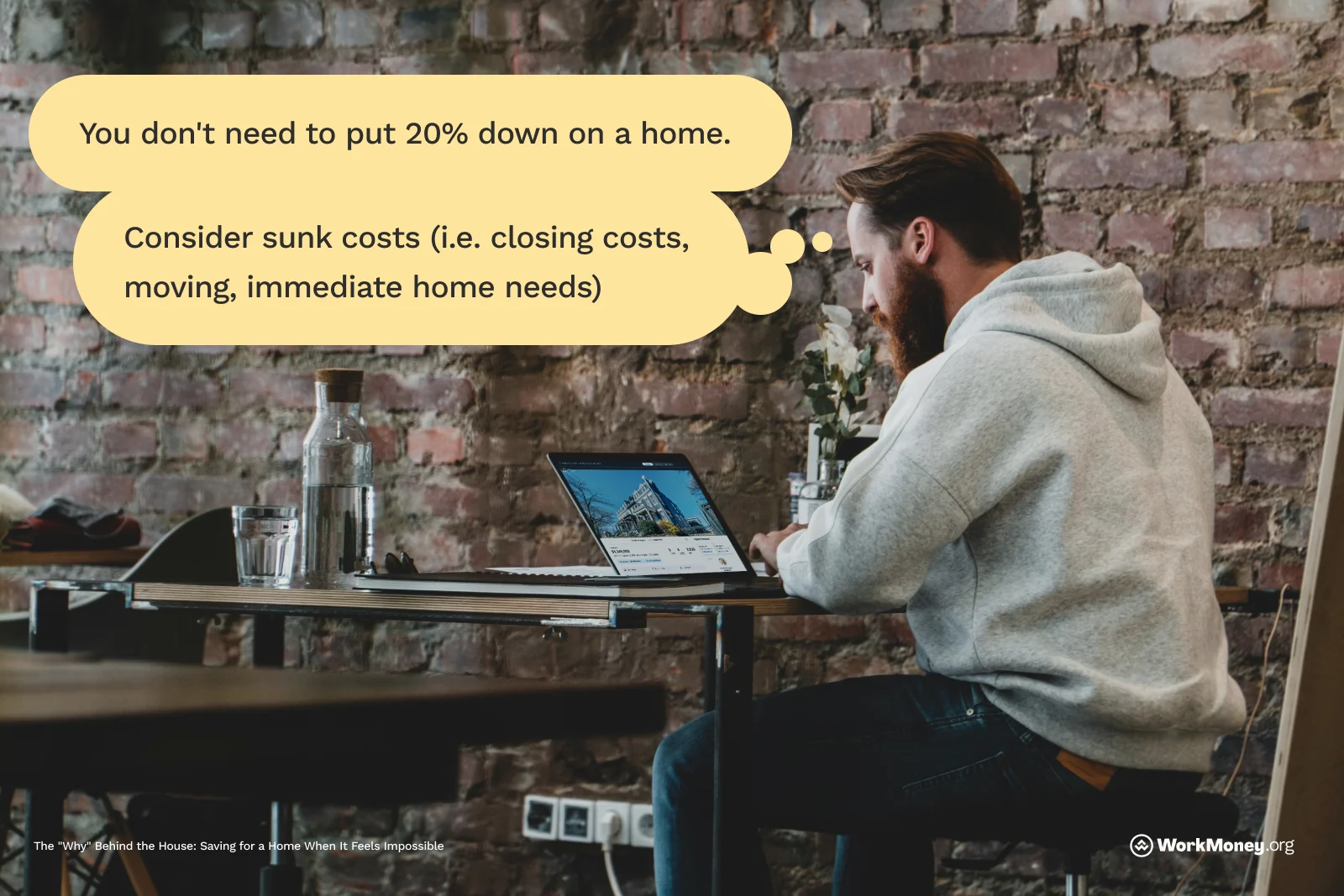
The upfront costs for buying a home can be lengthy and expensive. While a 20% down payment was once the norm, it’s not required for most home loans. The 20% rule is only if you want to avoid private mortgage insurance (PMI) — an additional mortgage insurance your lender charges. If you have less than 20% down, you’ll pay PMI until you hit 20% equity in your home.
Remember: 20% is a suggestion, not a rule. You can get a loan with as little as 3% down for some conventional loans, or 0% down with some government-backed loans, like USDA and VA. Most folks put down about 15%, according to data from the National Association of Realtors.
While a down payment is typically the most expensive part of buying a home, it’s not the only cost. Closing costs are typically 2-5% of your home loan. This covers lender fees, title insurance, taxes, and attorney charges.
There are also moving costs, immediate repairs and upgrades, and utility hookups, among other charges. Moving costs vary a lot by how many rooms you’re moving, where you’re going, the movers you hire (if you use them), and other factors. But the average local move costs around $1,400, while long-distance moves could run you $5,450.
Let’s take a look at what that could look like using the average home sale price of $534,000 with a 15% down payment, 2% closing costs, and local moving costs.
Home Price | Down Payment | Closing Costs | Moving Costs | Total Upfront Charges |
|---|---|---|---|---|
$534,000 | $80,100 | $9,078 | $1,400 | $90,578 |
Keep in mind this doesn’t include other immediate costs, like setting up your home internet, water, or electricity. Or if you have to make immediate purchases before moving in, like a new oven range, fridge, or water heater. You could expect costs to be well into the six figures before you even spend the first night in your new home.
Find “Hidden” Money in Your Current Budget
Saving money with your existing setup may feel like a long shot, but there’s a chance you have money already in your budget that you can reallocate to your home savings fund.
Track Your Spending
You may already do a version of this, but spend some extra time and watch every dollar you spend for the next 30 days. Pay close attention to both your discretionary spending and your bill payments.
Find Potential Changes
Look for places where you can make immediate changes, like:
Cancelling unnecessary subscriptions
Calling your provider to lower your internet and TV bills
Cutting down on excess purchases at the grocery store by sticking to a list
Switching your cell phone plan to a cheaper option
Trimming down dining out
Once you’ve made immediate changes, you can start to work towards longer-term strategies. For instance, comparison-shop insurance policies, like your home and auto plans, to see if you can lower your payments. Contact your credit card companies to negotiate a lower interest rate, or transfer your balance to a promotional 0% APR card to start chipping away at the balance.
When grocery shopping, shop your pantry first, then explore the weekly sales. Stock up on essentials when they go on sale so you aren’t paying full price when you need them.
Make Mini Savings Adjustments
While it’d be nice if you could move a hefty chunk of cash into a savings account, it’s not your only savings option. Sign up for a high-yield savings account and start making automatic transfers into the account.
You can also start micro-saving. Some banks round up your transactions and deposit the difference into an adjoining traditional savings account. This works for convenience, but you’re missing out on earning more with a high-yield savings account. If you don’t have a round-up feature with your bank, consider setting up automatic transfers with small-dollar amounts. Even a couple of dollars goes a long way.
Use Available Resources
Before you even look for homebuying help, see what type of resources you qualify for right now.
Government food assistance. Apply for SNAP and WIC to see if you qualify for subsidies to help subsidize your grocery bill. If you’re eligible, you could start putting the money you’re saving into your home fund.
Community food help. Look for food banks and pantries around your town. If you’re unsure which spots offer help, use Feeding America to find one near you.
Healthcare. Apply for Medicaid and CHIP to see if you’re eligible for low- or no-cost healthcare coverage.
Financial relief. Make sure you file for the child tax credit, earning up to $2,200 per child when you file your taxes or offset what you owe. You might qualify for the Low Income Home Energy Assistance Program (LIHEAP), a program to help pay for your home energy costs.
When you’re ready to start looking at homes, explore financial assistance at the local, state, and federal levels. You might qualify for government-backed mortgages, like FHA, VA, or USDA loans. Many states offer first-time homebuyer programs that assist with down payments or closing costs. Some municipalities offer grants for folks buying homes in those cities.
Make an Action Plan
The amount of upfront money you’ll spend on your home varies widely. The more you save before you start the homebuying process, the less you’ll need to stress when it comes to closing time.
Start by figuring out how much you’ll reasonably need to save to cover a decent down payment, potential closing costs, moving, setting up your new home, and any other unexpected costs. Rather than set a date for when you’ll start looking, set a budget amount—that way, you avoid moving in when you aren’t financially ready.
Be diligent with tracking your spending and cutting out any excess payments. Reduce recurring bills when you can and put every extra cent into a high-yield savings account to serve as your homebuying fund. Automate savings when you can, then trigger micro-savings.
Final thoughts
Buying a home can feel overwhelming and daunting. There’s a chance it’ll be the biggest purchase of your life. Owning a home isn’t for everyone, and it’s alright if you don’t believe it’s for you. If you want to make homebuying a reality, be as prepared as possible by taking precautions now. You’ll thank yourself later.
Take the next step
The Joy of Money Rent vs Buy Calculator
Compare the full costs of renting and buying, and find the option that actually fits your life.
Save hundreds on home insurance in under 5 minutes
Comparing premiums on Insurify can now save you up to $1,100 annually.
Was this information helpful?
About the Author

Dori Zinn
Dori Zinn is a longtime personal finance journalist with nearly 20 years of experience in digital media. Her work has been featured in the New York Times, Wall Street Journal, CBS News, Yahoo, CNN, USA Today, and more. She loves helping folks learn about money. If she isn’t writing, she’s reading, baking, or watching football.