Retirement Savings for Beginners: How to Start Building Your Nest Egg Today
Simple steps to secure your future even when money is tight
By Dori Zinn
3 min. read
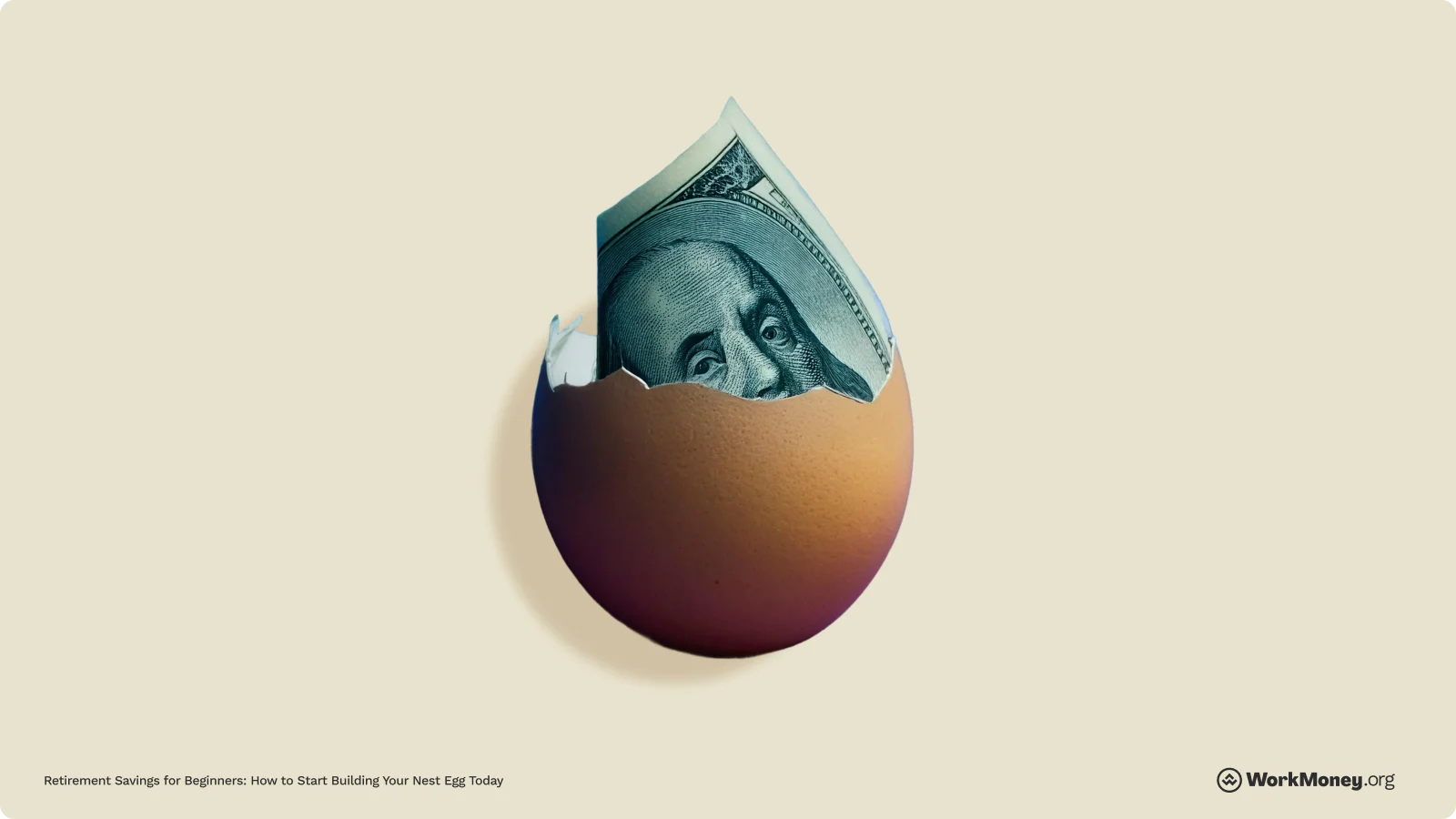
If you feel behind on your retirement savings, you’re not alone. According to a recent Bankrate survey, 58% of Americans say they feel behind on saving for retirement.
Whether you’re well into your career or you’re just beginning, you can start saving for retirement regardless of age or ability. WorkMoney has your guide for how to get started with retirement savings — right now, with what you have on hand.
Starting Is the Most Important Step
The biggest mistake for your retirement savings is not saving at all. But starting small is one of the best ways to build good savings habits for retirement.
The sooner you get started, the more your savings will add up, thanks to compound interest. When you make a deposit into your savings account, you’ll get interest added on top of your principal balance. Your interest gets added to become part of your principal, and the next time you earn interest, it’s on top of your new principal. Each time you earn new interest, it’s compound interest.
The longer your money stays in your savings account, the more it compounds. Let’s say you open a retirement account with $5 and then make $20 monthly contributions for the next 30 years. With interest rates around 4% during that time, you could earn $13,897.56 after the 30-year mark. If you did it for 10 years, you’d have $2,952.45.
Whether it’s retirement savings or for something else, compound interest can work in your favor the longer you save.
Open a Dedicated Retirement Account
There are two main types of investment accounts that are dedicated to saving for retirement: work-sponsored 401(k)s and individual retirement accounts (IRAs). You don’t have to pick one or the other, but the one you start with depends on what your job offers.
401(k) Plans
Work-sponsored plans allow employees to contribute to their retirement savings through investment accounts. Most private companies offer 401(k)s, while public schools and some non-profits offer 403(b)s.
You can automatically contribute to your retirement through your paycheck before taxes, depending on the plan your employer offers. For 2026, you can contribute $24,500 to a 401(k) plan, without accounting for any catch-up contributions.
IRAs
Anyone can open an IRA, regardless of what your work offers. There are two main types of IRAs: Traditional and Roth.
Traditional | Roth | |
|---|---|---|
Income requirements | None | $153,000 for single filers; less than $242,000 for married couples filing jointly. |
Contributions | Pre-tax, reducing your current taxable income | After-tax |
Earnings | Taxed as ordinary income in retirement | Tax-free if you withdraw after age 59 1/2 |
Required withdrawals | Yes — required minimum distributions (RMDs) must start at age 73 | No required minimum distributions |
Early withdrawals | 10% penalty if before age 59 1/2 | Contributions can be withdrawn anytime without penalty |
There’s no limit to how many IRAs you can open, so you can have multiple IRAs at once. But the contribution limit for IRAs applies across all of your accounts.
You can open an IRA whether you have a work-sponsored plan available to you or not. Even if you start with a 401(k) at work to maximize your savings, you can still open an IRA for even more future savings.
Missing Savings: Employer Matches
Some companies offer 401(k) employer matches, allowing workers to save a portion of their own money and use their employer's funds for retirement.
There’s no set amount for an employer match; it varies by company, typically between 4% and 6%. A common match is $1 for $1, up to 3% of the employee's salary, then $0.50 for every dollar up to 2% of the employee’s salary. After that, you can keep making contributions, but you may not get an employer match.
If you’re not contributing to a 401(k) through your job, you could be missing out on free money from your job. Check with your work’s human resources department or benefits program on what retirement benefits your company offers. Then set up your contributions to receive the full employer match.
Extra Tax Break With the Saver’s Credit
The Saver’s Credit is a dollar-for-dollar reduction in your federal tax bill for contributing to a retirement account. While you can lower what you owe in taxes, it can only reduce your bill — it won’t trigger a refund when you file your taxes.
Depending on your adjusted gross income, you could receive 10%, 20%, or 50% of the first $2,000 of your contribution (or $4,000 for joint filers). There’s no minimum contribution to be eligible for the Saver’s Credit, but the maximum benefit is $1,000 per person, or $2,000 for married couples filing jointly.
Keep in mind that the Saver’s Credit ends in 2026 and will be replaced by the Saver’s Match program. The program provides a federal matching contribution of up to 50% on the first $2,000 you contribute to your workplace retirement plan or IRA. There’s a maximum matching contribution of $1,000 per person, per year.
What If Money Is Tight?
If you don’t feel like there’s any money left at the end of the month to put towards other needs, saving for retirement can feel restrictive. A lot of times, there isn’t a savings gap — there’s an income gap. In the last 40 years, the richest Americans have only gotten richer — the richest 1% make nearly 139 times as much as the bottom 20%, according to the Congressional Budget Office.
If money is tight, you're not alone, but there are programs designed to help. Try to use the available resources to free up extra cash. For instance, use the Supplemental Nutrition Assistance Program (SNAP) — government-assisted benefits you pay into through taxes and available to families who need it most.
You can get started with next to nothing by micro-investing with apps like Acorns that let you round up your purchases and put the leftover funds into an investment account. Other brokerages like Fidelity let you open retirement accounts with no minimums, so the threshold to qualify is low.
You can also use platforms like Savi, which help you figure out what student loan forgiveness options you qualify for and help you enroll in eligible programs. Reducing your federal loan obligations can free up money to go elsewhere, such as saving for retirement.
Final thoughts
Retirement isn’t just something for the wealthy. Making dedicated changes to your retirement savings right now can have a lasting impact on your future. You’re not expected to figure it out all at once, so try to create small habits right now to help reduce your anxiety around retirement savings and give your future self some peace.
Talk to your HR or benefits department to explore your retirement plan options, and if you don’t have anything available through your job, open an IRA and start contributing. It’s never too late to get started saving for your post-working years.
Take the next step
The Joy of Money Retirement Calculator
This calculator will make retirement planning seem less mysterious—and more doable.
Build long-term wealth & investing success
Exclusive 20% off Stackwell monthly subscription for WorkMoney members
Was this information helpful?
About the Author

Dori Zinn
Dori Zinn is a longtime personal finance journalist with nearly 20 years of experience in digital media. Her work has been featured in the New York Times, Wall Street Journal, CBS News, Yahoo, CNN, USA Today, and more. She loves helping folks learn about money. If she isn’t writing, she’s reading, baking, or watching football.