Opportunity Cost: What If You Invested Your Down Payment Instead?
Comparing the long term wealth of homeownership versus strategic stock market investing
3 min. read

You may have encountered the phrase 'opportunity cost' before in an economics classroom. Opportunity cost is what you must give up when you choose one option over another. It’s the value of the next-best choice you didn’t take.
For example, you could spend money on upgrading your vehicle or starting a small business. Either way, you have to evaluate each opportunity and decide which one is the smaller sacrifice.
If you’re considering buying a house, you will have to bring a down payment. This amount can range significantly. But what if instead of using it for a down payment, you invested in the stock market for your retirement? This could include increasing your 401k contributions at your employer, maxing out your Roth IRA, opening a Health Savings Account (HSA), or using a taxable brokerage account.
Each one of your dollars has the potential to create more wealth, so it's vital to evaluate what opportunities are the best for your army of dollar bills. The WorkMoney team put together a guide on how you can evaluate the opportunity costs of your money.
The Traditional Wisdom vs. Modern Reality
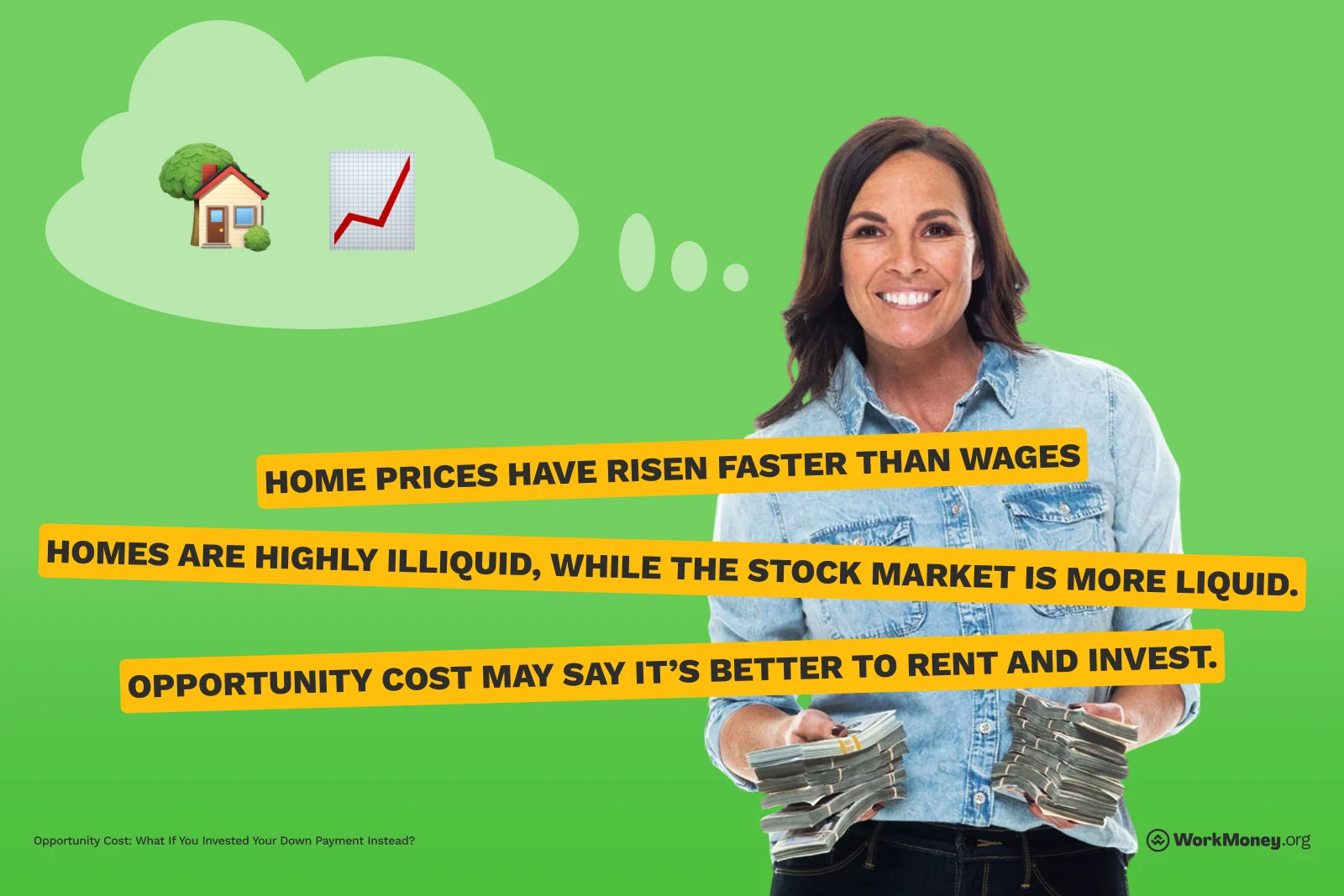
Buying a home has long been considered a financial no-brainer. But today’s financial reality looks very different. Home prices have risen faster than wages, student debt weighs heavily on younger buyers, and careers increasingly require flexibility and mobility. Locking up a large down payment in an illiquid asset can limit options—especially for lower-income or early-career earners.
Homeownership isn’t inherently a bad move, but it’s no longer an automatic one. In many cases, the real question isn’t whether you can buy a home, it’s what you’re giving up by doing so.
The Numbers: Down Payment as an Investment
Let's use this example: a working professional interested in buying a home with $40,000 set aside.
Traditionally, that money might go straight into a down payment to bring down the monthly mortgage payment. But what if it were invested instead in a diversified stock-and-bond portfolio, earning a conservative 6% annual return? Compounding over time can turn that $40,000 into roughly $72,000 in 10 years, $128,000 in 20 years, and more than $230,000 in 30 years.
Compare that to using the same $40,000 to buy a home. Yes, homeowners build equity and may benefit from appreciation, but those gains come with costs like mortgage interest, property taxes, insurance, maintenance, and transaction fees. Many of these costs are recurring, unavoidable, and don’t directly increase equity.
Here’s a simplified look at how the two paths compare:
Factor | Renting + Investing | Buying a Home |
|---|---|---|
Upfront capital | $40,000 invested | $40,000 down payment |
Growth potential | Compounds at 6% annually | Equity grows via principal + appreciation |
Monthly costs | Rent only | Mortgage, taxes, insurance, maintenance |
Transaction costs | Minimal | 6–10% when selling |
Liquidity | High | Low; capital tied up in home |
Maintenance/repairs | None | Ongoing, unpredictable |
Over decades, those ongoing ownership costs can add up—and the money spent maintaining a home is money that isn’t growing in the market. Renting while investing your down payment can give your money more time to work, making compound interest your strongest ally.
Hidden and Psychological Costs
Buying a home is both a financial commitment and an emotional one. Many homeowners experience what’s called “being house poor,” where a large portion of income goes toward mortgage, taxes, and upkeep. This can lead to stress, anxiety, and reduced lifestyle satisfaction. Vacations, hobbies, or even simple daily comforts can feel out of reach, leaving homeowners financially tied down even as they technically build wealth.
Renters face different pressures, both social and financial. You can be potentially looked down upon for renting by friends and family. Additionally, if you’re not actively saving for retirement and renting for extended periods of time, you could find yourself without a growing nest egg for your post-working years.
Ultimately, financial numbers are only part of the picture. Emotional and lifestyle costs play a huge role in deciding whether homeownership truly makes sense. Sometimes, the peace of mind that comes with renting and investing the down payment outweighs the pride of ownership.
Framework for Readers
Deciding whether to buy a home or rent while investing isn’t just about numbers—it’s about balancing financial, lifestyle, and emotional priorities. One way to simplify the decision is with a decision matrix that compares key factors side by side:
Factor | Renting + Investing | Buying a Home |
|---|---|---|
Financial Growth | High potential; compounding investments may outpace home equity over time | Moderate; equity builds slowly, appreciation uncertain, offset by mortgage interest, taxes, and maintenance |
Lifestyle Flexibility | High; easy to relocate for career or personal reasons | Low to moderate; homeownership ties you to a location and long-term obligations |
Mental Health | Lower stress from avoiding maintenance and unexpected costs | Higher stress risk, potentially being house poor, and repair/financial surprises |
Social Considerations | May face stigma for renting long-term | Often socially recognized as “settled” or financially successful |
This framework can guide concrete steps:
Calculate potential investment growth vs. home equity. Use realistic assumptions for returns, appreciation, and ongoing costs to see which path may build more net worth over your timeframe.
Assess career mobility needs. If your job or lifestyle requires flexibility, the liquidity of renting and investing can be a major advantage.
Consider emotional comfort with risk and stability. Ask yourself whether you prefer the security and pride of ownership, or the freedom and compounding potential of renting and investing.
By evaluating both financial and psychological factors, this framework helps clarify which path aligns with your priorities.
Final thoughts
There’s no one-size-fits-all answer to buying versus renting and investing. The right choice depends on your finances, career plans, and personal priorities.
Thinking in terms of opportunity cost helps highlight trade-offs: every dollar tied up in a home is money that could grow elsewhere. Balancing financial trajectory and your own personal values makes the decision intentional, and not an automatic yes or no.
Was this information helpful?
About the Author

Brett Holzhauer
Brett Holzhauer is a Certified Personal Finance Counselor (CPFC) who has reported for outlets like CNBC Select, Forbes Advisor, LendingTree, UpgradedPoints, MoneyGeek and more throughout his career. He is an alum of the Walter Cronkite School of Journalism at Arizona State. When he is not reporting, Brett is likely watching college football or traveling.