Average Cost of Routine Car Maintenance
What your car upkeep might cost this year and how to keep your wallet intact
5 min. read
Car maintenance is a widely varying expense for drivers. It can range from hundreds of dollars per year to thousands. The factors affecting this included how much you drive, the car you drive, and where you get your vehicle serviced.
In AAA’s 2024 Your Driving Costs study, it’s estimated that maintenance costs 10.13 cents per mile. General estimates say that Americans drive approximately 12,000 miles per year. That means drivers should expect to spend $1,215 per year in overall maintenance, regardless if they buy a new or used car.
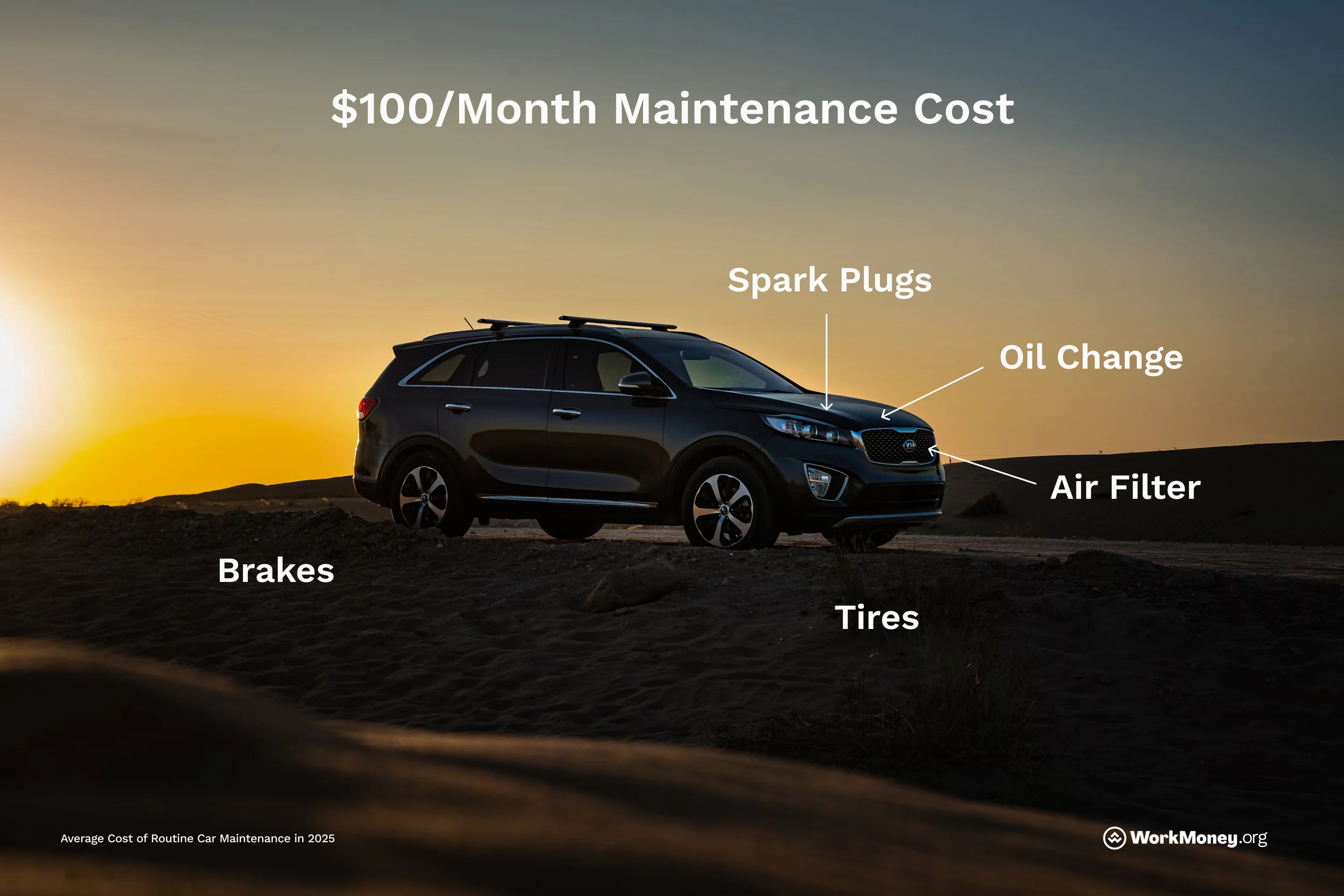
The WorkMoney team put together an explainer of all of these tasks to be aware of, and how you can potentially save on each one to keep your maintenance costs as low as possible.
Average Cost of Routine Car Maintenance
It’s difficult to say the average costs of each item above, as prices can vary widely based on what car you have and where you live. But here are a few estimates of larger expenses you may encounter gathered in 2025:
Maintenance Task | Frequency | Estimated Cost Range |
|---|---|---|
Oil Change | Every 5,000–7,500 miles | |
Tire Rotation | Every 5,000–7,500 miles | |
Brake Pad Replacement | Every 10,000–20,000 miles | |
Air Filter Replacement | Every 15,000–30,000 miles | |
Wiper Blade Replacement | Every 6–12 months | |
Battery Replacement | Every 3–5 years |
Car maintenance is essential to making your vehicle last as long as possible. If you put it off, you could cause more damage and regret it. A recent survey from PepBoys found that 35% regret putting their car care off, resulting in unexpected repair fees or a roadside emergency. And car repair debt can quickly spiral out of control if put on a credit card and paid off over time.
To help drivers stay on top of these costs and prevent unexpected expenses, a structured maintenance schedule is invaluable. The following chart lays out a routine car maintenance checklist, organized by frequency. By following this schedule, car owners can ensure their vehicles remain safe, efficient, and reliable, while also keeping annual maintenance costs more predictable.
Frequency | Task |
|---|---|
Monthly | Check tire pressure |
Monthly | Inspect tires for tread wear/damage |
Monthly | Check windshield washer fluid |
Monthly | Check all exterior lights |
Monthly | Look under car for fluid leaks |
Every 3,000–5,000 miles | Change engine oil & oil filter |
Every 3,000–5,000 miles | Check and top off all fluids |
Every 3,000–5,000 miles | Inspect belts and hoses |
Every 3,000–5,000 miles | Inspect battery terminals for corrosion |
Every 3,000–5,000 miles | Rotate tires |
Every 3,000–5,000 miles | Check wiper blades |
Every 15,000–30,000 miles | Replace air filter |
Every 15,000–30,000 miles | Replace cabin air filter |
Every 15,000–30,000 miles | Inspect brake pads, rotors, brake fluid |
Every 15,000–30,000 miles | Inspect suspension & steering components |
Every 15,000–30,000 miles | Check wheel alignment |
Every 50,000–60,000 miles | Replace spark plugs |
Every 50,000–60,000 miles | Check timing belt |
Every 50,000–60,000 miles | Flush brake fluid |
Every 50,000–60,000 miles | Inspect exhaust system |
Every 100,000 miles | Replace timing belt/chain |
Every 100,000 miles | Flush & replace coolant |
Every 100,000 miles | Replace transmission fluid & filter |
Every 100,000 miles | Replace differential fluid (if applicable) |
Seasonal | Before winter: check battery, tire tread, antifreeze |
Seasonal | Before summer: check A/C, coolant, tires |
EVs Have Far Less Maintenance
One of the lesser appreciated benefits of electric vehicles is their maintenance costs are significantly lower when compared to gas-powered vehicles.
A 2021 study from the U.S. Department of Energy found that EVs cost roughly 6.1 cents per mile, with internal combustion vehicles (ICE) at 10.1 cents – a 65% cost premium. This is because EVs have fewer parts to operate and maintain. So if you’re considering a new vehicle, an electric vehicle could be a potential option to save money over the long run.
In comparison, here’s a list of what needs to be maintained on an electric vehicle. It’s substantially smaller when compared to a gas-powered vehicle.
Frequency | Task |
|---|---|
Monthly | Check tire pressure |
Inspect tires for tread wear/damage | |
Check windshield washer fluid | |
Check all exterior lights | |
Look under car for leaks (rare) | |
Every 3,000–5,000 miles | Inspect brake pads (less frequent than gas cars) |
Rotate tires | |
Inspect battery health and electrical systems | |
Every 15,000–30,000 miles | Replace cabin air filter |
Inspect suspension & steering components | |
Check wheel alignment | |
Every 50,000–60,000 miles | Flush brake fluid (as recommended by manufacturer) |
Inspect electric motor and charging system | |
Inspect coolant system for battery/inverter | |
Every 100,000 miles | Battery pack diagnostics and service (if needed) |
Inspect major electrical components | |
Seasonal | Check battery coolant levels |
Check tires, brakes, and A/C/heating system |
How to Budget and Save on Car Maintenance
Car maintenance can be scheduled, but there will likely be a scenario that gets thrown at you. For example, you can schedule an oil change, but a tire blowout or cracked windshield unfortunately needs to be handled quickly.
Your best option is to have part of an emergency fund be dedicated to vehicle-related expenses. Most consumers don’t have $1,000 for an emergency, so even if you set aside $2,000 for future car repairs, you’re far ahead of the game.
Additionally, once your car needs service, it’s best to call around your area to see who can do the service for the best price. For example, if your car needs a regular oil change, you might find a local service shop that has a promotion on oil changes. Or if you need a new set of tires, you might find a deal online where you can have the tires shipped to an authorized shop.
Like anything else in life, be sure to shop around to get the best deal, rather than running to a car dealership where they may charge a premium on services you can get cheaper elsewhere.
Final thoughts
Car maintenance doesn’t have to be overwhelming or break the bank. By following a routine schedule and planning for unexpected repairs, you can keep your vehicle running and avoid financial surprises. Whether you drive a traditional gas-powered car or an electric vehicle, budgeting ahead and shopping smart for services are the best ways to save money and protect your investment over the long term.
Take the next step
Slash your car insurance premiums
Save up to $1,100 a year on your vehicle with Insurify
Easily lower your car loan payments
See if you can save over $1,900 a year by refinancing your auto loan through Caribou.
Was this information helpful?
About the Author

Brett Holzhauer
Brett Holzhauer is a Certified Personal Finance Counselor (CPFC) who has reported for outlets like CNBC Select, Forbes Advisor, LendingTree, UpgradedPoints, MoneyGeek and more throughout his career. He is an alum of the Walter Cronkite School of Journalism at Arizona State. When he is not reporting, Brett is likely watching college football or traveling.