ACA Open Enrollment: How to Find an Affordable Plan
Unlock peace of mind, understand your options, and find a health plan that truly fits your budget
7 min. read
Open enrollment starts November 1, and your health plan may cost more in 2027. Monthly premiums are expected to rise an average of 15%, and the federal cap on out-of-pocket costs rises to $12,000 for one person.
Fitting the higher monthly cost into your budget can get expensive. This WorkMoney guide walks you through the ACA Open Enrollment process, plus how you can get free help.
Key Dates for 2027 Coverage
If your state uses HealthCare.gov, here are the dates for 2027 coverage:
November 1, 2026: Open enrollment opens on HealthCare.gov and most state marketplaces.
December 15, 2026: Deadline to pick a plan for coverage starting January 1, 2027.
December 16, 2026 - January 15, 2027: You can still enroll, but coverage won't start until February 1.
State-run marketplaces set their own dates. California, DC, New Jersey, and New York stay open through January 31, 2027.
What’s Different This Year
Several changes could affect your plan choice this year.
First, the extra premium tax credits Congress passed in 2021 expired at the end of 2025. Now, people earning more than 400% of the poverty level get no federal help with premiums. For 2027 plans, that’s $63,840 for one person or $132,000 for a family of four.
Second, premiums are going up again. Insurers asked for a median increase of 15% for 2027, on top of last year’s hikes.
Along with that, the federal out-of-pocket costs rise to $12,000 for an individual and $24,000 for a family, up from $10,600 and $21,200. Your plan’s limit may be lower.
Next, fewer insurers will sell plans. Eleven insurers plan to leave some or all of their states in 2027, including Cigna.
The limits on paying back extra tax credits are gone. If you guess your income too low and get too much help, you’ll owe it all back at tax time.
Finally, starting in 2027, tax credits and extra savings go only to green card holders and a few other immigrant groups. Other lawfully present immigrants can still buy a marketplace plan at full price.
Step 1: Gather What You Need Before You Apply
Write down everyone who needs coverage in your home, and estimate your total household income for 2027, including wages, self-employment income, and investment income. Write down how often you visit the doctor and the prescriptions you take each month. Note any planned care, like a surgery or having a baby. HealthCare.gov’s application checklist lists what else you’ll need.
If your income varies — freelance work, seasonal hours, tips — estimate honestly and update your application at HealthCare.gov during the year when things change.
Step 2: Check if You Qualify for Free or Low-Cost Coverage First
Before comparing plans, find out what help you can get. In states that expanded Medicaid, adults earning up to 138% of the poverty level generally qualify for free or low-cost coverage. Starting January 1, 2027, most adults in that group will also need to show 80 hours a month of work, school, a work program, or community service to keep Medicaid, unless they qualify for an exemption. Additionally, children in families that earn too much for Medicaid may qualify for CHIP, the Children's Health Insurance Program.
You can check all of this in one HealthCare.gov application, and you can apply for Medicaid and CHIP year-round. If it looks like anyone in your household qualifies, the Marketplace sends your information to your state, and the state will contact you.
Step 3: Compare Plans by Total Yearly Cost
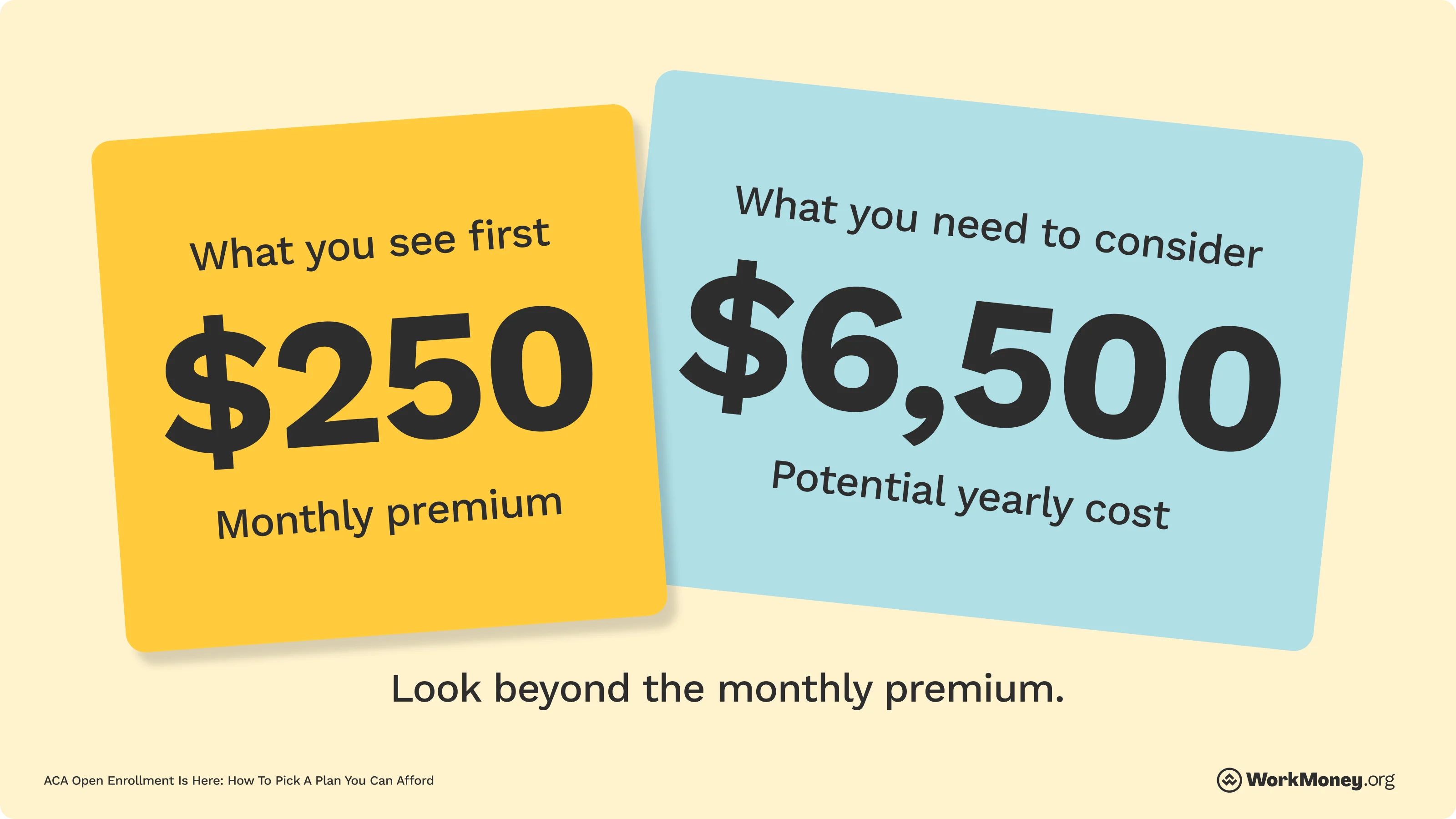
The monthly premium is the number you see first, and it’s one of five that decide what you’ll spend in a year.
Premium: The monthly cost to hold your policy, whether you see a doctor or not.
Deductible: The amount you pay over the year before your plan starts covering most costs. The average marketplace deductible was $3,786 in 2026.
Copays: A flat fee you pay for certain services, like a doctor visit or prescription.
Coinsurance: The percentage of the bill you split with your insurer after you meet your deductible.
Out-of-pocket maximum: The most you’ll pay for covered, in-network care in a year.
Do the full-year math before you pick. A plan with a $250 monthly premium and a $7,000 deductible looks cheaper than one with a $400 monthly premium and a $1,000 deductible — until you need surgery or start a new prescription. Multiply the premium by 12, then add what you'd spend on care, including your prescriptions, regular visits, and anything planned. The low-premium plan only works if you barely use it. Before you pick, check that your doctors are in each plan’s network and your medicines are on its drug list.
If your plan covers one of your medicines poorly, a GoodRx coupon may get you a lower price. You’d pay with GoodRx instead of your insurance, so ask your insurer whether that cost can count toward your deductible. Not every plan allows it
Six in 10 marketplace enrollees say it’s hard to afford their deductibles and other out-of-pocket costs, and higher-deductible plans can lead to bigger bills and medical debt. An affordable plan protects the rest of your budget.
Step 4: Get Free Help
HealthCare.gov funds local navigators who help people compare plans and apply for free. Find them through the Find Local Help tool on HealthCare.gov or call 1-800-318-2596. Reach out early in November.
If you’re a gig worker or freelancer, Stride, an official HealthCare.gov partner, shows the same plans at the same prices, checks which savings you qualify for, and helps you enroll in health, dental, and vision coverage. Additionally, Stride Health helps consumers compare healthcare plans, saving shoppers an average of $447/month in premiums.
Step 5: Enroll — and What Happens if You Miss the Deadline
Enroll at HealthCare.gov (or your state's marketplace) by December 15 for January 1 coverage, and pay your first premium. After January 15, you generally can't enroll or switch plans until the next open enrollment unless you have a qualifying life event — losing other coverage, moving to a new area, getting married, or having a baby. Those events open a Special Enrollment Period, which usually gives you 60 days to sign up.
Two Families, Two Decisions
Take Maria. She's single and earns $28,000 a year, about 175% of the poverty level. That qualifies her for two kinds of help: tax credits that lower her monthly premium and extra savings that lower her costs when she gets care. She only gets the second kind with a Silver plan. In 2026, Silver plans at her income averaged a $682 deductible, compared with $7,476 for Bronze. A Bronze plan might cost her less each month, but one hospital visit could cost her far more.
Take the Johnsons: married, two kids, $95,000 in household income. That puts them at about 288% of the poverty level. They get tax credits on their premium but earn too much for extra Silver savings. Their credit stays the same no matter which metal level they pick, so a Bronze plan can cost them less each month. But in 2026, standard Silver plans averaged a $4,902 deductible and Bronze averaged $7,476. With two kids, a Gold plan’s lower deductible might cost them less over the year. They should run the full-year math on all three.
Bottom Line
Picking an affordable plan comes down to knowing your dates, what you qualify for, and comparing each plan’s total yearly cost. Spend an hour reviewing your doctors’ list, prescriptions, and two or three plan summaries to find the plan that best fits your health needs and budget.
Take the next step
Health insurance that’s got your back
WorkMoney members can save an average of $447/month on health coverage with Stride—compare marketplaces and find affordable plans in minutes.
Save big on your prescriptions
WorkMoney members can save up to 80% on medications with GoodRx—no insurance needed. It’s free, easy to use, and accepted at over 70,000 pharmacies nationwide.
Was this information helpful?
About the Author

Brett Holzhauer
Brett Holzhauer is a Certified Personal Finance Counselor (CPFC) who has reported for outlets like CNBC Select, Forbes Advisor, LendingTree, UpgradedPoints, MoneyGeek and more throughout his career. He is an alum of the Walter Cronkite School of Journalism at Arizona State. When he is not reporting, Brett is likely watching college football or traveling.