How to Save Money Fast: Your Ultimate Guide to Quick Financial Wins
Real tips to boost your bank account now, not later.
By Dori Zinn
5 min. read

Financial anxiety can wreak havoc on our mental health. A Northwestern Mutual report found that financial uncertainty causes anxiety, stress, and depression.
Even if you’ve recently made smarter money decisions that can help you in the long run, you might still stress over money in the short term. Luckily, WorkMoney has a few fast ways to save money right now, allowing you to celebrate even the smallest financial wins.
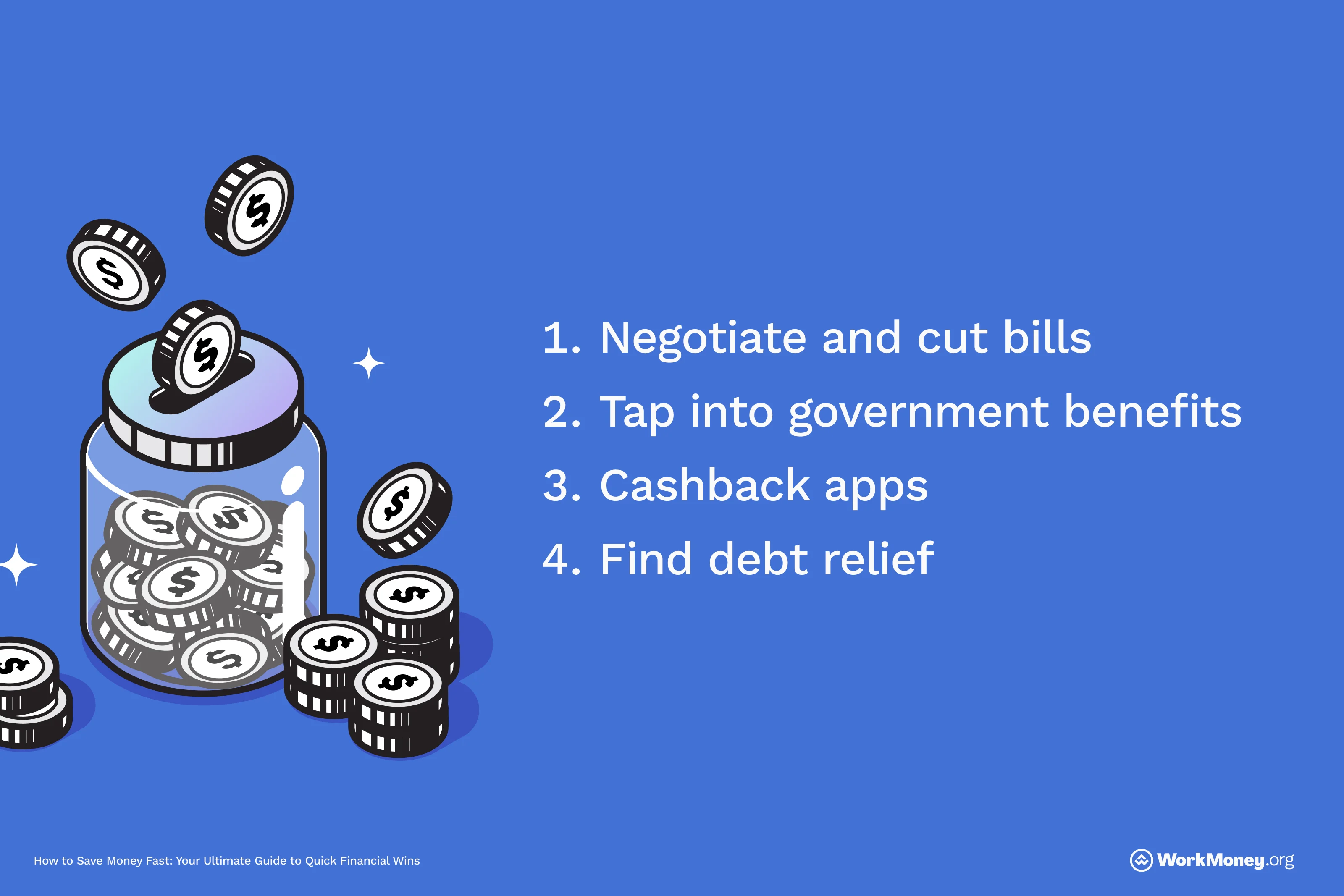
Styled List
Negotiate and Cut Out Bills
Most of your monthly bills are negotiable, including:
Cable and internet
Phone
Car insurance
Memberships and subscriptions
Credit card interest rates
First, look to see if your current provider offers any deals or discounts to new customers. Then compare your plan and needs to what competitors offer. Many times, all you need is a simple call to your provider to ask for what’s available.
Whenever you can, cut out anything that isn’t essential. For instance, can you ditch your cable package for a lower-cost streaming subscription or use free resources from the library? Can you get rid of your gym membership and exercise at home, around the neighborhood, or at a local park? Wherever you can, drop out the least important things.
You can look into bill negotiation services, but remember that the company takes a percentage of what they save you.
Tap Into Government Benefits
You can access several government programs and resources that run on taxpayer dollars. It’s your right to use these resources; it’s why they’re available. You may qualify for different programs and don’t know it yet. There are many resources at the federal, state, and local levels.
Temporary Assistance for Needy Families (TANF)
Look into Temporary Assistance for Needy Families (TANF) or welfare benefits. This federally funded program is state-run, helping families cover the costs of food, housing, and child care. Some states offer job training and tuition payments alongside TANF benefits. Your state might also offer Temporary Cash Assistance (TCA), but it may not be available everywhere.
Housing Assistance
At the federal level, rental assistance includes Section 8 housing, subsidized housing, and financial aid for veterans, seniors, and people with disabilities. There’s also emergency housing assistance. You can call 2-1-1 and get connected to resources in your community.
Supplemental Nutrition Assistance Program (SNAP)
The SNAP program provides food benefits to low-income households so you can afford to buy groceries and necessary food items. Eligibility is based on household size and income. You can use Propel to find out if you’re eligible and, if so, the assistance you’d get.
There are so many other government resources at every level. Search what’s available near you and complete applications when you find eligible programs. Not all government programs give out cash, so finding ways to save on significant, expensive needs allows you to save money in other areas.
Look for Other Resources Near You
Every community has different assistance options, so what’s available to you may not be available to everyone.
Meals on Wheels
Meals on Wheels helps feed seniors nationwide through local and regional meals and services.
Food Pantries and Food Banks
Use the WorkMoney Food Bank Finder to locate free food pantries in your area. You can also use Feeding America to find options near you. Many churches, temples, and religious groups offer free food — either meals or groceries — to those in need.
Try Apps and Cashback Services
Sign up for cashback portals and apps that reward you with cash back for doing the shopping you were already planning on doing. Apps like Ibotta, Rakuten, and Honey all offer savings and cashback options. The Upside app also helps you save on groceries, dining and gas.
While you can scour the internet for coupons and try extreme couponing, those options can take extensive time and energy, which you could use for other things. If you already clip coupons, you can keep doing that with these other options, but avoid making this your sole savings option.
Find Debt Relief
If you’re struggling to pay back old debt, like medical bills or credit card debt, there are a few resources you can explore.
Medical Bills
Call your hospital billing department and ask what financial relief options they offer. Tell them you can't afford your bill and ask if they can reduce it. If the final amount they give you is still too much for you to pay, ask about payment plans. You can also use government-backed charity care to see how to cover medical bills.
Credit Card Debt
Credit card debt can crush your financial freedom dreams. According to a recent Empower survey, 1 in 4 Americans carries more than $10,000 in credit card debt. If you can’t pay off your credit card balance every month, you’ll get interest charged on the outstanding amount. That debt can snowball, as the larger balance will increase how much interest you’ll pay each month that passes.
You can call your credit card issuer and negotiate your interest rate. If you’re in good standing with your credit card company, this shouldn’t be too much of a hassle. But if you regularly fall behind on payments or max out your card, you may have a harder time with this negotiation.
If you’re stuck with your current company, look for balance transfer offers with a 0% APR introductory offer. These intro offers allow you to transfer outstanding balances without getting charged interest on that balance for a set amount of months — anywhere from 12 to 21, depending on the card offer.
When exploring offers, make sure you meet the eligibility requirements before applying. Once approved, you’ll get a credit limit and move over your existing balance to your new card. Keep in mind that not all balance transfer cards give you a credit limit for the full amount of your debt. So you might have to repay your new card and any other card with existing balances with the monthly interest.
Final thoughts
Small changes right now can make a significant shift later on. While these little adjustments may not feel like they will do much, they add up and can make a difference to your budget. Start tracking your spending so you can celebrate wins — big and small.
Was this information helpful?
About the Author

Dori Zinn
Dori Zinn is a longtime personal finance journalist with nearly 20 years of experience in digital media. Her work has been featured in the New York Times, Wall Street Journal, CBS News, Yahoo, CNN, USA Today, and more. She loves helping folks learn about money. If she isn’t writing, she’s reading, baking, or watching football.