Traditional vs. Roth IRA: The "Tax Me Now or Tax Me Later" Guide
Deciding between immediate tax breaks or tax free retirement income to keep more of your money
4 min. read
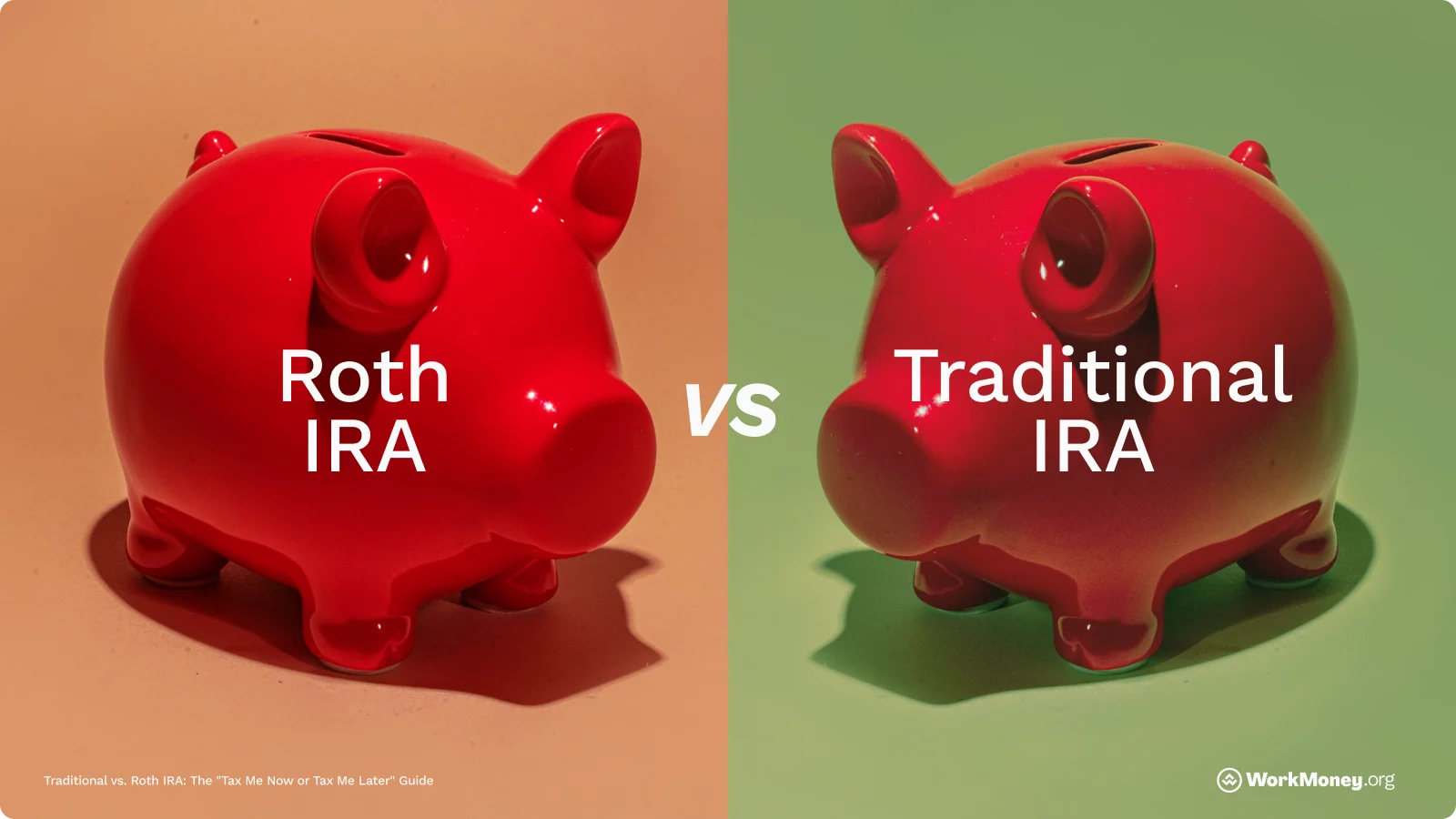
Most advice around IRAs makes this feel more complicated than it needs to be. At its core, you’re making one simple decision: do you want to pay taxes now, or later? You’re deciding how to position your money for today versus future you.
Tax advantaged retirement accounts can be powerful tools to save for retirement, but many people don’t even get to the question about taxes. Just over half of Americans are using these fruitful accounts that can put you on the path to retirement, according to Federal Reserve data.
You don’t need to max out an account or overhaul your finances to start. Even $20 a month is enough to begin building momentum. What matters most isn’t choosing the perfect account on day one. It’s starting, building consistency, and giving you more options than you have today.
WorkMoney built a comprehensive guide on what to consider with both types of accounts, and how you can use them for saving for your post working years.
The Core Idea
Simple Analogy
Think of this like planting a tree for retirement.
With a Traditional IRA, you plant the tree today without paying for the fruit. It grows over time, but when you finally harvest it in the future, you owe a share of everything you pick.
With a Roth IRA, you pay for the fruit upfront. It costs you more today, but once the tree grows, every piece of fruit you harvest later is completely yours.
Same tree. Same growth. The only difference is when you settle the bill.
Why It Matters
This decision matters because taxes aren’t a small line item. They’re one of the biggest expenses you’ll face over your lifetime, and this is one of the few places where you actually get to control the timing.
Despite taxes being a significant line item, IRAs can be a great way to reduce your tax burden. That’s why this choice matters. You’re not just picking an account. You’re deciding how to reduce one of your biggest lifetime costs while giving yourself a better shot at actually feeling secure later on.
You don’t need to predict your future perfectly. You just need to make a reasonable call based on where you are today and where you think you’re headed.
Traditional IRA (Tax Me Later)
How It Works
A Traditional IRA gives you a tax break today. Contributions may be tax-deductible, which lowers your taxable income now. The tradeoff is simple. You pay taxes later when you withdraw the money in retirement.
Think of it as deferring the bill. You get more money working for you upfront, but when you retire and begin pulling money out, you will owe Uncle Sam.
This account is also a great way to stay organized with your workplace retirement accounts. If you leave a job, you can roll a 401(k) into a Traditional IRA and keep everything tax-deferred without triggering a taxable event. This helps consolidate accounts and maintain investment control. This is a larger issuer than most realize: there are an estimated 29.2 million left-behind or forgotten 401(k) accounts holding over $1.65 trillion in assets as of May 2023, according to Capitalize.
Best For
A traditional IRA works best if you expect your tax rate to be lower in retirement than it is today. That often applies if you’re in peak earning years now or anticipate a simpler income picture later.
It’s also useful for people who change jobs frequently and want a consistent place to roll over old 401(k)s without tax friction.
The Fine Print
There are rules attached. Withdraw money before age 59½ and you will likely face a 10% penalty on top of income taxes.
You are also required to take distributions later in life. Required Minimum Distributions (RMDs) currently begin at age 73, whether you need the money or not. Those withdrawals are taxed as ordinary income.
Roth IRA (Tax Me Now)
How It Works
A Roth IRA is straightforward. You contribute money that’s already been taxed, so there’s no upfront deduction. That money grows over time, and when you withdraw it in retirement, both your contributions and earnings come out completely tax-free.
You’re essentially locking in today’s tax rate in exchange for future simplicity.
Best For
A Roth IRA tends to make the most sense if you’re earning less today than you expect to in the future. That could mean early in your career, during a lower-income year, or anytime your tax rate is relatively low.
It’s also a strong fit if you value predictability. You know exactly what you’re paying now, and you remove uncertainty later.
Why It Feels Easier
For a lot of people, the Roth just feels more manageable.
You can withdraw your contributions (not your earnings) at any time without taxes or penalties, which reduces the fear of locking your money away. That flexibility creates a built-in safety net.
On top of that, there are no required minimum distributions in retirement. Your money stays invested as long as you want, giving you more control over how and when you use it.
That combination of flexibility and simplicity is why many beginners start here and stick with it.
If Money Feels Tight
The Real Fear
For most people, the hesitation isn’t about understanding IRAs. It’s about access. Locking money away can feel risky when you’re living close to the edge.
Start Small
You don’t need a big number to start. Even $20 a month builds the habit and creates momentum over time. Here’s what $20/month looks like over 30 years:
$20/month at 7% for 30 years ≈ $24,000–$25,000
You contributed: $7,200 total
Compound interest: ~$17,000
Small, consistent contributions do more work than they look like on paper.
Find the Money
This doesn’t have to mean cutting everything. Start by reallocating one expense, like a subscription or a few takeout meals. You can also use windfalls like a tax refund or bonus to get started without changing your day-to-day spending.
Don’t Miss This In 2026: The Saver’s Credit
The Saver's Credit is one of the most overlooked benefits of saving for retirement, especially if your income is on the lower side.
It’s a tax credit, not just a deduction. That means it directly reduces your tax bill dollar for dollar. Depending on your income, you can get back 10%, 20%, or even 50% of what you contribute to accounts like a Traditional or Roth IRA.
This is where small contributions become much more powerful. If you put in $200, you could get up to $100 back through the credit. If you contribute $1,000, that could mean a $500 reduction in your taxes. That’s an immediate return before your money even has time to grow in the market.
There are income limits to qualify, but if you’re eligible, it effectively rewards you just for getting started. It won’t make you rich overnight, but it lowers the barrier to saving and makes every dollar you contribute work harder right away.
Saver’s Match Starts in 2027
Beginning in 2027, the Saver's Credit will be replaced by the new Saver's Match. This is essentially free money for saving toward retirement.
Instead of receiving a tax credit when you file your tax return, eligible workers will receive a 50% matching contribution from the federal government, deposited directly into their retirement account. The maximum match is $1,000 per person each year on the first $2,000 contributed. This match also comes with income limitations, so not everyone qualifies.
Traditional IRA vs. Roth IRA Comparison Table
Feature | Traditional IRA | Roth IRA |
|---|---|---|
Tax Treatment | Tax break now, taxed later | Taxed now, tax-free later |
Contributions | May be tax-deductible | Made with after-tax dollars |
Withdrawals (Retirement) | Taxed as ordinary income | 100% tax-free (if rules met) |
Income Limits (Contributing) | No limit to contribute, but deduction may phase out | Income limits apply to contribute |
Required Minimum Distributions (RMDs) | Yes, starting at age 73 | No RMDs during your lifetime |
Early Withdrawal Rules | Taxes + 10% penalty before 59½ (with exceptions) | Contributions can be withdrawn anytime tax/penalty-free |
Best For | Higher income now, expect lower income later | Lower income now, expect higher income later |
Flexibility | Less flexible | More flexible |
Ideal Use Case | Lower taxable income today | Build tax-free income in the future |
Final thoughts
This isn’t just a math problem. It’s about control. You’re deciding how to structure your money in a way that fits your life today and gives you more options later in life.
And while the choice matters, it’s not the most important thing. Consistency matters more than optimization. The best account is the one you actually use and keep contributing to.
Start small, stay consistent, and let time do the heavy lifting.
Take the next step
Build long-term wealth & investing success
Exclusive 20% off Stackwell monthly subscription for WorkMoney members
Free tax filing available
Make tax time easier, get the most from your refund
Earned Income Tax Credit
What is the EITC and it means for you
Was this information helpful?
About the Author

Brett Holzhauer
Brett Holzhauer is a Certified Personal Finance Counselor (CPFC) who has reported for outlets like CNBC Select, Forbes Advisor, LendingTree, UpgradedPoints, MoneyGeek and more throughout his career. He is an alum of the Walter Cronkite School of Journalism at Arizona State. When he is not reporting, Brett is likely watching college football or traveling.