The True Costs of Homeownership: What You Need to Know
Your mortgage is just the beginning. Budget for these key expenses to make your home affordable.
6 min. read

Upfront Costs of Buying a Home
Getting Into Your New Home
The obvious first expense of purchasing a home is the amount you put forward as your first down payment. The amount ranges depending on the type of mortgage you use, as well as how much you’re willing to put down.
The common misconception is that you must put 20% down. In fact, you could put as little as 0% down. For example, I purchased a home a few years ago, and opted to put 5% down. In 2024, the median down payment for first time home buyers was 9%. If you’re a member of the military and opt to use a VA loan, you could even qualify to put 0% down.
Aside from the amount of money you put down, here are a few things to know about the initial down payment on a home:
Potential PMI: If you put less than 20% down, you may get tacked with paying for private mortgage insurance, or PMI. This is an extra insurance policy for the lender in case you stop paying on the home. This typically costs between 0.5-1.5% of the loan amount, annually. However, you only need to pay this until you hit 20% equity in your home.
Assistance programs: In specific states and cities, there are programs available to help owners with their initial downpayment.
Closing costs aren’t included: Let’s say you have $25,000 set aside to become a homeowner. Some of that needs to be set aside for closing costs, which range from 2-5% of the price of the home. These costs include: inspection, lender fees, title searches and insurance, and more.
Moving expenses: Moving can be done cheaply if you’re local and have friends to help, but it can also cost thousands if you’re moving a long distance and need professional help.
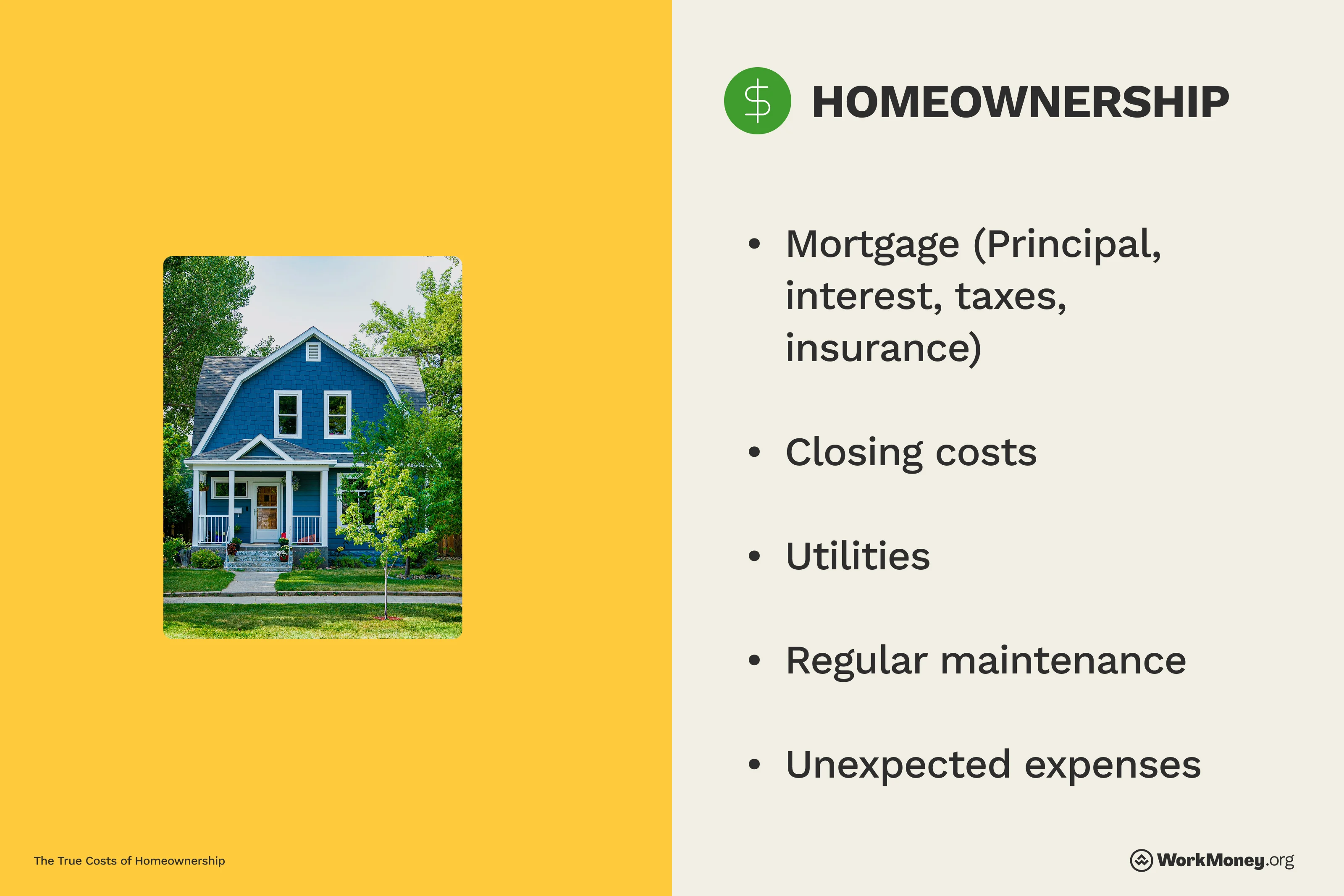
Ongoing Monthly Costs
Once you officially have the keys in your hands, you will begin to pay down the mortgage you have with the bank, along with other expenses to maintain and protect your home. This is commonly known as PITI (principal, interest, taxes, insurance).
Here’s what you need to know.
Mortgage Payments
Depending on how long you have your mortgage for, you will begin the process of paying down your mortgage over time.
First thing to note, your first payment will be due the first of the month, 30 days after closing. For example, if you take possession of the home on March 9th, your first payment will be due May 1st. This will give you some time to get settled into your new home, and take care of the smaller costs (including moving) before the big costs start.
Next, your first payments will be allocated significantly to interest. This is because banks amortize the mortgage to pay themselves first, and as you pay down your loan, more of it goes to principal. Here’s an example:
Payment schedule for a $400,000 home, 10% down payment, 30 year fixed rate mortgage at 7%
Year | Payment | Interest Paid | Principal Paid | Remaining Balance |
|---|---|---|---|---|
1 | 28,728 | 25,198 | 3,530 | 356,470 |
2 | 28,728 | 24,817 | 3,911 | 352,559 |
3 | 28,728 | 24,412 | 4,316 | 348,243 |
4 | 28,728 | 23,972 | 4,756 | 343,487 |
5 | 28,728 | 23,496 | 5,232 | 338,255 |
6 | 28,728 | 22,972 | 5,756 | 332,499 |
7 | 28,728 | 22,398 | 6,330 | 326,169 |
8 | 28,728 | 21,771 | 6,957 | 319,212 |
9 | 28,728 | 21,088 | 7,640 | 311,572 |
10 | 28,728 | 20,346 | 8,382 | 303,190 |
This is one of the reasons why it’s advised to own a home for at least 10 years to capture valuable equity and appreciation.
Property Taxes
Every state collects property taxes, some more than others. Hawaii is the lowest at 0.27%, while New Jersey has the highest at 2.33%. They typically help pay for local schools, fire departments, police, infrastructure projects, and other community services.
You are required to pay these, but there are two ways you can go about it.
Escrow account: Your mortgage servicer may offer to collect your property taxes as part of your monthly mortgage payment. When payment comes time, your mortgage servicer will make the payment on your behalf. This is extremely convenient as you don’t need to worry about paying your tax bill.
You pay directly: You can also pay your tax collector directly. The advantage to this is that you can put your tax bill over a year into a high yield savings account to earn interest along the way. You can also potentially set up a payment plan, depending on what your tax collector offers.
The easiest way to calculate your annual property taxes is to run this calculation:
Estimated annual property tax=Home price×Tax rate
You can find your county tax rate by searching online “______ county tax rate.” Take that number, multiply it by the home price, and it will give you an approximate amount. Note that the final number will vary based on potential deductions you may have.
Homeowners Insurance
This is the last portion of your monthly expense specific to PITI. While you have a mortgage on your home, it’s required for you to have homeowners insurance. Once your home is paid off, it isn’t technically required, but it’s advised to have.
Similar to property taxes, you can either pay this through an escrow account or pay it directly to the insurance company.
Pro tip: This is where you have the most leverage to bring down part of your monthly home expense. As homeowners insurance premiums rise across the country, you may be able to shop your policy around to find a lower price without sacrificing coverage amounts.
Maintenance and Repairs
Maintaining a home comes with a wide range of tasks, with different price points. From changing lightbulbs to replacing a roof and everything in between, these costs will come up.
Keep in mind that similar to a car, preventative maintenance can dodge more significant costs in the future.
Routine Maintenance
Each home varies differently in what it needs, so it may be best to ask a home inspector or contractor on specifics to your home. Here’s a general list, and how often to do them to ensure your home is operating smoothly.
Frequency | Task |
|---|---|
Monthly | Check HVAC filters |
Inspect fire extinguishers | |
Test smoke & carbon monoxide detectors | |
Clean kitchen sink disposal | |
Check for leaks | |
Quarterly (Every 3 Months) | Inspect plumbing |
Clean range hood filters | |
Flush drains with hot water | |
Check outdoor drains & gutters | |
Biannually (Twice a Year) | Change HVAC filters |
Test home security systems | |
Inspect roof & gutters | |
Check windows & doors | |
Clean dryer vent & lint trap | |
Inspect water heater | |
Inspect chimney & fire systems | |
Annually | Service HVAC system |
Inspect plumbing system | |
Inspect & clean chimney | |
Inspect attic & basement | |
Check foundation & exterior walls | |
Inspect deck & patio | |
Trim trees & shrubs | |
Pest control | |
Clean gutters thoroughly | |
Every Few Years | Reseal driveway & exterior surfaces |
Paint or touch up exterior | |
Check insulation | |
Inspect septic system |
There will also be unexpected repairs as things wear down or break. From replacing a broken faucet, to replacing an air conditioner, it will happen eventually.
Advice ranges widely, but a good rule of thumb is to save 1-4% of the home’s purchase price for yearly maintenance and unexpected fixes. So for the $400,000 home, you should have $4,000-$16,000 per year set aside for these items.
Utilities and Other Recurring Expenses
Similar to renting, there are additional expenses than paying for the house itself and keeping it maintained:
Homeowners Association (HOA) Fees: If the home is in a managed community; fee can vary widely.
Utilities: Electricity, water, sewer, gas, trash, internet, and cable. There are programs like Lifeline, LIHEAP, EveryoneOn, and more available to help you potentially reduce these bills.
Final thoughts
Homeownership is not a cheap endeavor, but it can be a great way to build equity for your future. However, there’s no shame in renting either as in many places, renting is cheaper than owning.
Before homeownership, it may be better to focus on paying down credit card debt, improving your credit score, and investing in a retirement account before taking the leap into homeownership
Was this information helpful?
About the Author

Brett Holzhauer
Brett Holzhauer is a Certified Personal Finance Counselor (CPFC) who has reported for outlets like CNBC Select, Forbes Advisor, LendingTree, UpgradedPoints, MoneyGeek and more throughout his career. He is an alum of the Walter Cronkite School of Journalism at Arizona State. When he is not reporting, Brett is likely watching college football or traveling.