Stop Just Saving: Why Your Retirement Money Needs to Be Investing
Unlock your golden years: Discover how investing, not just saving, builds the retirement you deserve
5 min. read
Saving money is one of the smartest things you can do — but for retirement, it may not be enough.
Say you put one dollar under your mattress in January 2020. Today, that same dollar has lost between 20% and 25% of its purchasing power due to inflation.
Inflation has made it nearly impossible to save your way to retirement. But with effective strategies, you can invest your money so that it grows with you. WorkMoney has your guide on how to get your retirement dollars to work for you through investing rather than savings, plus some of the hurdles people face before beginning to invest.
Saving Money Is Hard To Come By For Many
For many people, saving already feels like a stretch. The U.S. personal saving rate is around 4% of income, showing how little room many households have to set money aside. But only 46% of Americans have enough savings set aside to cover three months of expenses.
That financial pressure has lasting implications. Roughly one-third of Americans aren’t confident they will be able to cover day-to-day expenses for the remainder of their lives, according to TIAA. If you can’t save to cover regular expenses, it’s going to be even more difficult to save for retirement.
Saving vs. Investing: What’s the Difference?
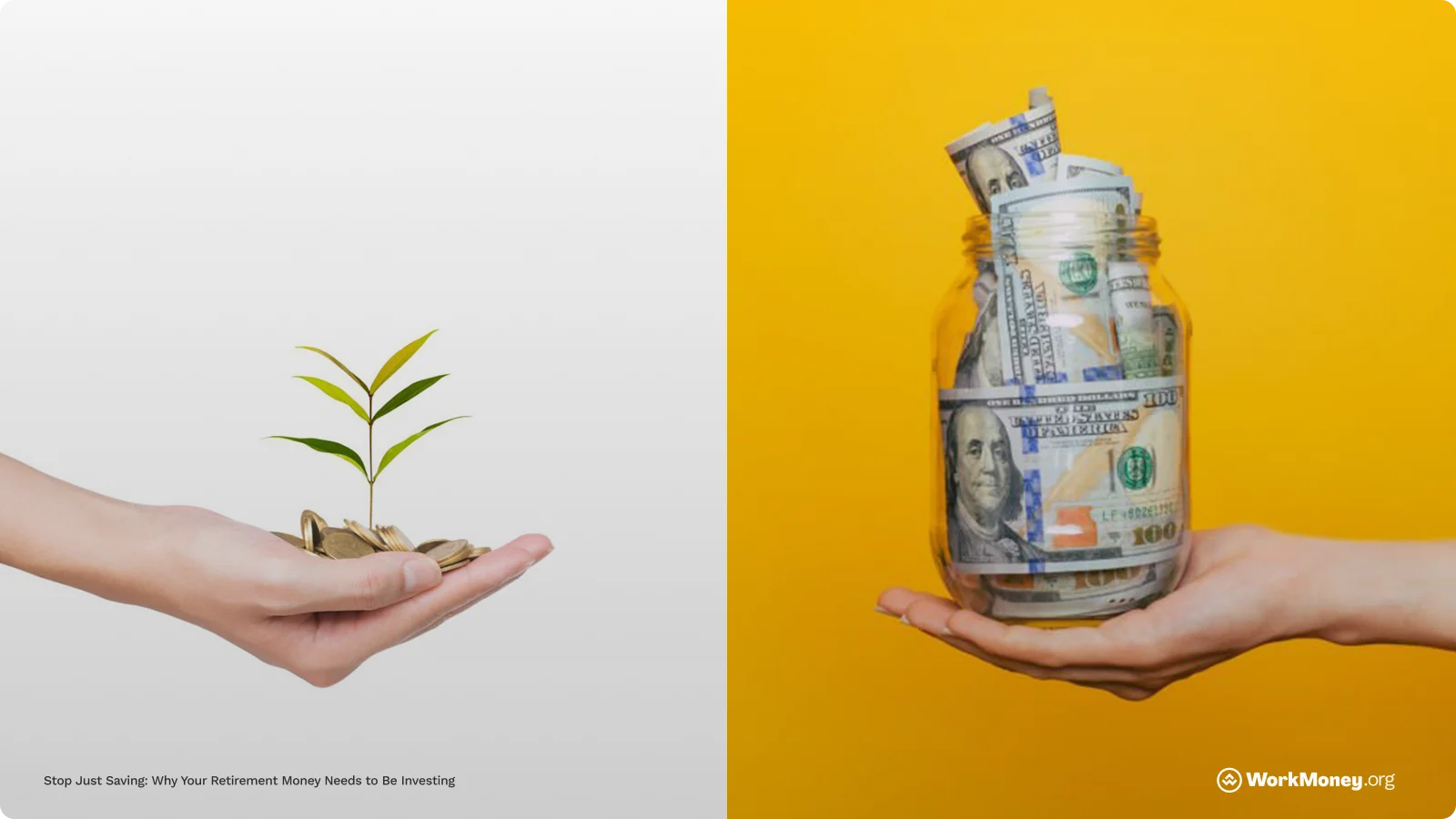
Saving protects your money for the short term, while investing grows it for the long term. You need both, but knowing when to use each moves your finances forward.
Here’s a quick way to compare both of them:
Category | Saving | Investing |
|---|---|---|
Risk | Very low | Varies, but generally higher |
Returns | Low | Historically higher over the long term |
Time Horizon | Short term | Long term |
Accessibility | Easy, immediate access | Can take time to access |
Purpose | Stability and protection | Growth and wealth building |
Saving helps keep your money safe for emergencies, while investing offers the potential to grow your money and build wealth over the long term.
Why People May Avoid Investing, And How to Get Past It
Fear of Losing Money
In a Federal Reserve Bank of Philadelphia survey, Americans said fear of losing money was among the top reasons for avoiding investing. Market swings can feel unpredictable, and headlines often make volatility sound worse than it is. While investing involves the risk of losing money, there are trade-offs that may make that risk worthwhile.
Markets constantly fluctuate, but historically, they’ve trended upward. For example, the S&P 500 (a staple index of overall market performance) has had years of losses, but has gained value over the long term. Here are the average returns over recent decades, according to Fidelity:
Period | Avg. Annual Return |
|---|---|
10 Years | 14.8% |
20 Years | 11.0% |
30 Years | 10.4% |
Feeling Like You Don’t Have Enough Money
The same Fed survey says nearly half of would-be investors believe they don’t have enough financial resources to start investing.
You can start investing with a few dollars. While $5, $10, or $25 may not seem life-changing, it’s more hurtful to watch your opportunity slip away.
Even putting $50 a month away consistently for 30 years at a 7% return can leave you with over $60,000 for retirement.
Overwhelm and Confusion`
With the endless options, unfamiliar terms, and conflicting advice, it’s normal for investing to feel complicated. That overwhelm could lead to inaction.
You don’t need to master the market to get started. Instead of selecting individual stocks or timing moves, use a simple approach. For example, ETFs and index funds are built for ease: simply invest and you can get the broad exposure you’re looking for, without the hassle of buying hundreds of individual stocks.
How to Start Investing for Retirement
Step 1: Build a Small Safety Net First
Before you start investing, give yourself a basic cushion. That means setting aside about $1,000 for emergencies. It’s a starter buffer so that if something unexpected happens, you’re not forced to sell your investments early or take on high-interest debt. It creates stability so your investments can stay invested.
This comes first, and then your “Life Happens Fund” comes after.
Step 2: Start With Retirement Accounts
Once you have that cushion, focus on accounts designed for long-term growth.
If you have access to a 401(k), start there—especially if your employer offers a match. That match is essentially free money and one of the fastest ways to boost your returns.
Then look at an IRA. A Roth IRA lets your money grow tax-free, while a traditional IRA may give you a tax break today. The one you choose depends on your income and when you want to make tax payments.
Step 3: Keep It Simple With Low-Cost Funds
You don’t need to pick individual stocks or build a complex portfolio. In fact, trying to do too much early on can backfire.
Instead, you may want to focus on low-cost index funds or ETFs that track the overall market. These funds give you broad exposure, meaning your money is spread across hundreds or even thousands of companies. They’re simple, diversified, and may be much cheaper than actively managed options.
Even small contributions, invested consistently, can add up to something meaningful over time.
Note: Investing involves risk, including the possible loss of principal. Past performance is not indicative of future results.
Final Thoughts
For many people, wages haven’t kept up with rising costs, and even those who are budgeting, saving, and doing the “right” things can still feel stuck. That reality makes one thing clear: saving alone isn’t enough to build long-term financial security.
Look at saving as your foundation. It gives you stability and protection. Investing is what turns that foundation into something that can actually support your future.
About the Author

Brett Holzhauer
Brett Holzhauer is a Certified Personal Finance Counselor (CPFC) who has reported for outlets like CNBC Select, Forbes Advisor, LendingTree, UpgradedPoints, MoneyGeek and more throughout his career. He is an alum of the Walter Cronkite School of Journalism at Arizona State. When he is not reporting, Brett is likely watching college football or traveling.