Solar Panels: Are They Worth the Cost in 2025?
Weighing the savings, costs, and benefits of going solar for your home
By Dori Zinn
5 min. read
Your electricity bill can fluctuate so much over the course of the year. The average monthly energy bill is $137, but usage varies by where you live, your home size, appliance efficiency, and how many people live with you.
Installing solar panels can help lower your energy bill and boost long-term savings, but they come with a significant initial investment. If you’re considering buying solar panels, WorkMoney helps you determine if it’s worth the cost and what you get out of them.
What are solar panels for?
Solar panels convert sunlight into electrical energy. The panels collect sunlight and convert it into energy. Your home uses that energy instead of electricity from the power grid. The less you use from the grid, the lower your electricity bill.
Pros and cons of solar panels
Investing in solar energy can be expensive for some homeowners, but there are some upsides for folks who have gone solar.
Pros of solar panels
Lowers your electricity bill — possibly eliminating it.
Some tax credits are available to lower the installation cost.
Can increase property value, if the systems are owned outright.
Reduce carbon footprint.
Energy independence from utility companies.
Cons of solar panels
Expensive upfront costs.
Can potentially raise homeowners insurance premium.
Long payback period.
Not all roofs are eligible for solar.
Ongoing maintenance and repair costs.
Federal tax credit ending at the end of 2025, increasing costs for future buyers.
Upfront cost of solar panels
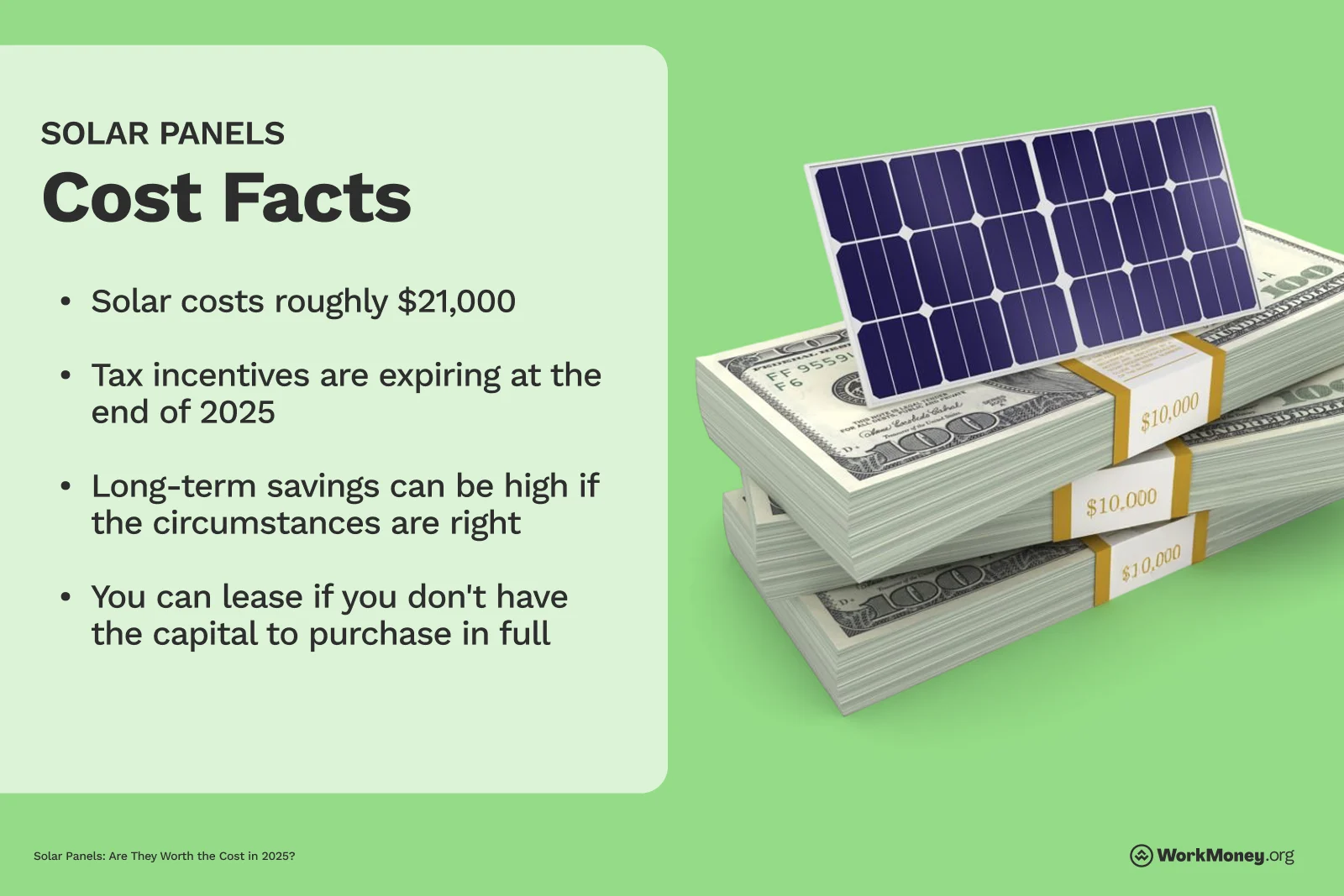
While solar panels can help offset your energy bill, they come with a considerable cost. The average cost to install solar panels is $20,754, according to EnergySage. This figure includes the solar panels, racking equipment, wiring, labor, and permits.
This also includes the current federal tax credit, lowering the installation cost to encourage more solar purchases. The credit allows you to take off 30% of solar installation costs if you spend $20,000 or more. After Dec. 31, 2025, that credit goes away, effectively raising the price by 30%.
Despite the federal tax incentive expiring, you may also qualify for state and local tax incentives, depending on where you live and what’s offered in your area.
When will you see the payback from solar panels?
There are several factors to consider in a cost-benefit analysis. First, the amount of energy you and your family consume at home. Next, consider the size of your solar panels and how much energy you’re able to absorb from those panels. For larger solar panel systems, your home could overproduce energy, which you can then sell back to the power company or receive credits for future use. But if your home uses more than you produce, you’ll buy back that energy from the power company.
On average, it takes roughly 7.3 years to break even on solar panel installations. After that, your earned solar energy is free. But that’s when the real savings kick in; most homeowners can expect to save anywhere from $34,000 to $120,000 over 25 years with solar.
Is your roof ready for solar?
Not all roofs are eligible for solar panel installation. It depends on:
The age of the roof. Older and aged roofs aren’t a good match for new roofs. The newer the roof, the more likely your roof qualifies.
Roof location. How much sun your roof gets matters a lot. If you have a lot of foliage overhead or your roof doesn’t get much sun exposure, panels won’t be able to collect as much energy.
Type of roof material. Some shingles and tiles are better for solar installation than other roof types.
If you want to see if your home is eligible for solar and how much your potential savings could be, use online calculators to estimate your solar power savings. Solar Reviews and EnergySage have calculators to see how much your solar power costs could be. These are also review sites where you can see what others have thought about working with companies in your area.
How to find a solar panel installation company
Find companies certified by the North American Board of Certified Energy Practitioners. Being NABCEP certified means companies meet high standards and qualifications for knowledge and expertise in renewable energy. Finding certified companies also gives you the peace of mind that you’re working with a reputable company that values its energy experience.
Also, look for companies that ensure warranty coverage — usually up to 25 years — and what that warranty covers. Your installation company will let you know what your warranty covers and how long it lasts.
Sites like EnergySage connect you to local solar farms to save up to 15% on electric bills. You aren’t obligated to install solar or be a homeowner to qualify for the savings.
Budgeting for solar
There are a few different financing options for solar panel purchases.
First, you can consider leasing solar panels. There’s a low upfront cost — or sometimes none at all — but you don’t own your solar panels. Because you didn’t buy them, you won’t qualify for the federal tax credit.
However, you still get the energy savings on your electric bill, and because it’s a lease, your provider handles all maintenance, repairs, and upkeep on the panels.You don’t own the system, and at the end of your term, they get removed, or you can negotiate an option to purchase them.
While you could fully pay these costs out-of-pocket, you can finance solar panel installation. You can choose from a few financing options, including:
Solar loans
Home equity loans
Personal loans
All loans come with interest, but the type of loan you get, your interest rate, and the financial institution impact monthly payments.
If you plan to purchase the system outright, make sure there’s room in your budget to afford the new payment. You won’t know how much difference the panels make until you’re a few months into use. Your electric bill fluctuates based on how much you’re heating or cooling your home, and your appliance energy use. Your summer bill will likely look much different than your winter bill.
Compare monthly installation payments to energy bill savings every month to see which one is higher. Depending on your energy use, you might see them cancel each other out for the first few months.
Final thoughts
While there are higher upfront costs to owning solar, most folks agree that solar panels are worth it. But if your home doesn’t qualify for solar, your roof can’t fit a lot of panels, or your home isn’t in a great place to capture a lot of sun, solar panels might not be worth it.
Take the next step
Lower Utility Bills
Simple steps to save on energy, phone, and more—just in case you want to cut costs down the road.
Was this information helpful?
About the Author

Dori Zinn
Dori Zinn is a longtime personal finance journalist with nearly 20 years of experience in digital media. Her work has been featured in the New York Times, Wall Street Journal, CBS News, Yahoo, CNN, USA Today, and more. She loves helping folks learn about money. If she isn’t writing, she’s reading, baking, or watching football.
