Save on Home Upgrades: Unpacking the Energy Efficiency Rebates (HOMES Program)
Transform your home, cut energy bills, and unlock government rebates
By Dori Zinn
6 min. read
It costs more than ever to keep a home warm in winter and cool in summer. The average household paid about $142 a month for electricity in 2024, according to the U.S. Energy Administration.
Many families are struggling to keep up with rising utility bills. Nearly one in four households cut back on food or medicine to pay their energy bills in 2024, up from one in five in 2020, according to the Center on Global Energy Policy at Columbia University. The same survey found one in three households struggled to cover their energy bills, up from about one in four four years earlier.
Two government programs offer real help in lowering the cost consumers pay for energy: HOMES and HEAR. These rebates are separate from the federal energy tax credit, which ended at the end of 2025. WorkMoney has your guide to how these programs work, who qualifies, and how to claim the money.
What Are Home Energy Rebates?
Both programs come from the federal government, but each state runs its own version. That means the details and whether the program is open yet depend on where you live. Here are the two programs you need to know about:
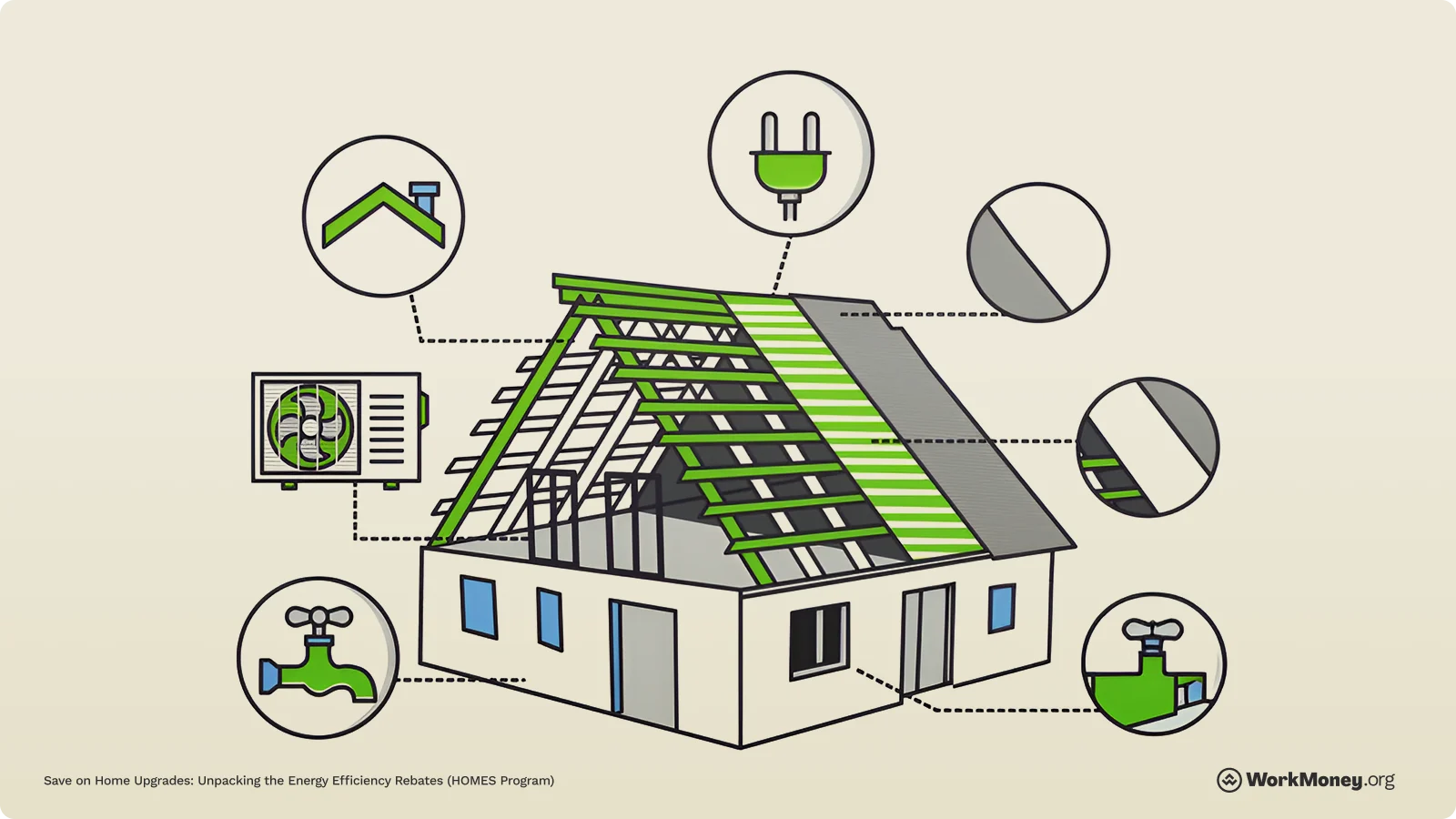
HOMES (Home Efficiency Rebates). Rewards upgrades that cut your whole home’s energy use, such as insulation and air sealing. The more energy you save, the larger the rebate.
HEAR (Home Electrification and Appliance Rebates). Helps you buy specific electric appliances, such as a heat pump or a heat pump water heater.
Think of HOMES as paying you for results, and HEAR as paying you for equipment.
What Qualifies for These Home Energy Programs?
Under HOMES, it comes down to sealing your home. Sealing air leaks and adding insulation cuts the average home's heating and cooling costs by about 15%, ENERGY STAR reports. Those savings can add up from month to month and eventually, year to year.
Under HEAR, the rebates go toward electric appliances, and each has a cap:
Heat pump for heating and cooling: up to $8,000
Heat pump water heater: up to $1,750
Electric stove or cooktop: up to $840
Heat pump clothes dryer: up to $840
Electrical panel upgrade: up to $4,000
Wiring: up to $2,500
A single household can claim up to $14,000 in HEAR rebates.
The appliance that draws the most interest is the heat pump, which both heats and cools a home. A 2024 National Renewable Energy Laboratory study found that a heat pump would lower energy bills for most U.S. households, with median savings of $300 to $650 a year for homes that heat with electricity, oil, or propane and already have air conditioning.
Are You Eligible for These Programs?
For HEAR, eligibility depends on your income compared with the typical income in your area, known as the area median income:
If your household earns less than 80% of your area’s median income, the program can cover up to 100% of the project cost.
If you earn between 80% and 150%, it can cover up to half of it.
Above that, HEAR isn’t available.
HOMES is open to households at various income levels, but it pays larger rebates to lower-income households. One in four low-income households already spends more than 15% of its income on energy, an ACEEE study found, so a lower bill frees up real money each month for other goals.
How to Apply and Check Your State
To check where you land, look up your area’s median income with HUD’s income limits tool, then visit the U.S. Department of Energy’s Home Energy Rebates page, which allows you to look up your State Energy Office to confirm the program is open.
So far this year, about a dozen states plus Washington, D.C., have fully launched, with more expected to follow. Funds are limited and can run out, so acting early pays off. If your state requires it, get a home energy assessment. When it comes time to implement, use a contractor approved by the program, and keep all receipts and documents.
Common Mistakes to Avoid
A little upfront care can save you time, effort, and energy later. Prepare yourself and avoid these common mistakes.
Buying before your program is open
HEAR rebates aren’t retroactive. If you buy and install a heat pump before your state’s program launches, that work won’t qualify, no matter how well it fits the rules. The U.S. Department of Energy has confirmed states can’t pay HEAR rebates for equipment bought early. Confirm your program is open, and reserve your rebate if the state asks you to.
Trying to claim both programs for one upgrade
You can’t stack a HOMES rebate and a HEAR rebate on the same piece of equipment. You can use HEAR for your heat pump and HOMES for separate insulation work, but not both on the same item, so pick the program that pays more for each upgrade.
Skipping the income paperwork
HEAR determines your rebate based on your household income. Gather recent pay stubs or tax forms early, because an application without them can delay your payment.
Using the wrong contractor
Many state programs pay only for work done by an approved contractor, and all of them want proof of what you bought and what it cost. Check that your contractor participates in the program before the work starts, and keep all receipts, invoices, and energy assessments in one place.
Counting on the expired federal tax credit
The Energy Efficient Home Improvement Credit ended in 2025. Any work done now won’t qualify. Don’t use an old credit as your guide, and make sure you build your plan around the active credits and programs.
Lower Your Bills Even Further
Big upgrades take planning, and you may have to wait a while to implement some of them.
If heating and cooling bills are hard to cover right now, the Low Income Home Energy Assistance Program (LIHEAP) helps eligible households pay them. You can also make many small home improvements to reduce your electricity bill. You can also use services like Arbor to review your electric bill and lock in a lower supply rate.
The Bottom Line
These rebates are earned benefits, paid for with public money, meant to make your home cheaper to run and more comfortable to live in. Take advantage of the programs available to you to start saving money as soon as possible.
About the Author

Dori Zinn
Dori Zinn is a longtime personal finance journalist with nearly 20 years of experience in digital media. Her work has been featured in the New York Times, Wall Street Journal, CBS News, Yahoo, CNN, USA Today, and more. She loves helping folks learn about money. If she isn’t writing, she’s reading, baking, or watching football.