How Much Down Payment Do You Really Need? (It’s Not 20%)
Break the 20% myth and discover low cost paths to owning your first home
2 min. read
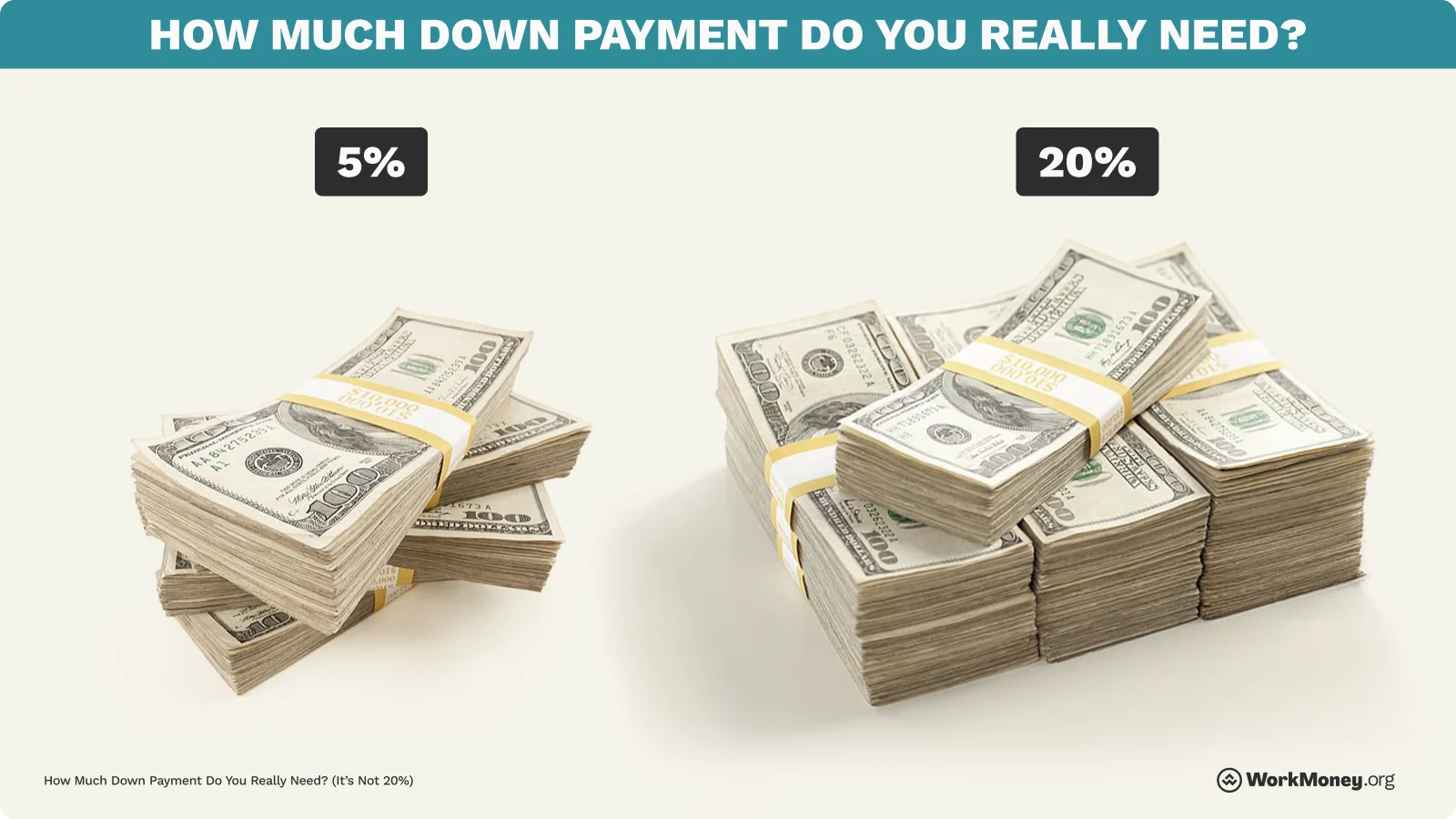
What 20% Really Does (And Doesn’t Do)
There are several pros and cons of putting 20% down on a home.
What 20% does:
Avoids private mortgage insurance (PMI): If you put less than 20% down, you will be required to pay monthly for an additional insurance policy called PMI. This protects the lender in case the borrower defaults on the loan. This is typically billed to you on your monthly mortgage statement. But with a 20% down payment, there is no need for PMI.
Reduces monthly payment: The larger the down payment is, the smaller your monthly payment is. This can be great to calculate your monthly mortgage into your monthly budget ahead of time.
Builds instant equity: Having an appreciating asset like a home as an investment can be a great way to build wealth. With a 20% down payment, it gives you instant equity in the property. This means if you sell it in the future, you have a higher chance of walking away with cash in your pocket.
What it doesn’t do:
Guarantee affordability: A 20% (or more) down payment doesn’t mean your home is guaranteed to be affordable. The figure to focus on is ensuring your monthly mortgage doesn’t exceed 28% of your monthly gross income.
Protect against market shifts: Housing prices over the long term have risen between 4-5%. However, your home value can also decrease based on market events and housing trends.
Make you a “better” homeowner: There is no surefire way of being a “better” homeowner than someone else. The most important part is ensuring you can afford the home on a monthly basis.
The Real Minimums
There are several loan programs available to potential homebuyers where you can put much less than 20% down on your next home purchase. Here are a few of them.
Conventional loans: 3%–5% down
Conventional loans are standard mortgages offered by private lenders. If they are conforming mortgages, they are backed by either Fannie Mae or Freddie Mac. Some programs allow buyers to put down as little as 3%–5%, making them accessible for first-time buyers who don’t have a large savings cushion. However, if your down payment is under 20%, you’ll typically need to pay private mortgage insurance (PMI). The upside is that PMI can usually be removed once you reach about 20% equity in the home.
Additionally, once you hit 22% equity in your home, by law, your PMI must be removed by your lender.
Writer’s note: I purchased my home in 2022 with 5% down. After seeing market appreciation and making some renovations, I was able to have my PMI removed less than one year after purchase.
FHA loans: 3.5% down
FHA loans are mortgages insured by the Federal Housing Administration and designed to help buyers with lower credit scores or limited savings. They require a minimum down payment of 3.5% if your credit score is at least 580. Because the government backs the loan, lenders are often more flexible with approval requirements. The tradeoff is that FHA loans require mortgage insurance premiums that typically last for the life of the loan.
VA loans: 0% down (if eligible)
VA loans are backed by the U.S. Department of Veterans Affairs and are available to eligible veterans, active-duty service members, and some military spouses. These loans allow qualified buyers to purchase a home with no down payment and no private mortgage insurance. They also tend to offer competitive interest rates and flexible credit requirements. However, most borrowers must pay a one-time VA funding fee, though it can sometimes be rolled into the loan.
USDA loans: 0% down (if eligible)
USDA loans are backed by the U.S. Department of Agriculture and are designed to encourage homeownership in eligible rural and suburban areas. Qualified buyers can purchase a home with no down payment if they meet income limits and the property is located in an approved area. These loans often come with lower interest rates than conventional mortgages.
What Different Down Payments Look Like
Here’s an example on a $480,000 home with a 6% interest rate on a 30-year fixed rate mortgage.
Additionally, for this example, PMI is estimated at 0.5% annually of the loan balance. However, PMI can range anywhere from 0.5%-1.5% annually, based on credit score and other financial factors.
Down Payment | Cash Down | Loan Amount | Monthly P&I | Monthly PMI | Estimated Monthly Payment |
|---|---|---|---|---|---|
0% | $0 | $480,000 | $2,878 | $200 | $3,078 |
3% | $14,400 | $465,600 | $2,792 | $194 | $2,986 |
5% | $24,000 | $456,000 | $2,735 | $190 | $2,925 |
10% | $48,000 | $432,000 | $2,590 | $180 | $2,770 |
20% | $96,000 | $384,000 | $2,302 | $0 | $2,302 |
Putting less than 20% down will incur extra fees. So you may be tempted to wait until you have more saved. However, let's say you rent an extra two years. That’s two more years of rent you could have put into your home, and seen your home appreciate in value.
In short, paying PMI may not be the worst case scenario. And with the right plan in place and a bit of luck, you could get it removed rather quickly – reducing your overall monthly payment.
Final thoughts
Home ownership is likely the largest purchase you will make in your life. But it’s advised to buy a home that also makes financial sense for you.
Recently, more people have found themselves regretting buying a home due to the maintenance and other surprise costs that come with home ownership. A recent survey says 82% of people who bought a home in either 2023 or 2024 have at least one regret about the purchase.
The most important takeaway is to buy a home you know you can afford, and potentially stay in for the foreseeable future.
Was this information helpful?
About the Author

Brett Holzhauer
Brett Holzhauer is a Certified Personal Finance Counselor (CPFC) who has reported for outlets like CNBC Select, Forbes Advisor, LendingTree, UpgradedPoints, MoneyGeek and more throughout his career. He is an alum of the Walter Cronkite School of Journalism at Arizona State. When he is not reporting, Brett is likely watching college football or traveling.