FHA Loans Explained: What You Need to Know for 2025
Your simple guide to FHA loans. Understand eligibility, costs, and smart tips in 2025
By Dori Zinn
5 min. read
FHA loans are home loans administered by the Federal Housing Authority, or FHA. You can qualify for an FHA loan with a lower credit score and down payment compared to other home loan options. These loans have helped millions of homebuyers qualify for mortgages for almost a century.
Not everyone qualifies for an FHA loan and these types of loans come with different restrictions and requirements compared to other home loans, including other government-backed loans, like USDA and VA loans.
WorkMoney put together this guide for what you need to know about FHA loans, including how to qualify and what you’re on the hook for if you get one.
What Is an FHA Loan?
An FHA loan is a government-backed mortgage. The FHA insures your home loan through financial institutions that are approved to lend FHA loans.
These loans don't directly come from the FHA, but they’re insured by the government agency and distributed by FHA-approved lenders.
When you take out an FHA loan from a bank, credit union, or another financial institution, you’ll still get your money from that lender. The FHA — part of the U.S. Housing and Urban Development (HUD) — insures the loan and pays the lender if you default on your mortgage.
FHA loans have different loan limits compared to conventional loans. You might be restricted by how much you can spend on your home because of your FHA, which could impact the home you buy.
How to Qualify for an FHA Loan
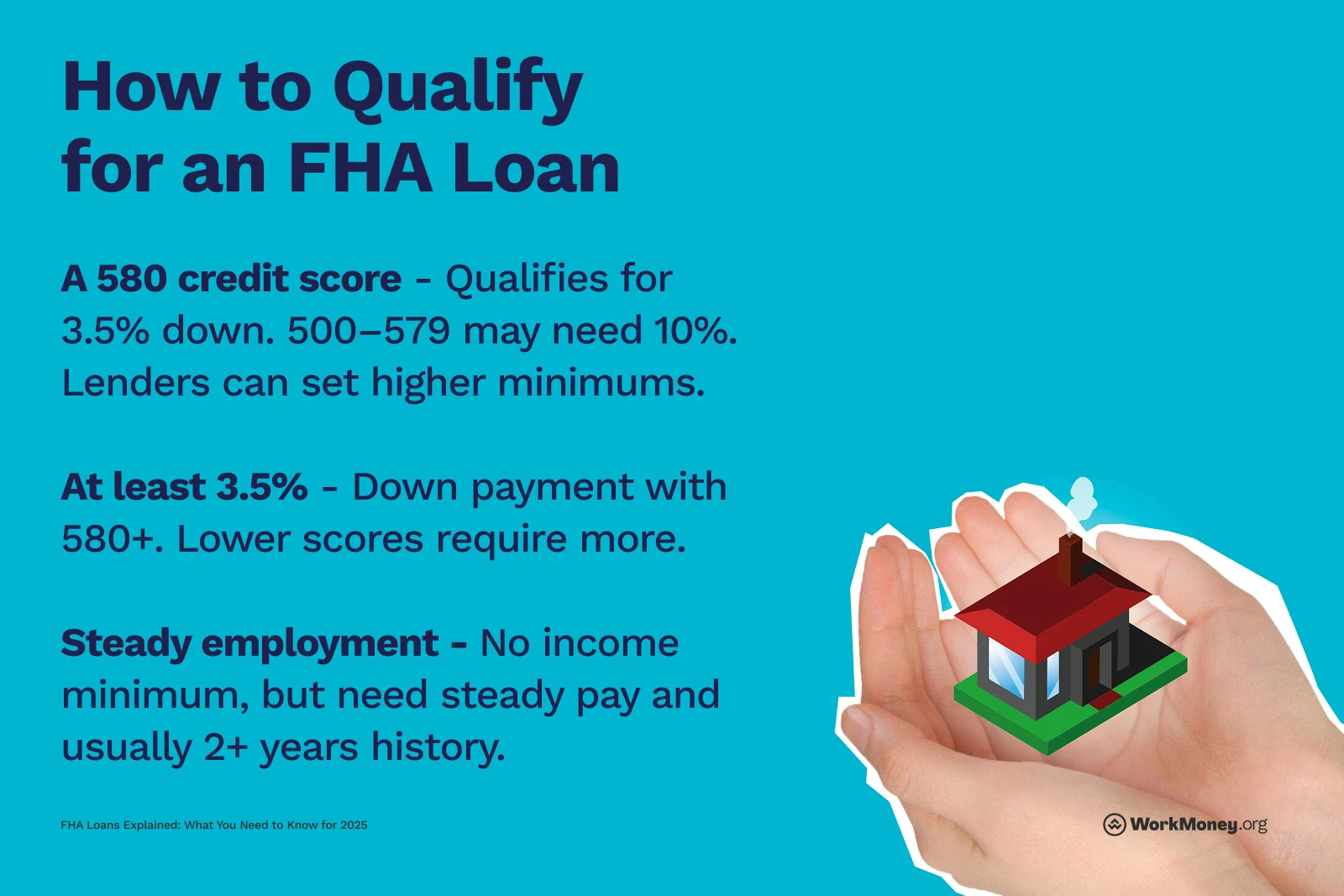
FHA loans have a few eligibility requirements, including:
A 580 credit score. Most FHA loans allow you to qualify with at least a 580 credit score to qualify for the 3.5% down payment. You might be eligible for a loan with a lower credit score, but you may need to make a larger down payment. While the FHA sets this credit score requirement, individual FHA-approved lenders can set their own minimum credit score.
At least 3.5% down payment. Your down payment can be at least 3.5% of the home’s price. If your credit score is between 500 and 579, you may need to put down upwards of 10%.
Steady employment. There aren’t income requirements for an FHA loan, but you’ll need to prove a reliable, steady income. Lenders have different requirements here, but generally, you’ll need at least two years of employment history.
Your FHA loan is only for buying a primary residence. You won't qualify for an FHA loan if you’re looking to buy an investment property or a second home — like a vacation home.
Your debt-to-income (DTI) ratio is also significant to your eligibility. Try not to have a higher DTI than 43%. While you might still get an FHA loan with a higher DTI, you may need to meet other requirements, like a larger down payment or a higher credit score.
The Extra Costs of FHA Loans
FHA loans are a great way to get into a home that would’ve otherwise kept you from buying one. But it doesn’t come without costs and sacrifices.
For instance, you’re on the hook for an upfront mortgage premium (UFMIP). This fee is on all FHA loans on single-family residences, except Title I, Home Equity Conversion Mortgages (HECM), Indian Lands, or Hawaiian Homelands. It’s a one-time payment of 1.75% of the basetotal loan amount and is due at closing.
There’s also the annual mortgage insurance premium (MIP). MIP is the federal version of private mortgage insurance (PMI), but rather than coming from your private mortgage lender, it’s the federal government. Your percentage comes from how much money you made in your down payment and loan terms.
Unlike PMI, you’ll pay MIP for the life of the loan if you put down less than 10% in your down payment. For homes purchased between 2001 and 2013, you might be eligible to have MIP removed if your loan-to-value (LTV) ratio is at least 78% or you’ve been making home payments for at least 11 years.
For homes bought today, you have to make this payment as long as you have your FHA loan, whether you pay your loan through the terms or until you refinance. Let’s see how much that is over your loan’s lifetime.
Example of an FHA loan home purchase
Say you buy a $360,000 home with a 7% interest rate and put 5% — or $18,000 — down. Your loan amount is what you didn’t put down, so $342,000. Your UFMIP of 1.75% is $5,985, due at closing with your down payment. If you don’t make this payment within 10 days of closing, you’ll face a 4% late charge.
For monthly payments, you'll pay your principal amount, insurance, property tax, interest, and MIP. Of your $2,893 estimated monthly payment, $228 will go towards MIP, or 5%.
If you have a 30-year loan, that’s $82,080 in MIP.
Home Price | $360,000 |
Down Payment (5%) | $18,000 |
Loan Amount | $342,000 |
Upfront Mortgage Insurance Premium (UFMIP) | $5,985 |
UFMIP Late Fee (if not paid within 10 days of closing) | $239.40 (4% of $5,985) |
Interest Rate | 7% |
Estimated Monthly Payment | $2,893 |
Monthly MIP | $228 |
Total MIP Over 30 Years | $82,080 |
FHA loans vs. other types of home loans
FHA loans are one type of home loan, but they’re not the only one. Here’s how they compare.
FHA | Conventional | VA | USDA | |
|---|---|---|---|---|
Minimum Down Payment | 3.5% to 10% | At least 3%, depending | 0% | 0% |
Credit Score Requirements | 500-580, depending | At least 620 for most lenders | Varies by lender | Varies by lender |
Mortgage Insurance | MIP is for the life of the loan | Removed at 20% equity | None | None |
Eligibility | Primary residences, down payment and credit score requirements | Open to most potential homebuyers | Only for veterans and those in the military | Only available for some rural areas |
Regardless of what home loan you decide to use, you’ll need homeowners insurance. Insurify can help you find the right homeowners policy for your needs.
FHA vs. Conventional Loans: Which one is better?
The best home loan is the one that works right for you. If you put 20% down, you’ll avoid PMI. But if you have the exact loan details as our earlier example — a $360,000 home, 5% down, and a 7% interest rate — you’ll have PMI in your monthly payments.
PMI rates vary by your credit score. If you have a lower credit score, you’ll pay around a 1.50% PMI. With monthly payments at $3,345, the monthly PMI portions will be $428. Based on your payments, it’ll take nearly 11 years of payments before you can drop PMI. In that time, you’ll pay $55,402 in PMI.
In this instance, conventional loans mean paying a larger monthly payment, but you’ll save almost $30,000 in mortgage insurance costs. FHA loans will give you lower monthly payments, but you’ll pay much more in mortgage insurance.
Lower monthly payments can help if you’re in a tight spot right now, but hurts you in the long run. The Wall Street Journal reported that nearly all of the mortgage delinquencies in the last year are from FHA and VA loans and the majority of underwater loans.
Is an FHA loan right for you?
If you’re interested in finding the best option, use mortgage calculators to see your potential payments.You can contact a HUD-approved housing counselor to see if you’re eligible for an FHA loan and how it compares to other lending options.
An FHA loan might be a good option if:
You have bad or fair credit.
You can afford to buy a home within the FHA loan limit in your area.
You have a low down payment, or at least enough to cover the minimum based on your credit score.
You don’t mind paying MIP for the life of your loan.
You may want to explore other options if:
You have fair, good, or excellent credit.
You have a bigger down payment, which brings down your monthly payment.
Your potential home doesn’t meet FHA requirements.
You qualify for other government-backed programs that are less expensive.
Final thoughts
Buying a home is likely the most expensive purchase you’ll ever make. Take some time to find the right loan options for you and to see if an FHA loan works for you.
Take the next step
Save hundreds on home insurance in under 5 minutes
Comparing premiums on Insurify can now save you up to $1,100 annually.
Reduce your property taxes
Lower your property tax bill by an average of $774 with Ownwell
Was this information helpful?
About the Author

Dori Zinn
Dori Zinn is a longtime personal finance journalist with nearly 20 years of experience in digital media. Her work has been featured in the New York Times, Wall Street Journal, CBS News, Yahoo, CNN, USA Today, and more. She loves helping folks learn about money. If she isn’t writing, she’s reading, baking, or watching football.