Does Home Insurance Cover Your Air Conditioner?
Learn when your AC unit is covered for damage and how to find a cheaper policy
4 min. read
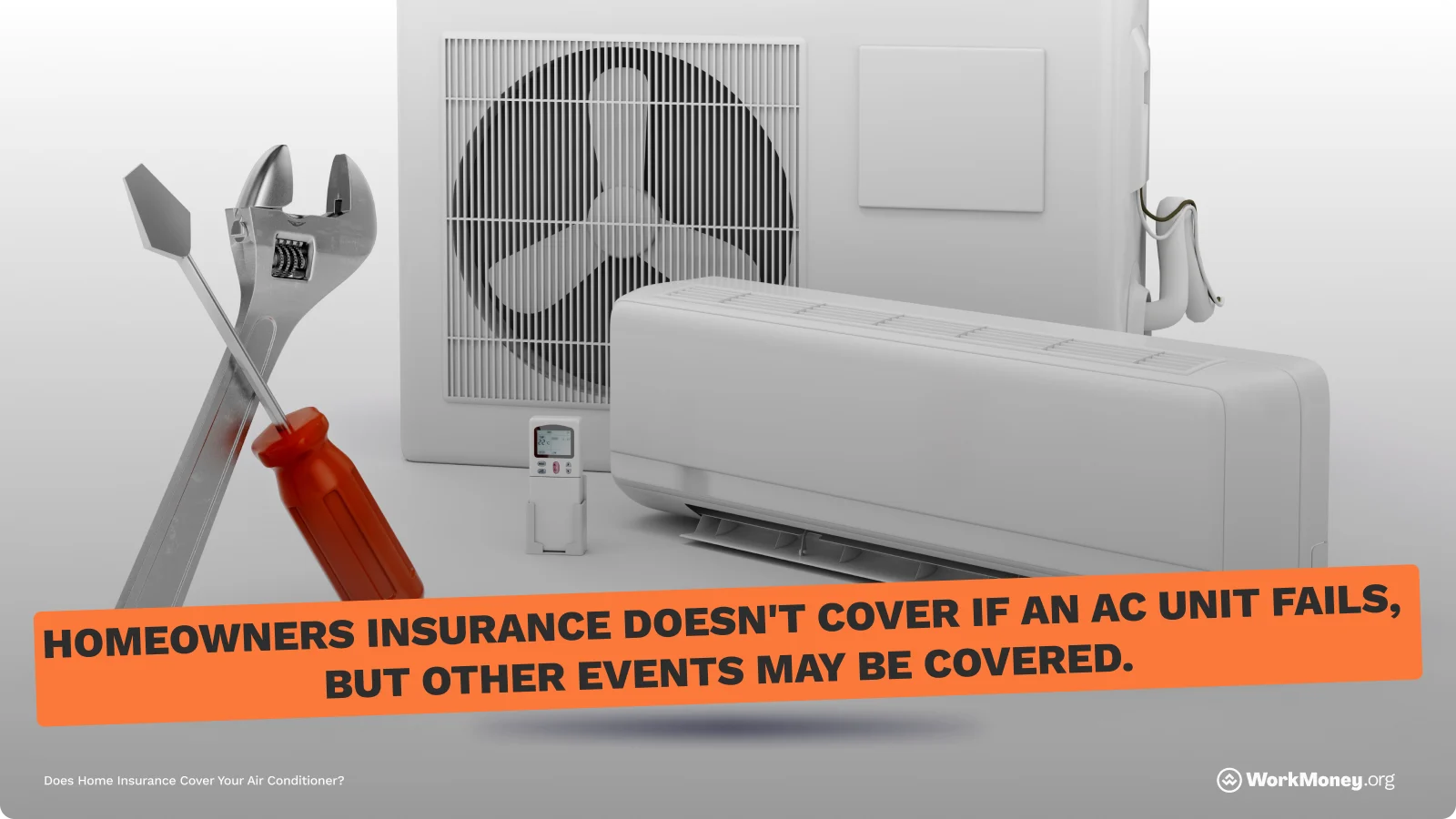
A broken air conditioner can leave you hot, uncomfortable, and suddenly facing a hefty repair bill. And while it’s tempting to assume your homeowners' insurance will help, coverage isn’t always that simple.
The WorkMoney team is here to help you cut through the confusion, avoid unnecessary costs, and feel confident in every financial decision you make. This guide breaks down when your AC is actually covered, when it isn’t, what to do next, and how to protect your wallet if the claim doesn’t go your way.
When Home Insurance Covers an AC Unit
Standard homeowners' policies aren’t intended to pay for every AC problem. But they will step in if the damage was caused by a covered peril. A covered peril simply means a sudden event that your insurance agrees to pay for, like a fire or break-in.
Some common covered perils include:
Fire or smoke damage
Lightning
Vandalism or theft
Hail or windstorm damage
A falling tree or other object
Explosion
Weight of snow, ice, or sleet
If your AC is part of your home’s structure — say a central air system built into the house — it often falls under the dwelling coverage portion of your policy. If it’s a window unit or a portable system, it might instead be treated like personal property.
How to Tell if Your Unit Is Covered
Is the unit attached and part of the home’s HVAC system? Then, dwelling coverage likely applies.
Was the damage caused by a sudden event (storm, vandalism, fire)? Then coverage is possible.
If the AC simply quits due to age, wear, or lack of maintenance, you’re less likely to be covered.
When Home Insurance Will Not Cover Your AC
Some circumstances typically won’t be covered under a standard homeowners policy, which include the following:
Wear and tear or old age: If your AC simply stops working because it’s old, worn out, or the motor gave up after years of use, that’s maintenance — not a covered peril.
Mechanical breakdown due to neglect: Suppose you skipped servicing, didn’t change filters, and suddenly the compressor dies. Your insurer may deny the claim because the cause was preventable.
Leaks, flooding, or gradual damage: For instance, if the damage was slow, creeping in, or caused by neglect, it's usually excluded.
Quick Comparison Table
Here’s a quick look at how insurers treat these situations in real life:
Situation | Usually Covered? | Why/Why not? |
|---|---|---|
Tree falls on the outdoor AC unit in a storm | Yes | Sudden physical damage from a covered peril |
AC unit fails after 15 years | No | Wear and tear/age |
AC overheats due to blocked airflow | Likely No | Neglect leading to damage |
Window AC stolen during a break-in | Possibly | Personal property coverage may apply as a covered peril |
How Location Affects Your Coverage
Depending on where you live, homeowners can run into different claim problems. Some may be tied to climate, others are based on local insurance rules. For example:
If you live in Texas:
Heat-related compressor failure from extreme summer temperatures is treated as wear and tear, not a covered peril.
Flooding from hurricanes or heavy rain demands separate flood insurance; a standard homeowners policy won’t cover an AC unit destroyed by rising water.
If you live in Florida:
Wind-driven rain that forces water into the home is usually not covered unless your policy includes special protection.
If you live in Washington, D.C.:
Freezing damage is only covered if you took basic precautions, like insulating pipes and maintaining heat; if not, your insurer may deny the claim.
Knowing these patterns upfront helps you avoid spending hours fighting a claim you’re unlikely to win.
Understanding Deductibles, ACV vs. RCV, and Coverage Limits
Even if the damage is covered, your payout depends on the details of your policy.
Deductible
If the repair cost is close to or below your deductible, it may not be worth filing a claim. You’ll have to cover that amount before insurance pays anything.
Actual Cash Value (ACV) vs. Replacement Cost Value (RCV)
ACV pays the depreciated value of your old unit — often far less than what a new system costs.
RCV pays the cost to replace the unit at today’s prices.
Since a new AC system can run several thousand dollars, a policy that only pays ACV can leave you covering most of the bill out of pocket. Many budget-friendly policies fall into this category.
Coverage Limits
Your policy also has dollar limits on what it will pay. If replacing your AC costs more than that limit, you’re responsible for the difference — even if the damage itself is covered.
Before You Call Your Insurance Company
You can save time (and avoid unnecessary denials) by doing a quick check first.
Document the damage with photos or video.
Identify the cause as clearly as you can.
Gather maintenance records showing you serviced the unit.
Check where the AC falls in your policy (dwelling vs. other structures vs. personal property).
Confirm whether your policy uses ACV or RCV.
If you already know the issue is wear and tear or age, filing a claim is unlikely to help.
How to File an AC Claim and What Happens Next
Filing a claim for AC damage is usually a straightforward process. Here’s what it typically looks like, based on standard homeowners insurance procedures:
Gather unit details. Write down the model and serial number of your HVAC system.
Document the damage. Take clear photos of what happened.
Start your claim. Use your insurer’s website, app, or call your agent to report the damage.
Get a police report if needed. If the issue involves theft or vandalism, request a copy of the police report.
Talk with the adjuster. They’ll explain what your insurer needs, including whether you should get repair estimates.
Save and submit receipts. Keep all repair or replacement receipts and send them to your insurer for reimbursement.
If the claim is denied, that doesn’t mean you’re out of options.
If Your AC Claim Is Denied: How to Cut Costs Quickly
Most AC claims get denied because the issue is tied to wear and tear — something homeowners' insurance doesn’t cover. If your insurer didn’t pay, it may be a sign your policy isn’t giving you the protection you need. Many people overpay for coverage that falls short when it matters.
Insurify lets you compare home insurance rates in your area and find policies with stronger protection, including options like equipment breakdown coverage. You can visit Insurify here to find a policy that fits your budget and offers more reliable coverage in the future.
Government Rebates That Can Reduce the Cost of a New AC Unit
If you’re upgrading to a more efficient system, you may qualify for federal rebates that reduce the cost. Government rebate programs are funded by your tax dollars, and many homeowners don’t realize they’re eligible.
HOMES Rebate Program
The federal HOMES program offers rebates for energy-efficient upgrades, including high-efficiency AC units and heat pumps. The amount you can receive depends on your household income and the improvements you make. But it can significantly reduce your out-of-pocket cost.
To see what you qualify for and how to apply, visit the official HOMES program website.
Home Warranty and Equipment Breakdown Coverage
Many homeowners confuse home insurance with home warranties, but they serve different purposes.
Homeowners insurance covers sudden, accidental damage caused by covered events like fire, theft, or wind.
Home warranties help pay for repairs or replacements when systems or appliances fail from normal wear and tear.
For the AC problems your homeowners' insurance won’t cover—like when the system suddenly fails from a mechanical or electrical issue—you have another option. You can add equipment breakdown coverage to your policy. It costs about $25–$50 a year and helps pay for repairs or a new unit.
Simple Maintenance That Helps Prevent Denials
A few small habits can help your AC last longer and reduce the chance of an insurer blaming the damage on neglect:
Replace or clean your air filters every one to three months.
Keep the outdoor unit clear of weeds, leaves, and debris.
Schedule seasonal tune-ups to catch minor issues early.
Since insurers often deny claims linked to poor maintenance, these steps can help protect you from avoidable out-of-pocket costs.
Final thoughts
A broken AC can feel stressful, but understanding what your insurance covers—and what it doesn’t—can help you avoid surprise bills and make smarter decisions. Taking a few simple steps, like checking the cause of the damage, reviewing your policy, and exploring add-ons or rebates, can save you both time and money.
Take the next step
Save hundreds on home insurance in under 5 minutes
Comparing premiums on Insurify can now save you up to $1,100 annually.
Was this information helpful?
About the Author

DeShena Woodard
DeShena Woodard is a Financial Freedom Coach, Certified Life Coach, freelance personal finance writer, and podcast host. Her story, advice, and expertise have been featured in prominent outlets such as CNN Underscored, Business Insider, Yahoo Finance, NerdWallet, and more. Through her platform, Extravagantly Broke, she helps women take control of their finances with simple, stress-free strategies—without sacrificing the joy of everyday life. When she’s not writing or coaching, DeShena enjoys traveling, biking, and spending time with her family.